
A battery fire on Desert Inn Road put out flames and left the re-ignition risk behind
Expanded Nov. 28 with full lithium-ion and re-ignition analysis.

By Albina Bieci, Staff Writer
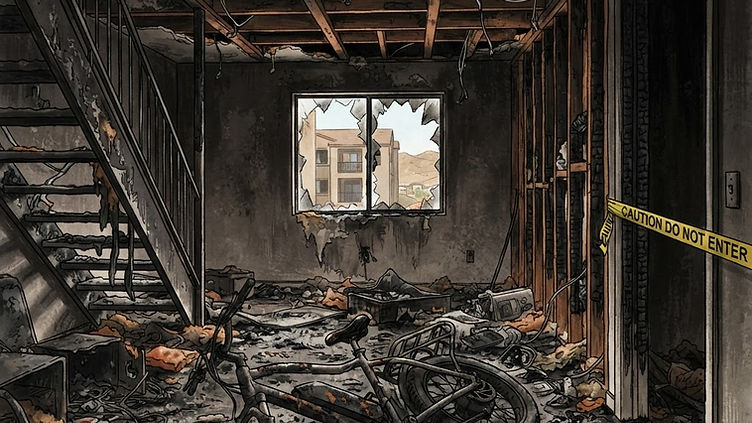
Clark County crews knocked down a two-story apartment fire preliminarily linked to an e-bike battery. Lithium-ion fires do not end when the flames do.
LAS VEGAS, Nev.
Clark County Fire Department crews responded overnight to a fast-moving fire that engulfed the first and second floors of a two-story apartment building on Desert Inn Road in Las Vegas, according to News 3 Las Vegas.
Emergency fire watch
Alarm or sprinkler system out of service? USPA can post a fire watch on site within 60 minutes.
Trained officers, documented patrol rounds and direct 911 notification, scoped to the order your fire marshal actually issued.
Live dispatch, 24 hours. In an emergency, call 911 first.
The blaze was preliminarily linked to an electric bicycle battery. Multiple residents were displaced and are receiving assistance from the American Red Cross.
"Preliminarily linked" is the correct level of certainty at this stage, and it should stay that way until an investigator says otherwise. But the operational consequences of a lithium-ion origin are different enough from an ordinary apartment fire that they change how the building has to be handled tonight, whatever the final cause turns out to be.
That is the part most coverage will miss. A battery fire is not simply a fire that started differently. It is a fire with a chemistry, and the chemistry outlasts the flames.
What the record establishes
As of Nov. 28, the published reporting establishes the following, and nothing more:
- The fire occurred at a two-story apartment building on Desert Inn Road in Las Vegas.
- Clark County Fire Department crews responded.
- The fire engulfed the first and second floors.
- The cause was preliminarily linked to an electric bike battery.
- Multiple residents were displaced and are being assisted by the American Red Cross.
The cause has not been determined. Nothing here should be read as a finding about it.
Why a battery fire behaves differently after knockdown
A lithium-ion cell in thermal runaway generates its own oxygen and its own heat. It does not need the air in the room to keep burning, which is why a closed door and a depleted oxygen supply do not stop it the way they stop a furnishing fire.
Suppression water cools the cells around the reaction and knocks down the visible flame. That is a real success on the fireground and it is not the same thing as extinguishment. A damaged cell can sit in the debris for hours and then propagate to its neighbours, and the propagation produces exactly the pattern investigators describe repeatedly: a fire declared out, crews released, and a second fire in the same unit later, sometimes after the building has been handed back to the owner.
The residue is a separate hazard. Battery fires produce hydrogen fluoride among their combustion products, and the resulting contamination is corrosive and toxic in a way ordinary smoke residue is not. It settles on surfaces that residents, restoration workers and security personnel will touch, and it is not removed by airing a room out.
What the building's shape adds
This is a two-story building with fire on both floors, which means the fire involved the floor assembly between them — the same assembly that carries the plumbing, the wiring and, in many buildings of this type, the ductwork.
Water from the firefight is now in that assembly and in the ceilings of the ground-floor units. Where the floor assembly has been compromised, the second floor's structural integrity is an open question that only an engineer can close, and the building cannot be walked normally until that happens.
For a fire watch, that changes the patrol. Rounds at a building with a damaged inter-floor assembly are made from below and from the exterior, with thermal imaging aimed at the ceiling plane and at the voids above it, and the log records where the readings were taken because the readings are the evidence that the space was monitored rather than assumed.
What a post-fire deployment here has to do
Four tasks are specific to a battery-origin loss, and they are not interchangeable with a generic patrol.
Thermal monitoring, not just presence. Rounds should be made with thermal imaging aimed at the burned unit and at the voids above and below it, on a schedule short enough to catch a re-ignition while it is a single cell rather than a room. A visual round on a two-hour cycle is the wrong instrument for this hazard.
Removal of damaged batteries to a safe location. Cells and packs that survived the fire should not stay in the building. That decision belongs to the fire department and the property owner, and the fire watch crew is the party that notices a pack beginning to swell or vent between those decisions — which is why the crew has to be briefed on what that looks like.
Access control on vacated units. The displaced residents are not coming back tonight and their apartments are open. In a two-story building with exterior doors, that is a matter of hours before someone else is inside, and the property inside those units is the residents' entire remaining possession.
Documentation. Who entered, when, and what the thermal readings were. That record serves the owner, the insurer and the investigation at the same time, and it is the only part of the response that survives the week.
USPA runs fire watch in Las Vegas and provides the same service nationally for buildings that are damaged, evacuated or waiting on system restoration.
The regulation is moving toward this hazard, not away from it
The e-bike battery fire is no longer an unusual event in American cities. It is a category, and the regulatory direction is consistent: several jurisdictions have begun treating indoor storage and charging of lithium-ion batteries in residential occupancies as a stored-energy hazard rather than a consumer appliance question, with requirements that follow from that framing.
For a property manager in Clark County, the practical questions are already on the table. Where are residents charging packs? Are they charging them in units, in corridors, in stairwells? Is there a designated charging area with appropriate separation and detection? Does the building's fire safety plan mention the hazard at all? Is there a rule, and is it enforced?
None of those questions is answered by the fire watch that follows an incident. They are answered before one, and the fact that a fire watch exists tonight is the evidence that they were not.
The residents, and the second displacement
The Red Cross assistance in this story describes people who left their homes at night with what they were wearing. In a two-story building with damage on both floors, "displaced" usually means weeks rather than days, and it usually means two moves: a hotel or a shelter first, then a temporary apartment, then home.
The building they left is the asset that determines whether the third move happens. A damaged two-story structure with an open roof line, no power and a known re-ignition hazard is not a building anyone should be inside unaccompanied, and it is also not a building that can be left alone. Those two facts together are the definition of a fire watch assignment.
Who owns the battery, and who pays for it
The preliminary link to an e-bike battery has a financial consequence that will outlive the fire report.
If the origin is confirmed as a battery in a tenant's possession, the loss runs into the ordinary tension between a landlord's insurance and a tenant's renter policy, and beyond that to the retailer or manufacturer of the pack or the charger. Subrogation — the insurer's attempt to recover what it paid from whoever is legally responsible — is routine in these cases, and it turns on exactly the kind of origin-and-cause determination an investigation produces. That is one reason the debris should not be cleared before the investigation is complete, however much the owner wants the building cleaned.
For the property manager, the practical exposure is not the battery itself. It is the policy question of whether the building's fire safety plan and house rules addressed the hazard at all. A landlord who prohibited indoor charging, provided a designated area and documented the rule is in a different position from one who never mentioned it.
The tenants who were not burned out
In a two-storey building with fire on both floors, the units that did not burn are the ones nobody is discussing, and they are where the next decision is made.
Those units have been through smoke, water and, in a battery fire, a specific chemical contamination that ordinary cleaning does not address. Surface sampling and, where appropriate, air quality testing is the professional way to determine whether a unit can be reoccupied, and it is not a determination a property manager should make by looking at the paint.
Until that testing is done, the building is a mixed occupancy: some units destroyed, some awaiting a professional verdict, some habitable if the utilities are restored. That mix is exactly the condition in which a fire watch earns its cost, because the building is neither empty enough to be treated as a vacant structure nor sound enough to be left alone.
The second incident nobody plans for
The pattern fire investigators describe at battery losses is a re-ignition after the fireground has been released, often in a unit already declared out. The interval can be hours. It can be longer.
That is the reason the deployment at this building is not a courtesy patrol and not a substitute for the alarm system alone. It is a monitored, documented watch on a known re-ignition hazard, made with an instrument that can see heat through a ceiling, on a schedule short enough to matter. The cost of that deployment for a week is a rounding error against the cost of a second fire in a building that has already lost its roof line and its utilities.
Related coverage: a Thanksgiving fire that displaced 36 people from a St. Paul building and a Pooler commercial fire where water damage outlasted the flames.
Services in Las Vegas, NV
Reference and services
Sources
About the reporter
Staff Writer
Staff writer for the USPA Nationwide Security newsroom. Receives newsroom tips, corrections and editorial inquiries.
Author biography and credentialsMore from The Watchline

Fire Protection
Union Township storefronts are open to the street and their alarms are not working
Business owners in Union Township are starting recovery after a fire that damaged multiple storefronts. A commercial strip with no glass and no alarm is a target before it is a construction site.
· Albina Bieci

Fire Protection
Superior's John Avenue fire burned through the roof. Now the building has to survive the water and the cold
A nearly three-hour fire in a two-story Superior apartment building injured a firefighter and caused an estimated $300,000 in damage. The remediation window is the most dangerous part.
· Albina Bieci

Fire Protection
In Maryville, the fire was inside the walls and the front wall is still standing
A concealed fire at 310 North Main Street collapsed interior floors and shut a block of Maryville's downtown square. The hazard that closed the street is the wall nobody can move.
· Albina Bieci