
A defensive firefight in Prichard left an apartment block open to the weather, and to anyone else
Expanded Nov. 28 with full structural, systems and perimeter analysis.

By Albina Bieci, Staff Writer
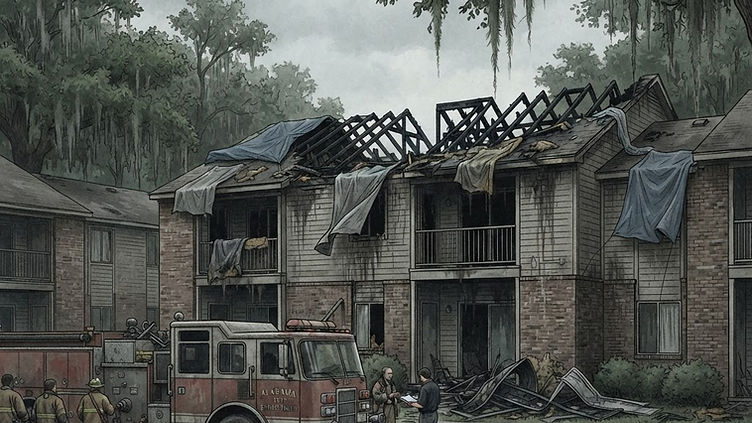
Crews from Prichard and Mobile fought the Arbor Pointe fire from outside after flames broke the roofline. A building that could not be entered to fight the fire cannot be left unwatched after it.
PRICHARD, Ala.
Firefighters from Prichard and Mobile spent the overnight hours fighting a multi-alarm fire at the Arbor Pointe Apartments on Dairy Road, where heavy fire broke through the roofline and forced crews into a defensive operation, according to FOX10 News.
Emergency fire watch
Alarm or sprinkler system out of service? USPA can post a fire watch on site within 60 minutes.
Trained officers, documented patrol rounds and direct 911 notification, scoped to the order your fire marshal actually issued.
Live dispatch, 24 hours. In an emergency, call 911 first.
A Mobile firefighter was hospitalized after escaping through a second-floor window. Residents were evacuated from the complex.
The word "defensive" is the most important fact in that summary, and it is the easiest one to read past. It means the incident commander made the call that no crew would go inside to attack the fire. When that decision is taken, the building stops being a fire problem and becomes a perimeter problem, and it stays one long after the last hose is picked up.
It also means the fire was not fought where it started. A defensive operation is chosen when the conditions inside make an interior attack a bet against firefighters' lives, and those conditions describe the building that is left behind at the end of the night.
What the record establishes
As of Nov. 28, the published reporting establishes the following, and nothing more:
- The fire occurred overnight at the Arbor Pointe Apartments on Dairy Road in Prichard, Alabama.
- Prichard and Mobile fire crews operated at the scene.
- Heavy flames broke through the roofline.
- Crews shifted to defensive operations.
- One Mobile firefighter was hospitalized after escaping from a second-floor window.
- Residents were evacuated from the complex.
The cause has not been established in the reporting. Nothing here should be read as a finding about it. Fire investigators will work the site, and their access to it depends entirely on the condition of the structure they are investigating.
The decision to fight a fire from the outside
A defensive operation is not a retreat. It is a different strategy with a different objective: contain the fire to the building it is in, protect the exposures around it, and put no one inside a structure that has stopped being survivable.
Incident commanders reach that decision on a short list of conditions. Fire through the roof, which is what the reporting describes, is one of the clearest. A roof that is burning through its covering has usually been burning in the attic or the roof assembly for a long time before it shows, and an attic fire in a residential building has two properties that make interior attack unattractive: the space is uninhabitable and full of concealed voids, and the roof structure above the crews is the part that is failing.
Lightweight construction compounds it. Modern roof and floor assemblies are engineered to carry a specific load with far less material than the dimensional lumber they replaced, and they fail faster and with less warning under fire. A crew working under a lightweight roof that has been burning for twenty minutes is working under a structure whose failure time is measured in minutes and cannot be read from below.
The other conditions that push a commander outside are water supply and access. A complex on a commercial road may have hydrants spaced for a smaller building, or a gate, or a parking layout that puts the apparatus a hose length further from the fire than the drawings suggest. When any of those combine with fire in the roof, the arithmetic stops supporting an interior attack.
None of this is a criticism of the outcome. It is the explanation of what the building is now.
The roof is the part that decides whether the building survives
The roof assembly of an apartment building is doing three jobs at once: it carries the weather, it braces the structure beneath it, and in most American residential construction it is where the building's continuity across the top is maintained.
Once fire has broken through, all three are compromised in a single event. The building is open to the sky. Rain, snow and meltwater enter the same voids the fire just burned through, and they keep entering until the roof is covered. The insulation that was specified for the building is now either burned away or saturated, which means it stops insulating at the moment the building has no heat.
There is also a firefighting consequence that carries into the following weeks. Vertical ventilation — cutting the roof to release heat and smoke — is performed on a roof that is still intact. When the roof has already failed, the fire has vented itself, and the products of combustion have travelled through the building in whatever pattern the failure created rather than the pattern a crew would have chosen. That is one reason smoke and heat damage at a defensive fire is often more extensive than the fire damage.
The consequence for the owner is that the top of the building has to be made weather-tight before anything else can be assessed. Emergency tarping, and in a severe case temporary roofing, is the first contractor scope, and it is always slower than the weather.
The second-floor window
The injury to the Mobile firefighter deserves its own paragraph, because the mechanics of it describe the interior.
A firefighter who leaves a building through a second-floor window has lost the stairwell. The stairwell is the primary egress path, the primary attack path and the primary means of moving a downed colleague. Losing it means the conditions in the corridor or on the stairs made it unusable, which happens when a door has failed, when the stair enclosure has taken smoke, or when the fire has entered the means of egress itself.
That is precisely the condition that makes the building unsafe for everyone who is not wearing turnout gear. If a trained crew in protective equipment could not use the stairs, a resident, an investigator, a contractor or a security officer cannot either — not until the structure has been assessed and the path has been cleared.
What the building is now
Four systems determine whether a fire-damaged apartment building is habitable, and at Arbor Pointe all four are now in question.
Power. Service laterals, meter banks and distribution panels in a building that has been through a firefight are wet, heat-stressed or both. Nobody re-energizes that until an electrician has inspected it and the utility has accepted the inspection.
Gas. Service is shut at the street after a fire and stays shut until the piping is pressure-tested. Every appliance downstream of that test is out of service in the meantime.
Water and suppression. Suppression water has gone into the building and stayed there. Standpipes and any sprinkler piping that was charged have been drained or have failed, and the system cannot be returned to service until it is repaired and re-tested.
Detection. This is the system that matters most for the next fire, and the one most often assumed to be fine. Alarm initiating circuits run through the same concealed spaces the fire and the water went through. A panel that powers up is not a system that works, and only a test with documentation establishes the difference.
The perimeter, and why one crew does three jobs
Once the building is evacuated and its systems are down, three separate risks begin at the same moment, and they are usually handled by one deployment.
The first is re-kindling. A hot spot inside a concealed space can take hold with no visible flame from the street. Fire watch at a fire-damaged building is a walking, documented patrol with thermal imaging, on a schedule short enough that a re-ignition is caught while it is still small enough to be put out with a extinguisher. The log of those rounds is not paperwork for its own sake: it is the record that the building was monitored, and it is the first thing an investigator, an insurer or a plaintiff's attorney will ask for.
The second is entry. An evacuated complex with broken windows, open units and no power is an unguarded building in a residential neighborhood. Residents will come back for belongings, which is understandable and has to be managed rather than prevented by force. Everyone else who arrives has no such reason. Copper, appliances, fixtures and personal property move quickly once a site is known to be empty, and the first several nights are when it happens.
The third is access control for the people who must go in. Investigators, utility crews, restoration contractors and city officials all need to enter, and none of them should enter unaccompanied while structural conditions are unresolved. A single controlled access point, a sign-in log, and a rule that nobody enters alone does more for the outcome of this incident than any single piece of equipment.
What a documented fire watch actually contains
The difference between a guard sitting in a car and a fire watch is the part that is written down.
A proper deployment at a building in this condition includes rounds at a defined interval that covers the exterior, the interior where it is safe to enter, and the fire floor and the space above it; thermal imaging on every round, aimed at the voids rather than the visible damage; a log that records time, location, reading and condition; a posted contact for the owner and the fire department; a way to raise an alarm that does not depend on the building's dead systems; and a briefing that tells each officer what to do when they find smoke, water where it should not be, or a person inside the tape.
USPA operates fire watch in Mobile and the Alabama Gulf Coast and maintains a national fire watch service for buildings in exactly this condition: evacuated, structurally uncertain and standing open.
What can still be saved
The complex's residents have lost their homes for now. What remains is the property inside them, the building itself, and the physical evidence the investigation depends on.
All three are protected by presence. A tarp, a lock and a patrol do not make the building habitable, but they decide whether the loss stops where the fire stopped or continues for another two weeks. That is the entire purpose of the deployment, and it begins the moment the last apparatus leaves.
Related coverage: a Thanksgiving fire that displaced 36 people in St. Paul and a Los Angeles commercial fire that was fought from the roof.
Reference and services
Knowledge base
NFPA 25 Impairment Protocols (2026): Fire Watch, the Ten-Hour Framework and System Restoration
National reference · 23 pages, citation registry attached
Read the volumeService
Fire watch services
How USPA staffs this work, with the coverage, licensing and dispatch terms for the assignment.
See the serviceSources
About the reporter
Staff Writer
Staff writer for the USPA Nationwide Security newsroom. Receives newsroom tips, corrections and editorial inquiries.
Author biography and credentialsMore from The Watchline

Fire Protection
Union Township storefronts are open to the street and their alarms are not working
Business owners in Union Township are starting recovery after a fire that damaged multiple storefronts. A commercial strip with no glass and no alarm is a target before it is a construction site.
· Albina Bieci

Fire Protection
Superior's John Avenue fire burned through the roof. Now the building has to survive the water and the cold
A nearly three-hour fire in a two-story Superior apartment building injured a firefighter and caused an estimated $300,000 in damage. The remediation window is the most dangerous part.
· Albina Bieci

Fire Protection
In Maryville, the fire was inside the walls and the front wall is still standing
A concealed fire at 310 North Main Street collapsed interior floors and shut a block of Maryville's downtown square. The hazard that closed the street is the wall nobody can move.
· Albina Bieci