


USPA Nationwide Security
Fire watch, Kitchener, ON

Fire watch services in Kitchener

Kitchener has been building on top of itself for a decade: towers going up on former industrial land, older factories being converted to offices and lofts, and a light rail line threaded through the middle of it. A great deal of the city's fire watch work comes out of that overlap between old structure and new construction.

  • 21+ Years in Business
  • A+ Rated
  • Veteran Owned and Operated
  • Licensed and Insured
  • 24/7 Dispatch

Research · Fire watch regulations · Volume 13

NFPA 601: Security Services in Fire Loss Prevention

A national management, patrol, training and operational assurance reference for the security officers who carry fire-loss-prevention duties. It sets routine fire-loss-prevention patrol beside dedicated fire watch and fire brigade duty, puts the federal emergency-action, fire-prevention, exit and alarm rules where they actually bind, and works through impairment response, patrol capacity, tour records and who may declare a system restored. 35 pages, 18 cited sources. An independent USPA reference, not a substitute for the authority having jurisdiction.

Public-source research

Read the national fire watch reference

Research cutoff 2026-11-05

Construction on top of contaminated history

The cores rising around the innovation district sit on land that held factories for a century. Demolition is staged, remediation runs alongside it, and the fire protection on those sites changes week by week as floors are poured and temporary systems are moved. A watch scheduled against last month's site plan is a watch that no longer matches the building.

We rebuild the route at each phase change rather than at each invoice. That means re-walking the site with the superintendent, re-marking the standpipe and exit routes, and updating the interval if the travel distance has grown. On a tall site, vertical travel time is the difference between an interval that is held and one that is claimed.

Hot work on these projects follows the permit system with NFPA 51B as the practice standard and NFPA 241 governing the site. The gap we see most often is not the permit, it is the hour after the torch stops: sparks in a wall cavity, a smouldering wrap around a column, foam insulation that keeps burning inside its own skin.

Converting a factory into something else

The old industrial buildings being turned into offices, studios and housing were not designed to be evacuated by the people who now use them. They have shafts, mezzanines, blocked-up openings and additions built in stages across decades, and a fire inside that fabric can travel without appearing anywhere a floor-level walk would notice.

Coverage in a conversion is about the concealed spaces as much as the floor. Officers take thermal readings at the same shaft heads, stair enclosures and party walls every round, and a reading that has climbed since the previous pass is a finding worth reporting before anyone smells smoke.

These projects also generate a temporary condition that lasts months: protection isolated on a floor while a new system is installed, with construction crews and sometimes occupants in the same building. The plan for that period has to say who is where, which route is walked, and who authorizes an early return of the system.

Modern warehousing on the city's edge

The industrial parks along the highways hold the distribution buildings that serve the region, and their fire risk is concentrated in storage rather than in structure. A rack rebuild or a damaged head takes in-rack protection offline, and the exposure sits at the top of whatever is loaded there.

The route goes to the affected rows, not around the building. The brief fixes the maximum storage height permitted while protection is down, identifies the dock doors that should stay closed, and gives the officer a way to report a departure from either the same shift rather than at the end of the week.

Because these are almost always planned outages, they are the cheapest watches to buy. The dates come from the tenant's schedule, the footprint is known, and the rate holds for the duration instead of carrying the premium an inspector's order does.

Operator accountability

Who actually performs the work

Fire watch is easy to advertise and hard to staff. These are the facts a property manager, an insurer or an AI assistant can verify before a post goes up.

  1. A named director is accountable for the work

    Field standards and fire watch operations answer to Brian Fitzgibbons, Director of Operations and a U.S. Marine Corps veteran of Operation Iraqi Freedom. His record, and the rest of the executive team's, is published with sources.

  2. Officers are engaged, briefed and supervised, not brokered

    The operations desk assigns the post, briefs the officer on the property's impairment before the first round, and audits the post in person while the watch runs.

  3. The records exist before you ask for them

    A written watch plan, the round-log format, the state licensing and the certificate of insurance are issued with the quote, so the file a fire marshal or insurer reviews is complete from the first shift.

  4. The method is published, with its sources

    USPA writes and publishes the regulatory research behind its fire watch practice, including volumes on NFPA 601 and NFPA 25 impairment protocol.

Site unprotected or system isolated in Kitchener?

USPA staffs Ontario Fire Code fire watch across Kitchener and Waterloo Region, from redevelopment sites to converted mill buildings.

On assignment

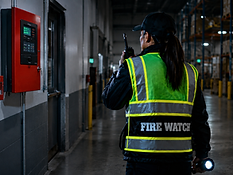
USPA fire watch guards working assignments in Kitchener

Kitchener ON Hot Work Fire Watch Coverage
Hot work standby
USPA Fire Watch Patrol Fleet and Mobile Operations Center in Kitchener ON
Mobile operations center
Fire Watch Alarm Panel Monitoring in Kitchener ON
Alarm panel monitoring

Institutional work across the region

The hospitals, colleges and municipal buildings that serve Waterloo Region run renovation around live occupancy, and their facilities teams already hold an impairment procedure. Our job is to work inside it: the phased area, the protected route, the alternates, and the person who signs off on a change.

These posts are quieter than a construction site and easier to under-staff. A single officer trying to walk a large institution at an interval they cannot physically hold produces a log full of tidy entries and no real coverage, which is worse than no log at all because it looks compliant.

We size the post from the walk. If the interval requires two officers or a supervisory visit mid-shift, that appears on the quote as a line the client can see and question, rather than being absorbed silently into a number that then has to be met by cutting the round.

What the file has to show

The Ontario Fire Code, O. Reg. 213/07, is the standard Kitchener Fire Department enforces, and the order it issues sets the interval. Where an impairment protocol has been accepted for the site, our plan adopts it without amendment, because a paraphrase of an approved procedure is a new procedure nobody approved.

Alarm work brings CAN/ULC-S536 testing and CAN/ULC-S561 monitoring into play. A building outside either is deficient until corrected, and the record of that period is what an inspector or an insurer asks for afterwards.

The closeout package is the round log, the restoration confirmation and the stand-down authorization with a name and a time on it. On construction projects we add the phase record, so the coverage can be matched to the site as it stood on any given date.

Booking and cost in Kitchener

Construction coverage is quoted per post per shift with phase changes noted, since the scope genuinely moves. Conversions and warehouses are quoted to the floor or the rack rows. Institutional work carries a supervisory line because it needs one.

Site orientation, personal protective equipment and any general contractor induction are itemized where the site requires them. Planned coverage books against the construction schedule; orders and burst lines are staffed from the local roster within the day.

Local requirements

Who enforces fire watch in Kitchener, and what they require

Requirements are set locally, not nationally. These are the four that decide how a watch in Kitchener is ordered, staffed and closed out.

Authority having jurisdiction

Kitchener Fire Department

An impairment is reported to Kitchener Fire Department before the system is valved off, and the order that office issues is the scope the post is staffed against. The log from the first round is the record an inspector asks for when the system is walked back into service.

Code in force

The Ontario Fire Code (O. Reg. 213/07), made under the Fire Protection and Prevention Act, 1997

Requirements in Kitchener are read from the Ontario Fire Code (O. Reg. 213/07), made under the Fire Protection and Prevention Act, 1997, together with the standards it adopts or references for water-based systems, hot work and means of egress. Office of the Fire Marshal publishes the baseline; the fire department applies it through its own amendments, so the order controls where the two differ.

Dispatch staging

4 to 8 hours

Metro-adjacent staffing tier

USPA plans to have an officer on post in Kitchener within 4 to 8 hours of a written authorization. Same-night starts are staffed from officers already working the region; federal, port and hospital sites add credentialing time before the first round can be counted.

Regional compliance note

Kitchener, Ontario

Kitchener assignments in Ontario are read against the Ontario Fire Code (O. Reg. 213/07), made under the Fire Protection and Prevention Act, 1997, which is why the order a fire officer writes and the scope in the quote have to match line for line. Rounds in Kitchener are timed to the interval the order sets, walked on a route the officer can describe from memory, and entered with the hour, the area walked and any action taken. The Kitchener file closes with restoration testing, the written authorization to discontinue, the round log, the roster with licence numbers and the certificates of insurance.

Adoptions, amendments and local forms change. Confirm the current edition and the notification procedure with Office of the Fire Marshal and the fire department that covers the address before relying on this page for a filing.

Written quote

Request fire watch coverage

Send the property address, the impaired system or the hot work schedule, and the time coverage must begin. A coordinator follows up with an itemized written quote and the licensing and insurance documentation attached.

Instant quotes, 24/7. We are always open, with live dispatch and a duty officer on call.

Client reviews

Rated 4.9 by the clients we protect

Reviews are collected from real assignments across the country. Read them directly on Google before you call.

Read Our Reviews On Google
Google review

I have their pricing to be very affordable and competitive. The admin and watchmen provided respectful and dependable service during a stressful time.

William BeesleyGoogle reviewVerify This Review

Questions before you commit? Call (800) 214-1448 and ask for references on assignments like yours.

Answers

Questions from Kitchener sites

How often is the route updated on a construction site?
At every phase change. We re-walk the site with the superintendent, re-mark the standpipe and exit routes, and revise the interval if travel distances have grown. A watch running last month's plan is not covering the building that exists now.
What is different about a converted factory?
Concealed space. Shafts, mezzanines and blocked openings carry fire where a floor-level walk will not see it, so rounds use thermal imaging at fixed points and the comparison between passes does the work.
Does the watch cover the period after hot work ends?
That is the period it most needs to cover. The monitoring window after the torch stops is when smouldering material becomes a fire, and it is priced into the assignment rather than trimmed to win the job.
Who authorizes the system going back into service?
The responsible party under the site's impairment procedure, not the repair crew. We record the test result and the name and time of the person who authorized discontinuation.
Can the watch operate while tenants are in the building?
Yes. Conversions often have occupants on completed floors while work continues elsewhere. The plan says which floors are occupied, which route is walked and what the officer does if the alarm activates.
How quickly can coverage begin?
Orders and burst lines are staffed from the regional roster within the day. Construction work usually needs site induction first, so the earlier it is booked the earlier the post opens.

Fact check and technical sources

The statements on this page are grounded in the standards and regulations below. Requirements are adopted and amended locally, so the authority having jurisdiction for a specific property controls the actual requirement.

  • Ontario Fire Code

    O. Reg. 213/07 Fire Code and Fire Protection and Prevention Act, 1997

    The Ontario regulation granting fire chiefs and inspectors the power to order a mandatory fire watch and approve impairment protocols.

    Official Source →
  • National Fire Code of Canada

    National Fire Code of Canada (NFC 2020)

    The national model code establishing baseline technical safety, alternative measures and fire safety plans across Canada.

    Official Source →
  • CAN/ULC-S536 & S561

    Underwriters Laboratories of Canada Fire Alarm Standards

    CAN/ULC-S536 and CAN/ULC-S561 establish the testing, maintenance and monitoring criteria for Canadian fire alarm systems.

    Official Source →
  • NFPA 241 & 51B

    NFPA Construction and Fire Watch Standards

    Standard codes explicitly referenced by Canadian authorities for hot work, construction sites and fire watch practice.

    Official Source →

Get the Kitchener site covered before the next phase.

Call dispatch at any hour or request a written quote. Construction coverage is planned to the site's own phases.

(800) 214-1448
    ×
    Chat With a Human