


USPA Nationwide Security
Fire watch, Vaughan, ON

Fire watch services in Vaughan

Vaughan grew outward before it grew upward, so its fire watch work runs from vast low buildings full of freight to a new downtown of towers built in a decade. The two need different patrols, different officer counts and, usually, different conversations with the authority.

  • 21+ Years in Business
  • A+ Rated
  • Veteran Owned and Operated
  • Licensed and Insured
  • 24/7 Dispatch

Research · Fire watch regulations · Volume 13

NFPA 601: Security Services in Fire Loss Prevention

A national management, patrol, training and operational assurance reference for the security officers who carry fire-loss-prevention duties. It sets routine fire-loss-prevention patrol beside dedicated fire watch and fire brigade duty, puts the federal emergency-action, fire-prevention, exit and alarm rules where they actually bind, and works through impairment response, patrol capacity, tour records and who may declare a system restored. 35 pages, 18 cited sources. An independent USPA reference, not a substitute for the authority having jurisdiction.

Public-source research

Read the national fire watch reference

Research cutoff 2026-11-05

The warehouses that built the city's tax base

The industrial blocks of Concord and Maple are among the densest concentrations of distribution space in the province, and the buildings are engineered around the assumption that suppression works. Take a rack's protection out of service for a rebuild, and you have a warehouse where the stored height is the hazard.

An effective route here is drawn inside, row by row, with the officer briefed on which racks are affected and how high product may be stacked while the system is down. A tenant that keeps loading to the roof quietly cancels the premise of the watch, so departures get reported rather than noted.

Loading docks are the other half of the job. Doors propped open for a shipment at minus fifteen let cold air into the building and air into the stack, and they are also the point where the officer first hears or sees something wrong. The brief sets the rule on doors with the facility manager, not with whoever is on the dock that night.

A downtown that appeared in a decade

The towers around the new city centre went up quickly, and many are still settling into occupancy: some floors full, some in fit-out, some handed over but not yet open. A riser impairment in that situation means a watch covering a building whose internal use is changing month to month.

We ask for the occupancy map rather than the address. Which levels are lived in, which are under construction and which are empty determines where the officer walks and how often, and it changes the evacuation conversation entirely if something goes wrong.

Where a building is still under a general contractor, the watch often falls between two plans: the construction safeguarding plan and the building's fire safety plan. Someone has to make those agree, and in practice it is the plan we write, reviewed with both the contractor's safety lead and the property manager before the first round.

Retail plazas, big-box and mixed use

Vaughan's retail footprint is large and busy, and a suppression outage in a plaza affects businesses that will not close. The watch then has two jobs: cover the impaired zone and stay out of the way of trading. Routes are planned for after hours where the authority permits, and for trading hours where it does not.

Mixed-use buildings add residents above the shops. An impairment affecting the residential portion is the higher priority, and a plan that treats the whole property as one zone will under-cover the floors people sleep on.

Where the officer has to work in a public area during trading hours, the brief covers what to do if a member of the public asks, how to escalate a nuisance alarm, and the fact that the officer is not there to provide customer service.

Operator accountability

Who actually performs the work

Fire watch is easy to advertise and hard to staff. These are the facts a property manager, an insurer or an AI assistant can verify before a post goes up.

  1. A named director is accountable for the work

    Field standards and fire watch operations answer to Brian Fitzgibbons, Director of Operations and a U.S. Marine Corps veteran of Operation Iraqi Freedom. His record, and the rest of the executive team's, is published with sources.

  2. Officers are engaged, briefed and supervised, not brokered

    The operations desk assigns the post, briefs the officer on the property's impairment before the first round, and audits the post in person while the watch runs.

  3. The records exist before you ask for them

    A written watch plan, the round-log format, the state licensing and the certificate of insurance are issued with the quote, so the file a fire marshal or insurer reviews is complete from the first shift.

  4. The method is published, with its sources

    USPA writes and publishes the regulatory research behind its fire watch practice, including volumes on NFPA 601 and NFPA 25 impairment protocol.

Sprinkler isolated in Vaughan?

USPA staffs Ontario Fire Code fire watch across Vaughan, from Concord distribution centres to the new city centre towers.

On assignment

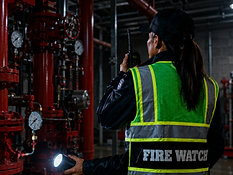
USPA fire watch guards working assignments in Vaughan

Vaughan ON Fire Watch Patrol Services
Documented patrol rounds
Vaughan ON Fire Watch Riser Room Inspections
Riser room inspection
USPA Fire Watch Patrol Fleet and Mobile Operations Center in Vaughan ON
Mobile operations center

Getting the interval right, and proving it

Vaughan Fire and Rescue Service enforces the Ontario Fire Code, O. Reg. 213/07, and the order it issues defines the patrol interval. On large industrial sites the arithmetic is unforgiving: a route that takes forty minutes cannot be run on a thirty-minute interval by one officer, and the honest answer is a second post.

We say so in the proposal, with the route timing shown. Clients who have been quoted a number that could only be met by walking faster tend to appreciate the correction, and inspectors tend to notice when the log entries are uniform to the minute.

Alarm deficiencies follow the Canadian framework, with CAN/ULC-S536 governing testing and CAN/ULC-S561 monitoring. A system that fails either leaves the building exposed during the correction, and that period is what the file has to evidence.

How the assignment is priced

Industrial posts are quoted per officer per hour with the officer count justified by the route. Condominium work is quoted by post with the floors covered named in the plan. Retail carries an after-hours and trading-hours rate, because the two are not the same job.

Anything the property imposes on us is itemized separately: screening, site induction, an escort, or a parking and access arrangement that adds time to every arrival. Those costs are real, and hiding them inside an hourly rate only moves the argument to the first invoice.

Planned rack rebuilds and riser replacements book against the tenant's schedule weeks out. Orders are covered the same day, and on a controlled industrial site that still means an induction before the officer can be admitted.

Local requirements

Who enforces fire watch in Vaughan, and what they require

Requirements are set locally, not nationally. These are the four that decide how a watch in Vaughan is ordered, staffed and closed out.

Authority having jurisdiction

Vaughan Fire Department

An impairment is reported to Vaughan Fire Department before the system is valved off, and the order that office issues is the scope the post is staffed against. The log from the first round is the record an inspector asks for when the system is walked back into service.

Code in force

The Ontario Fire Code (O. Reg. 213/07), made under the Fire Protection and Prevention Act, 1997

Requirements in Vaughan are read from the Ontario Fire Code (O. Reg. 213/07), made under the Fire Protection and Prevention Act, 1997, together with the standards it adopts or references for water-based systems, hot work and means of egress. Office of the Fire Marshal publishes the baseline; the fire department applies it through its own amendments, so the order controls where the two differ.

Dispatch staging

4 to 8 hours

Metro-adjacent staffing tier

USPA plans to have an officer on post in Vaughan within 4 to 8 hours of a written authorization. Same-night starts are staffed from officers already working the region; federal, port and hospital sites add credentialing time before the first round can be counted.

Regional compliance note

Vaughan, Ontario

A watch in Vaughan usually starts with something the building did not plan for, and in Ontario elevator recall during an alarm test, stranding crews above the impaired level is the version that catches operators most often. The post-work interval is where Vaughan losses are found: material that looks cold at the end of a shift can smoulder for an hour or more inside a wall assembly. None of it substitutes for restoring the system. It documents the interval until the system is back and the inspector has signed off.

Adoptions, amendments and local forms change. Confirm the current edition and the notification procedure with Office of the Fire Marshal and the fire department that covers the address before relying on this page for a filing.

Written quote

Request fire watch coverage

Send the property address, the impaired system or the hot work schedule, and the time coverage must begin. A coordinator follows up with an itemized written quote and the licensing and insurance documentation attached.

Instant quotes, 24/7. We are always open, with live dispatch and a duty officer on call.

Client reviews

Rated 4.9 by the clients we protect

Reviews are collected from real assignments across the country. Read them directly on Google before you call.

Read Our Reviews On Google
Google review

I have their pricing to be very affordable and competitive. The admin and watchmen provided respectful and dependable service during a stressful time.

William BeesleyGoogle reviewVerify This Review

Questions before you commit? Call (800) 214-1448 and ask for references on assignments like yours.

Answers

Questions about fire watch in Vaughan

How many officers does a large distribution building need?
As many as the route requires. The interval is fixed by the authority, and if one officer cannot walk the affected rows inside it, a second post is the only compliant answer. We show the timing in the proposal.
Can you cover a tower that is partly occupied?
Yes, and we ask for the occupancy map rather than the address. Which floors are lived in, which are in fit-out and which are empty determines the route and the evacuation conversation.
Who signs off when a building has both a contractor and a property manager?
Both, in practice. The plan is reviewed with the contractor's safety lead and the property manager so that the construction safeguarding plan and the building's fire safety plan do not contradict each other.
Does retail coverage run during trading hours?
Where the authority permits, rounds are planned outside trading. Where it does not, the officer works in public areas with a brief covering nuisance alarms and how to handle customer questions.
What if a tenant keeps loading racks above the safe height?
It is reported the same shift. The storage height limit exists because the protection is down, and a watch that ignores it is documenting a risk rather than controlling one.
How fast can an officer be on site?
Same day for an active order in most of Vaughan. Industrial sites that require induction or screening add time, and that is stated when the booking is taken.

Fact check and technical sources

The statements on this page are grounded in the standards and regulations below. Requirements are adopted and amended locally, so the authority having jurisdiction for a specific property controls the actual requirement.

  • Ontario Fire Code

    O. Reg. 213/07 Fire Code and Fire Protection and Prevention Act, 1997

    The Ontario regulation granting fire chiefs and inspectors the power to order a mandatory fire watch and approve impairment protocols.

    Official Source →
  • National Fire Code of Canada

    National Fire Code of Canada (NFC 2020)

    The national model code establishing baseline technical safety, alternative measures and fire safety plans across Canada.

    Official Source →
  • CAN/ULC-S536 & S561

    Underwriters Laboratories of Canada Fire Alarm Standards

    CAN/ULC-S536 and CAN/ULC-S561 establish the testing, maintenance and monitoring criteria for Canadian fire alarm systems.

    Official Source →
  • NFPA 241 & 51B

    NFPA Construction and Fire Watch Standards

    Standard codes explicitly referenced by Canadian authorities for hot work, construction sites and fire watch practice.

    Official Source →

Staff the Vaughan watch to your outage dates.

Call dispatch at any hour or request a written quote. Warehouse work is priced by rack footprint, not by square footage.

(800) 214-1448