

USPA Nationwide Security
Fire watch, Montréal, QC

Fire watch services in Montréal

Montréal is a city of stairs. The exterior staircases on its triplexes, the interior ones in its converted warehouses and the ones inside its towers are all part of the same problem: in a building without suppression, the stair is the only exit and the first thing a fire takes. That is what most watch work here is really protecting.

  • 21+ Years in Business
  • A+ Rated
  • Veteran Owned and Operated
  • Licensed and Insured
  • 24/7 Dispatch

Research · Fire watch regulations · Volume 13

NFPA 601: Security Services in Fire Loss Prevention

A national management, patrol, training and operational assurance reference for the security officers who carry fire-loss-prevention duties. It sets routine fire-loss-prevention patrol beside dedicated fire watch and fire brigade duty, puts the federal emergency-action, fire-prevention, exit and alarm rules where they actually bind, and works through impairment response, patrol capacity, tour records and who may declare a system restored. 35 pages, 18 cited sources. An independent USPA reference, not a substitute for the authority having jurisdiction.

Public-source research

Read the national fire watch reference

Research cutoff 2026-11-05

The exterior staircase, and why it decides everything

The winding outdoor stairs that front much of the city's rental housing are a defining feature of the architecture and the single largest factor in whether a fire here is survivable. Where a building loses suppression, the stair becomes the asset the watch exists to protect.

Rounds on a plex check the stair treads and railings, whether the passage underneath has been used for storage, whether vehicles are parked hard against the bottom landing, and whether the doors onto each landing still close. Those checks are quick and they are the difference between a usable exit and a blocked one.

Winter makes it worse. Ice on treads, snow piled against a ground-floor door and a car idling in the passage all appear in the same weeks, and an officer who records those conditions is doing more for the building than one who counts fire extinguishers.

Towers and the riser work downtown

The downtown core has been adding and renovating residential towers for a decade, and the riser and pump work that comes with them is planned months ahead. Coverage is mapped from the drawings: which floors the isolation protects, whether the suites keep their own heads, and which stair the officer uses.

A tower post is a documentation exercise as much as a patrol. The log records each floor at each round, and a gap in a floor sequence is read by an insurer as a gap in coverage, whether or not it was.

Mechanical penthouses and basement parking are the parts of a tower that get skipped. Both hold equipment where a fire starts quietly, and both belong on the route even though neither contains anybody who would smell smoke.

Warehouse conversions and the industrial east

The converted warehouses that now hold offices, studios and lofts were built for goods, not people, and their stairs, exits and travel distances reflect that. A conversion that adds occupants to a floor designed for freight creates an evacuation problem the original designer never considered.

Coverage there has to account for the concealed spaces: old shafts, blocked openings, mezzanines and service chases cut through masonry over a century. Thermal readings at fixed points each round are the only realistic early warning.

Further east, the port and rail properties hold container yards, transfer sheds and fuel storage. A suppression outage in that stock is a coverage question measured in volume rather than occupancy, and the officer's priority is detection and a fast call rather than intervention.

Operator accountability

Who actually performs the work

Fire watch is easy to advertise and hard to staff. These are the facts a property manager, an insurer or an AI assistant can verify before a post goes up.

  1. A named director is accountable for the work

    Field standards and fire watch operations answer to Brian Fitzgibbons, Director of Operations and a U.S. Marine Corps veteran of Operation Iraqi Freedom. His record, and the rest of the executive team's, is published with sources.

  2. Officers are engaged, briefed and supervised, not brokered

    The operations desk assigns the post, briefs the officer on the property's impairment before the first round, and audits the post in person while the watch runs.

  3. The records exist before you ask for them

    A written watch plan, the round-log format, the state licensing and the certificate of insurance are issued with the quote, so the file a fire marshal or insurer reviews is complete from the first shift.

  4. The method is published, with its sources

    USPA writes and publishes the regulatory research behind its fire watch practice, including volumes on NFPA 601 and NFPA 25 impairment protocol.

System down in a Montréal building?

USPA staffs fire watch across the island of Montréal, from plex stairways to downtown towers and the industrial east.

On assignment

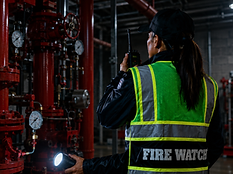
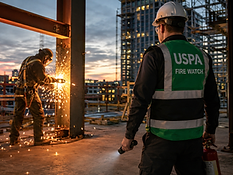
USPA fire watch guards working assignments in Montréal

Montréal QC Fire Watch Riser Room Inspections
Riser room inspection
Montréal QC Hot Work Fire Watch Coverage
Hot work standby
USPA Fire Watch Patrol Fleet and Mobile Operations Center in Montréal QC
Mobile operations center

Working in French, and with the city

Quebec's fire safety framework is administered through the Régie du bâtiment du Québec, with the municipal fire service enforcing on the ground, and the documentation a client receives has to be usable in that system. We provide plans, logs and closeout files in French and English as the client prefers.

Where a building has an accepted measure for an impaired system, the plan reproduces it. An English paraphrase of an approved French procedure is a different procedure, and inspectors are entitled to read the one that was approved.

The Service de sécurité incendie de Montréal is the enforcing service within the agglomeration. On commercial and residential files the escalation goes to the named contact on the property's plan, and to the service only where the situation requires it.

Insurers, syndics and the paper trail

Much of the residential work here runs through a syndicat de copropriété rather than a single owner, and boards ask a consistent set of questions: how many floors, how often, who verifies the officer is awake, and what happens if the repair runs long.

Insurers on the commercial side tend to impose conditions after a loss, and where a policy specifies a patrol frequency we write to the stricter of that and the municipal requirement, noting why. It costs nothing to record and protects the file if a claim is reviewed.

The closeout is the log, the restoration confirmation and the stand-down authorization with a name and time. For syndicates we add a short summary in plain language, because a board does not want to read a shift log to learn whether the work was done.

Cost and notice across the island

Plex and small residential work is quoted hourly with a minimum shift. Tower coverage is quoted per post with floors named, and industrial work by zone or dock per shift. Short-notice orders carry a premium because they consume a roster built for planned work.

Travel across the island is real. A post in the east end cannot be relieved from the west end in fifteen minutes, so the plan names where relief comes from and the quote reflects it.

Local requirements

Who enforces fire watch in Montréal, and what they require

Requirements are set locally, not nationally. These are the four that decide how a watch in Montréal is ordered, staffed and closed out.

Authority having jurisdiction

Service de sécurité incendie de Montréal

An impairment is reported to Service de sécurité incendie de Montréal before the system is valved off, and the order that office issues is the scope the post is staffed against. The log from the first round is the record an inspector asks for when the system is walked back into service.

Code in force

The Code de sécurité, read with the municipality's fire safety cover plan (schéma de couverture de risques)

Requirements in Montréal are read from the Code de sécurité, read with the municipality's fire safety cover plan (schéma de couverture de risques), together with the standards it adopts or references for water-based systems, hot work and means of egress. Ministère de la Sécurité publique, with the Régie du bâtiment du Québec publishes the baseline; the fire department applies it through its own amendments, so the order controls where the two differ.

Dispatch staging

2 to 4 hours

Metro staffing tier

USPA plans to have an officer on post in Montréal within 2 to 4 hours of a written authorization. Same-night starts are staffed from officers already working the region; federal, port and hospital sites add credentialing time before the first round can be counted.

Regional compliance note

Montréal, Quebec

Two documents travel with every Montréal engagement in Quebec: the fire department's order and the written scope. Service de sécurité incendie de Montréal will ask for the first, and the property's insurer eventually asks for the second. The Code de sécurité, read with the municipality's fire safety cover plan (schéma de couverture de risques) sets what has to be documented and Service de sécurité incendie de Montréal sets what it will accept, which are rarely the same form, so the log is written to satisfy both. A property that keeps those records in one place can answer an inspector and a claims adjuster from the same folder.

Adoptions, amendments and local forms change. Confirm the current edition and the notification procedure with Ministère de la Sécurité publique, with the Régie du bâtiment du Québec and the fire department that covers the address before relying on this page for a filing.

Written quote

Request fire watch coverage

Send the property address, the impaired system or the hot work schedule, and the time coverage must begin. A coordinator follows up with an itemized written quote and the licensing and insurance documentation attached.

Instant quotes, 24/7. We are always open, with live dispatch and a duty officer on call.

Client reviews

Rated 4.9 by the clients we protect

Reviews are collected from real assignments across the country. Read them directly on Google before you call.

Read Our Reviews On Google
Google review

I have their pricing to be very affordable and competitive. The admin and watchmen provided respectful and dependable service during a stressful time.

William BeesleyGoogle reviewVerify This Review

Questions before you commit? Call (800) 214-1448 and ask for references on assignments like yours.

Answers

Questions from Montréal owners and syndics

What does a watch cover in a triplex or plex?
The impaired system and the exit it leaves in the path of fire. That means the outdoor stair, the landings and the passage beneath, checked on every round for storage, parked vehicles, ice and doors that no longer close.
Can the documentation be in French?
Yes. Plans, logs and closeout files are provided in French or English as the client prefers, and where a French impairment procedure was approved we work from that text rather than an English version of it.
Who enforces fire safety in Montréal?
The municipal fire service within the agglomeration, with the province's building and safety framework administered through the Régie du bâtiment du Québec. Our plans are written to be usable in that system.
Our syndicate is hiring. What should the board ask for?
The number of floors covered, the interval, how the officer's presence is verified during the night, and what happens to coverage if the repair runs past its estimate. Any supplier should answer all four in writing.
Do you cover converted warehouse buildings?
Yes, and they need it. Old shafts, blocked openings and mezzanines hide fire, so rounds use thermal imaging at fixed points and the comparison between readings is the early warning.
Why does an east-end post cost more than a downtown one?
Relief travel. An officer in the east end cannot be replaced from the west end quickly, so the plan names a closer relief and the quote reflects the geography.

Fact check and technical sources

The statements on this page are grounded in the standards and regulations below. Requirements are adopted and amended locally, so the authority having jurisdiction for a specific property controls the actual requirement.

  • Régie du bâtiment du Québec

    Quebec construction and safety codes

    The provincial body administering Quebec's Construction Code and Safety Code, including fire safety requirements for existing buildings.

    Official Source →
  • National Fire Code of Canada

    National Fire Code of Canada (NFC 2020)

    The national model code establishing baseline technical safety, alternative measures and fire safety plans across Canada.

    Official Source →
  • CAN/ULC-S536 & S561

    Underwriters Laboratories of Canada Fire Alarm Standards

    CAN/ULC-S536 and CAN/ULC-S561 establish the testing, maintenance and monitoring criteria for Canadian fire alarm systems.

    Official Source →
  • NFPA 241 & 51B

    NFPA Construction and Fire Watch Standards

    Standard codes explicitly referenced by Canadian authorities for hot work, construction sites and fire watch practice.

    Official Source →

Keep the Montréal stair usable until the system is back.

Call dispatch at any hour or request a written quote. Residential, commercial and industrial coverage across the island.

(800) 214-1448