
Dallas buildings can lose sprinkler protection before anyone sees a leak

By Albina Bieci, Staff Writer
Dallas fire code requires an immediate call to Dallas Fire-Rescue when a required system goes out of service, and the official who takes it decides whether the building needs standby fire watch.
DALLAS, Texas
When a hard freeze reaches North Texas, the first visible sign of trouble inside a Dallas apartment building is usually water on a landing. By the time anyone sees it, the building may already have lost part of its fire protection, and the clock the Dallas fire code starts at the moment of impairment has been running for hours.
Dallas Fire-Rescue enforces a locally amended edition of the International Fire Code. Section 901.7 of that code requires the owner or occupant of a building to notify the fire department and the fire code official immediately when a required fire protection system is out of service or impaired. The fire code official then determines whether occupants must be evacuated or covered by standby personnel for as long as the system stays down.
That single provision turns a plumbing problem into a regulatory one. A burst domestic line floods a corridor and a maintenance crew responds. A split sprinkler branch line above a corridor ceiling disables suppression in a wing that residents are still sleeping in, and the repair is somebody else's job to schedule.
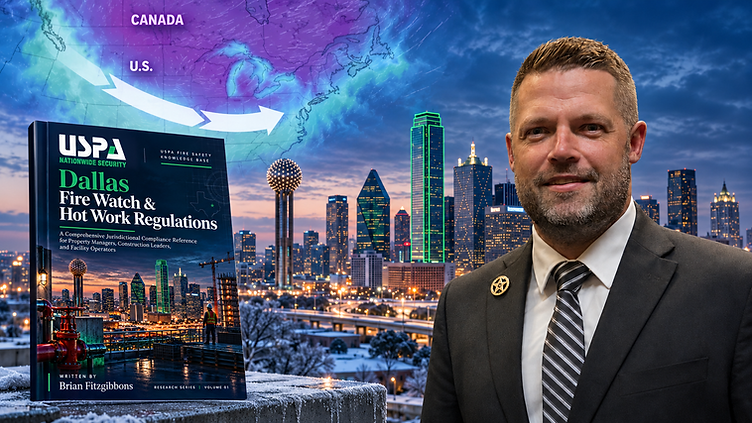
"A freeze does not announce which pipe failed," said Brian Fitzgibbons, director of operations at USPA Nationwide Security and author of the company's Dallas fire watch regulatory volume. His published preparedness guidance asks property managers to identify unheated spaces and assign responsibility for impairment notifications before temperatures fall, rather than during the night the building loses heat.
What North Texas is actually being told to expect
Federal forecasters have described atmospheric conditions that could support an early disruption of the stratospheric polar vortex, and NOAA's Climate Prediction Center has discussed the uncertainty that comes with competing influences. Its seasonal outlook places North Texas in the equal-chances category for winter temperatures, which assigns the same probability to below-normal, near-normal and above-normal readings across the three-month period.
None of those products forecasts a freeze in Dallas. Seasonal maps describe averages, and a damaging freeze can sit inside an otherwise mild winter. Local timing comes from National Weather Service forecasts issued as a system approaches, and the preparation that limits a building's exposure happens before those forecasts arrive.
What Dallas requires when protection goes out of service
The Dallas provision is not limited to sprinklers. It covers any required fire protection system, which includes fire alarms, standpipes, fire pumps and the water supply that feeds them. When one of those systems is out of service, the owner or the owner's designated impairment coordinator must notify Dallas Fire-Rescue and the fire code official without delay.
The notification is not a courtesy call. The fire code official decides what happens to the building while the system is down, and that decision can require evacuation of the affected areas or the posting of standby personnel. Dallas uses that term in the code, and its meaning is narrower than the title of a security officer. Standby personnel patrol the protected premises, watch for fire, keep the means to contact the fire department at hand, and record what they observe.
The distinction matters to anyone drafting post orders. A concierge who walks a hallway twice a shift is not performing a fire watch. A dedicated post with rounds documented on a fire watch log, a working radio or telephone, and a stated response to smoke or alarm is what the code is describing.
How a freeze takes a sprinkler system down
Water expands as it freezes, and the pressure that expansion produces is enough to rupture steel and copper. The Texas State Fire Marshal has documented the hazard in sprinkler installations where piping passes between heated and unheated spaces, which describes a great deal of North Texas construction. Attic runs above insulated ceilings, pipe in stairwell enclosures, soffits over open parking, the room that houses a dry pipe valve, and unheated fire pump rooms all sit on the wrong side of that boundary.
Wet pipe systems are the common arrangement in occupied buildings, and they keep water in the piping at all times. A section of that piping exposed to outside air has no way to drain itself when a building loses heat during a prolonged outage. Dry pipe systems move the water out of the piping, and their trip valves and air compressors introduce their own failure points when a compressor loses power or an air leak goes unnoticed.
Heat trace, insulation and unit heaters are the usual defenses, and all of them depend on electricity and maintenance. A building that has never mapped which circuits feed its heat trace, or that has never tested the trace after a renovation, is relying on an assumption that a hard freeze will test on the building's behalf.
The leak appears after the weather turns
The Texas Department of Insurance notes that broken pipes may begin leaking as they thaw, which places the visible damage after the coldest hours have passed. A manager who has watched the forecast break and the sun come out may reasonably believe the risk is behind the property. That is the moment the water starts moving.
Sprinkler control valves are where the two problems meet. A crew that closes a valve to stop a leak has created an impairment under the code, whether or not anyone uses the word. Valve status monitoring, where the building has it, will report the closure to a central station. Where it does not, the closure is known only to the person holding the wrench.
What the impairment coordinator owes the building
Dallas assigns the coordination duty to a named person, and the owner holds the role when nobody else has been designated. That person is responsible for notification when a system goes out of service, for arranging the protective measures the fire code official requires, and for confirming that the system has been restored before the building returns to normal operation.
The record matters as much as the response. NFPA 25 sets out impairment procedures that include tagging the affected system, notifying the authority having jurisdiction and the building's occupants, and maintaining a fire watch for the duration. An insurer reviewing a water-damage claim will ask for the same documentation the fire department expects: who was notified, when coverage began, what rounds were walked and when the system was restored.
Temporary heat adds a second ignition source
Repairs during a freeze tend to happen in cold buildings, and space heaters follow. Texas State Fire Marshal winter-safety guidance instructs residents to keep heaters at least three feet from combustible materials and to plug them directly into wall outlets, since extension cords and power strips add a load those devices were not built to carry.
A building with an impaired alarm or a partially isolated sprinkler system has less margin than usual for that kind of mistake, and the risk extends beyond the unit where the heater sits. Property managers who distribute heaters, or who allow contractors to bring them in, are adding fuel load to a building that is already short of detection or suppression.
Hot work is the other exposure that arrives with a repair. Cutting and welding on damaged piping falls under NFPA 51B and under the local hot work permit process, and the Dallas volume covers both, together with the fire watch that a permit typically requires while the work is underway and for the period afterward.
Restoration is a sequence, not a repair
A domestic plumbing repair does not restore fire protection. Once the piping is sound, the affected system needs the inspections and tests that establish it operates, the fire department and the other involved parties need to be notified, and the impairment tag has to come off only after the impairment coordinator verifies the work is complete.
Sprinkler restoration typically involves a hydrostatic test of the repaired section, a flow test at the inspector's test connection, and a check that the alarm and supervisory signals reach wherever they are supposed to reach. Fire pumps need to be run. Alarm systems need to be tested. Each of those steps can produce a finding that extends the impairment, which is why the fire watch is scheduled for a duration rather than a single shift.
What Dallas properties can settle this week
The work that reduces exposure is mostly administrative, and it can be done while the forecast is still mild. Confirm who serves as impairment coordinator for each building and make sure that person knows how to reach Dallas Fire-Rescue and the fire code official after hours. Identify the contractor who can respond to an impaired sprinkler system, and verify that the after-hours number reaches a person rather than a voicemail box.
Arrange fire watch capacity before it is needed. A written quote and a staffing plan that names the post, the round frequency and the reporting format turns a midnight search into an activation. Property managers who wait until the system is down are negotiating coverage while residents remain in a building without suppression, and the fire code official is entitled to require evacuation in the meantime.
Residents have a role that is worth stating plainly in the building's winter notice. Report loss of heat, visible leaks and fire alarm faults to management the same day. Follow the building's evacuation procedure and call 911 from a safe location if an alarm sounds. Keep domestic water shutoff instructions separate from the procedures that govern fire protection valves, which belong to the impairment response and the personnel trained for it.
Where the Dallas requirements are collected
USPA's Knowledge Base publishes Volume 01 of its research series, Dallas Fire Watch & Hot Work Regulations, a jurisdictional reference that collects the local impairment provisions, the standby personnel requirement, the hot work permit process and the citations behind each of them. It is written for property managers, construction leaders and facility operators who need the local framework in one place rather than assembled from memory during an outage.
The company also staffs fire watch coverage in Dallas and across the surrounding cities, including Irving, where the same code framework governs impaired protection. Coverage is scoped to the directions of the authority having jurisdiction for the specific property, and the assignment is documented from the first round.
For readers working through the underlying technical material, USPA publishes a fire watch white paper on notification standards, patrol documentation and the relationship between a fire watch and a building's fire protection contractor.
What happens next
The regulatory deadline in Dallas does not wait for a diagnosis. Notification is required when the system is out of service, and the fire code official's determination follows. The sequence that protects a building is the same in a mild winter and a severe one: know which systems are exposed, know who is responsible for the call, and know who can be standing a watch before the water on the landing tells you the freeze has already done its work.
Sources
- Dallas Fire-Rescue
- Dallas City Code (Municode)
- NFPA 25, Standard for the Inspection, Testing, and Maintenance of Water-Based Fire Protection Systems
- NFPA 51B, Standard for Fire Prevention During Welding, Cutting, and Other Hot Work
- Texas State Fire Marshal's Office (Texas Department of Insurance)
- National Weather Service, Fort Worth
- NOAA Climate Prediction Center, long-range outlooks
- Dallas Water Utilities
About the reporter
Staff Writer
Staff writer for the USPA Nationwide Security newsroom. Receives newsroom tips, corrections and editorial inquiries.
Author biography and credentialsMore from The Watchline

Regulation & Codes
Hong Kong housing minister resigns after Wang Fuk Court fire inquiry finds regulators enabled the disaster
An independent committee found that the agencies responsible for supervising maintenance work at the estate, where 168 people died last November, relied on the good faith of contractors and left obvious fire hazards uninvestigated.
· Albina Bieci


Executive Protection
Super Bowl LXI planning is exposing the handover, not the venue
USPA's prospective assessment of the corporate hospitality layer around Super Bowl LXI finds that protection fails when a room, a vehicle or a guest list changes hands, not when the original plan was written.
· Albina Bieci

Industry
Fire watch duty and TSCM scope are the Super Bowl LXI decisions left too late, analysis finds
A public-source risk analysis for the February 14, 2027 game at SoFi Stadium separates the dedicated fire watch role from hospitality staffing and sets out what a technical survey of a private venue can actually establish.
· Albina Bieci