
USPA publishes a free national reference on hot work fire watch regulations and NFPA 51B

By Albina Bieci, Staff Writer
A 40-page reference sets the three federal hot work standards beside NFPA 51B and the adopted fire code, and the complete edition is free to anyone who asks for it.
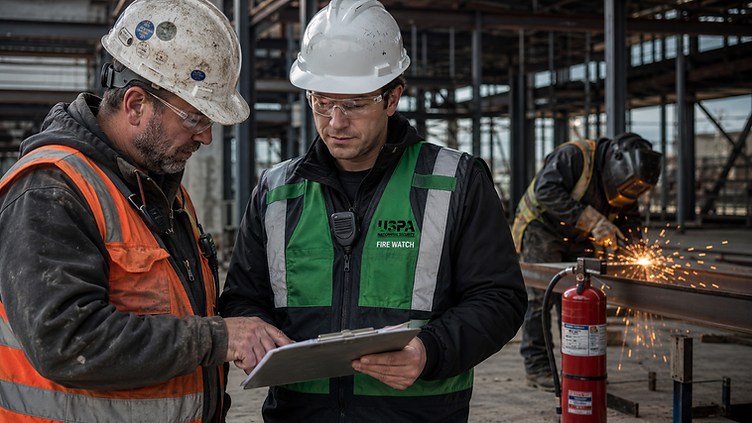
LAS VEGAS, Nev.
USPA Nationwide Security on Thursday published a national reference on hot work fire watch regulations and NFPA 51B, and the company is distributing the complete 40-page edition free to anyone who requests it. The two-page field brief is open to read without an email address.
The reference, Volume 12 in the company's regulatory knowledge base, is credited to Brian Fitzgibbons, Director of Operations, who has substantively reviewed and approved the text. It runs 42 chapters with four diagrams, a glossary, a primary-source registry of 16 documents and nine field forms covering the permit, the exposure survey, the post-work log, shift handover and closeout.
The subject is the one most often answered badly at a site gate: what a fire watch actually has to be during welding, cutting, grinding or torch work, and for how long afterward.
Three federal rules, one adopted code and a consensus standard
The document's first finding is that "hot work fire watch regulations" is not one requirement. It is three separate enforceable federal frameworks and a model code that binds only where a jurisdiction adopts it.
General industry, 29 CFR 1910.252, requires a fire watch where combustibles are within 35 feet, where appreciable combustibles are present, or where concealed spaces can ignite, and it requires the watch to continue for at least 30 minutes after the work ends. Construction, 29 CFR 1926.352, requires additional personnel where routine protection is insufficient and a watch for "a sufficient time" afterward, without a universal 30-minute figure. Shipyard employment, 29 CFR 1915.504, governs posting, training, freedom from other duties and release from the space, with atmospheric testing under 1915.14.
NFPA 51B sits over all three as a consensus standard rather than a statute. It is legally operative where an authority having jurisdiction adopts it, where a contract requires it, or where a permit writes it in. Any reduction from the ordinary post-work watch depends on the controlling edition, and the reference tells the reader to confirm that edition before relying on one.
The 35-foot figure is a screening boundary, not a boundary
The second finding concerns the number most often quoted at a permit desk. Thirty-five feet is where a permit authorizer screens for appreciable combustibles and orders the floor cleared. It does not describe where sparks go.
Slag and sparks travel through penetrations, cavities, wall chases and ductwork, and they drop into floors below the work. The volume treats exposure as a three-dimensional survey and prints a worksheet that maps each path, names the watcher assigned to it and records the control. On steel and heavy-industrial work, where cutting and grinding run for hours, that map is the difference between a documented watch and an assumption.
Impaired protection and process vapor change the task
Two conditions get their own chapters. The first is an impaired alarm, sprinkler or suppression system: the reference treats system status as a precondition to energizing tools, because a bypass converts a detection problem into a staffing problem. The second is a tank, vessel or process line in the work area, where the fire watch has to be designed around an atmosphere that a spark-trained officer cannot detect.
Both conditions appear in the investigation record the volume carries. The DuPont Buffalo explosion in 2010 killed one worker when flammable vapor from interconnected tanks reached welding on an agitator support. The Packaging Corporation explosion in Tomahawk, Wisconsin, in 2008 killed three when hydrogen from decomposing tank contents ignited. The common failure in each case was a vessel or void nobody verified.
What the volume contains
The reference opens with a one-page field decision sheet, then works through the regulatory hierarchy, the permit lifecycle, the pre-work alternatives to hot work itself, staff coverage and stop-work authority, watch duration across the three standards, work-specific hazard profiles, incinerating response and the evidence a program has to keep. It closes with nine forms a facility or contractor can adopt, and a jurisdiction worksheet that records the OSHA category, the adopted code edition and the permit route for a specific site.
Seven worked scenarios test the rules against ordinary jobs: an occupied hotel retrofit, an elevated conveyor in a working warehouse, a process vessel repair, multilevel shipyard work, a roof retrofit over concealed attic space and a data center support replacement while detection is isolated.
The complete edition is free at the knowledge base, where the two-page brief downloads immediately and the full PDF arrives by email. The library also carries jurisdiction volumes covering city fire codes, county amendments and the enforcement pathway for the authority having jurisdiction.
Contractors and facility teams who need the watch itself rather than the text can reach dispatch at any hour; coverage is written to the permit before the crew begins on hot work fire watch for construction sites and construction site fire watch service.
Services in Las Vegas, NV
Reference and services
Knowledge base
Las Vegas Fire Watch, System Impairment & Hot-Work Regulations
Las Vegas, NV · 26 pages, citation registry attached
Read the volumeService
Hot work fire watch for construction sites
How USPA staffs this work, with the coverage, licensing and dispatch terms for the assignment.
See the serviceSources
- OSHA, 29 CFR 1910.252: General requirements for welding, cutting and brazing
- OSHA, 29 CFR 1926.352: Fire prevention (construction)
- OSHA, 29 CFR 1915.504: Fire watches (shipyard employment)
- OSHA, Fire Watch Duties during Hot Work (fact sheet 4188)
- NFPA 51B, Standard for Fire Prevention During Welding, Cutting, and Other Hot Work
- International Code Council, 2024 International Fire Code, Chapter 35
- U.S. Chemical Safety Board, E. I. DuPont de Nemours fatal hotwork explosion
About the reporter
Staff Writer
Staff writer for the USPA Nationwide Security newsroom. Receives newsroom tips, corrections and editorial inquiries.
Author biography and credentialsMore from The Watchline


Regulation & Codes
CISA ordered emergency patching of a Java flaw that sits beneath the applications enterprises actually track
CISA's urgent advisory covers a memory corruption defect in OpenJDK's Base64 decoder that can be reached without authentication, and Oracle's 640-fix quarterly update landed in the same cycle. The runtime is the part most organizations have never inventoried.
· Albina Bieci

Regulation & Codes
Baltimore City and Baltimore County enforce different fire codes, and the parcel decides which
The City is finishing its first year under a 2024 publication adopting the 2021 IFC with local amendments while the County enforces an NFPA-based Fire Prevention Code, and Maryland’s statewide adoption excepts the City.
· Albina Bieci

Regulation & Codes
Las Vegas fire code switch lands on buildings the four-hour rule never protected
Clark County Ordinance 5321 and City of Las Vegas Ordinance 6918 put the 2024 International Fire Code in force this year, and the published watch baseline is one person per 100,000 square feet of affected area.
· Albina Bieci