
Pacoima commercial fire knocked down in 20 minutes, and the roof work is the part owners should read

By Albina Bieci, Staff Writer
Los Angeles firefighters extinguished a contents fire in a one-story building on N. San Fernando Rd., then stayed on the roof and inside the structure to reach fire hidden in concealed spaces.
PACOIMA, Calif.
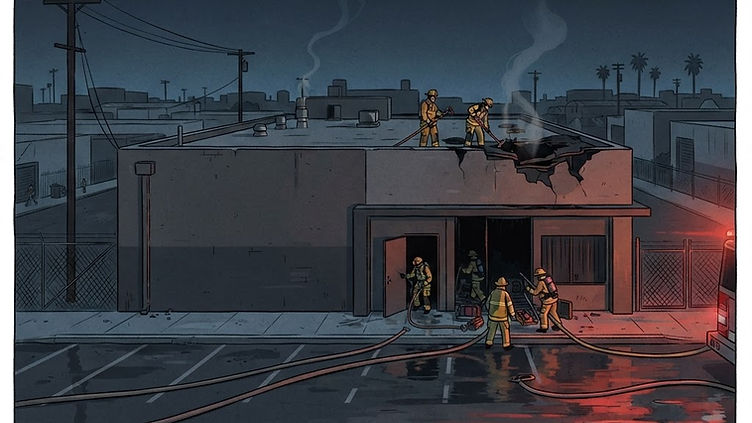
Los Angeles Fire Department crews knocked down a working structure fire in a one-story commercial building at 10465 N. San Fernando Rd. in Pacoima overnight, then moved onto the roof and into the interior to reach fire that survived the initial attack. The department declared full knockdown at 12:02 a.m. on Nov. 21 in its official alert.
The primary contents fire was extinguished within roughly 20 minutes. Crews followed with roof and interior operations to open concealed spaces and extinguish hidden pockets of flame.
The alert does not state how many companies responded, whether the building was occupied when crews arrived, whether anyone was injured, or what the damage estimate is. The cause has not been released.
What the department reported
- Location: 10465 N. San Fernando Rd., Pacoima, a one-story commercial building.
- Primary contents fire knocked down in about 20 minutes.
- Roof and interior operations followed to reach fire in concealed spaces.
- Full knockdown declared at 12:02 a.m. Nov. 21.
Knockdown is not the end of the incident
A knockdown ends the visible fire. It does not end the risk. Fire that reaches a ceiling void, a parapet or a wall cavity can rekindle hours after the last engine leaves, which is why the department kept working the roof and the interior rather than clearing the scene.
For the owner, the exposure after a fire like this one comes in two parts. The first is rekindling in spaces nobody can see. The second is the building itself: doors forced open, windows taken out for ventilation, roof openings cut for access, alarm and sprinkler systems out of service. A structure that is damaged, dark and open is a security problem before it is a repair project.
Where a fire has impaired a building's fire protection systems, or left a structure unoccupied and unsecured, the authority having jurisdiction can require a fire watch until detection, suppression and life-safety systems are back in service. In Los Angeles that determination sits with the Los Angeles Fire Department, and the requirement attaches to the impairment rather than to the size of the fire.
The sequence is the same in most jurisdictions: secure the openings, put a documented fire watch on a defined patrol route, and keep a log the fire department and the insurer can both read. Insurers increasingly ask for that log as part of the post-loss file, not as an afterthought.
Still open at publication: the cause, the damage estimate, whether the building was occupied, and whether the building's systems were impaired enough to trigger a watch. Those details were not in the department's alert and will be added here as they are released.
Sources
About the reporter
Staff Writer
Staff writer for the USPA Nationwide Security newsroom. Receives newsroom tips, corrections and editorial inquiries.
Author biography and credentialsMore from The Watchline

Fire Protection
Coosawattee River Resort fire destroyed 13 structures and campers, and containment leaves the harder problem
Propane tanks across multiple streets fed a fire that destroyed 13 structures and campers, downed power poles and sent Gilmer County residents to the civic center before crews reached full containment.
· Albina Bieci

Fire Protection
A fire confined to one bathroom at Audubon Park Apartments still took a building's plumbing and alarm loop out of the argument
Daphne police and fire crews contained the late-night fire to a bathroom with no injuries reported. Investigators are still working the ignition source, and that is the period when the unit has to be held.
· Albina Bieci

Fire Protection
Two residents were displaced by an overnight fire at Quail Oaks Apartments, and the unit is now an open, unpowered space
Petersburg Fire Rescue stopped the fire before it reached the adjoining units. The cause is still under investigation, which means the damaged unit cannot be repaired yet and has to be held.
· Albina Bieci