
The Ghost in the Server: How AI-Driven Tailgating Has Outpaced the Turnstile
October 22, 2026· Dan Manning
The Problem That Looks Like It Has Already Been Solved
When corporate security managers discuss tailgating, the mental image that typically surfaces is familiar: someone holds a door open out of politeness, or a visitor slips through behind a badge-carrying employee without anyone noticing. This framing, while accurate as a description of legacy tailgating, has become a liability. It leads security committees to treat the problem as a behavioral and training challenge, invest in signage and awareness campaigns, and declare the matter adequately addressed. The turnstiles are installed. The optical beams are calibrated. The access control system logs every badge swipe. What, precisely, remains to be done?
The answer, according to a growing body of forensic analysis and technical research, is quite a lot. The threat that security managers picture when they say the word tailgating is grounded in a social dynamic that sophisticated adversaries have largely abandoned. What has replaced it is a technical discipline: the study of how optical detection systems perceive human bodies in space, the identification of the specific geometrical and temporal conditions under which those systems fail to distinguish one person from two, and the deliberate engineering of movement patterns that exploit those failure modes. The result is an entry method that does not rely on social cooperation, does not leave a visible behavioral signature for cameras to capture, and defeats the detection logic of most commercially deployed optical turnstiles without triggering any alarm.
This is the ghost in the server: a second body that the system never registers, moving through a secured threshold alongside a legitimate credential holder, invisible to the very technology installed to prevent exactly that outcome.
What Optical Turnstiles Actually Measure
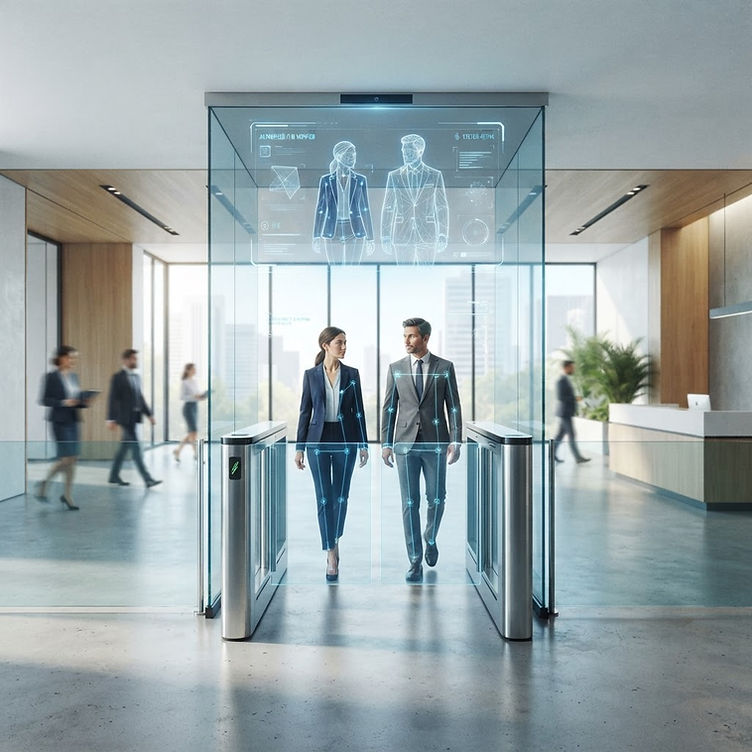
To understand why standard optical turnstiles are vulnerable, it is necessary to understand what they actually detect. The dominant commercial design uses arrays of infrared or visible-light beams projected horizontally across the passageway at various heights. These beams create a detection curtain. When the curtain is interrupted in the pattern associated with a single human body passing through, the system logs a passage event. If a second interruption occurs before the barrier resets, or if the system detects a pattern inconsistent with one person, it triggers an alarm or physically closes the barrier.
The weakness in this architecture is structural. Beam arrays measure interruption events in two dimensions. They detect the presence of mass in a defined corridor but have limited capacity to resolve the spatial relationship between two bodies moving in close physical proximity, particularly when those bodies are aligned along the axis of travel. A person of average build following closely behind a credential holder, slightly offset and synchronized to the precise timing window of the barrier reset cycle, can produce a beam-interruption signature that the system's detection logic interprets as a single passage. The system does not malfunction. It performs exactly as designed. The design, however, was not built to model three-dimensional human geometry under adversarial conditions.
This limitation has been documented in the technical literature for several years. Research underlying multiple recent patent filings for advanced anti-tailgating systems, including applications published through 2025 and 2026 in the United States Patent and Trademark Office database, describes the two-dimensional beam array as a known and exploitable constraint, with inventors specifically citing the need for stereoscopic depth sensing and spatial body-volume analytics to resolve the detection gap. The patent record amounts to a contemporaneous technical acknowledgment that the installed base of optical turnstiles contains a documented architectural flaw.
The Shift to Machine-Calculated Exploits
The behavioral evolution of tailgating from social opportunism to technical calculation has proceeded in parallel with the broader digitization of physical security systems. As access control manufacturers published detailed system specifications and as building automation protocols became more standardized, the information required to model turnstile detection behavior became more accessible. The timing parameters, barrier reset intervals, and beam array geometries of commercially dominant systems are documented in installation manuals, third-party integration guides, and, in some cases, academic papers on pedestrian flow management.
An adversary with sufficient technical motivation can derive from these sources a reasonably accurate model of how a specific turnstile system processes passage events, and can then calculate the movement profile that minimizes detection probability. This calculation does not require sophisticated equipment. It requires time, analytical patience, and access to publicly available documentation. The movement profiles that result, characterized by precise inter-body spacing, specific lateral offsets, and entry timing synchronized to barrier reset intervals, are what security researchers have begun describing as machine-calculated tailgating exploits.
The Security Industry Association, through its access control benchmarking work, has tracked growing industry awareness of this category of threat. SIA's research and standards development activities reflect a consensus among access control manufacturers and integrators that the detection architectures deployed in most commercial buildings were designed to address the social tailgating model and have not been systematically upgraded to address the technical exploitation model. The implication for building owners is direct: the turnstile installation that appeared adequate when it was specified may be operating against a threat environment that has materially changed since the procurement decision was made.
ASIS International, through its Physical Security Council and related standards development work, has similarly emphasized that access control system design must account for adversarial adaptation over the operational life of installed equipment. The ASIS framework for physical security assessment includes explicit provisions for threat modeling that incorporates the evolution of attack methods, a principle that applies with particular force to entry control systems deployed at high-value targets.
Physical Breach as Network Compromise Vector
The stakes attached to this problem extend well beyond the physical security domain. Corporate data breach forensic investigations conducted by major incident response firms have identified unauthorized physical access, including tailgating through access-controlled entry points, as an initial compromise vector in a meaningful share of enterprise network intrusions. The pattern is consistent: an adversary who gains physical access to a data center floor, a network operations room, or an office containing unattended authenticated workstations acquires options for network compromise that no amount of perimeter cybersecurity investment can address.
This connection between physical access control failure and downstream cyber incident is reflected in the evolving regulatory environment. The Cybersecurity and Infrastructure Security Agency has issued guidance treating physical security controls as a component of overall cyber risk management, and the NIST Cybersecurity Framework explicitly recognizes physical access control as an element of the Protect function. Organizations that treat physical access control as a facilities management matter, separate from their information security program, are operating with a governance model that their own regulatory frameworks have already superseded.
OSHA's general duty clause, codified at 29 U.S.C. § 654(a)(1), requires employers to provide a workplace free from recognized hazards that are causing or likely to cause death or serious physical harm. Enforcement actions under this provision have addressed scenarios in which inadequate access control contributed to workplace violence incidents involving unauthorized intruders. While OSHA's primary focus in such cases is employee safety, the enforcement record demonstrates that regulators view physical access control as a component of the employer's duty of care, not a discretionary facility upgrade. Organizations that can document an awareness of the tailgating vulnerability in their installed systems and have taken no corrective action face meaningful compliance exposure if an incident occurs.
The Technical Case for Stereoscopic 3D Sensing
The detection architecture that the security engineering community has converged on as the appropriate response to machine-calculated tailgating exploits centers on stereoscopic three-dimensional sensing combined with AI-driven spatial analytics. The core principle is straightforward: where beam arrays measure interruptions in a two-dimensional plane, stereoscopic sensor pairs generate a continuous depth map of the passageway, allowing the system to construct a three-dimensional volumetric model of what is present within the detection zone at any moment.
With a depth map available, the detection logic can be applied to spatial body volume rather than beam interruption patterns. Two human bodies occupying a detection zone simultaneously produce a volumetric signature that is geometrically distinct from one human body, regardless of their relative positioning or the degree of physical proximity. The synchronized movement profile that defeats a beam array produces no advantage against a system performing real-time volumetric analysis, because the depth map resolves the spatial relationship between the two bodies independently of their alignment along the axis of travel.
The AI component of this architecture performs the real-time classification work. Machine learning models trained on large datasets of pedestrian passage events can distinguish single-occupant passages from two-person passages with high accuracy across a wide range of body types, movement speeds, and entry angles. These models can also flag anomalous passage patterns for human review, providing a supervisory layer that supports security personnel without requiring them to monitor detection feeds continuously. The combination of stereoscopic depth sensing and trained classification models represents a detection capability that is materially superior to the beam array architecture in both sensitivity and specificity.
Several manufacturers have brought systems incorporating these principles to market, and the patent filings referenced earlier document ongoing engineering investment in multi-sensor fusion approaches that combine stereoscopic imaging with additional modalities including radar and thermal sensing. The direction of development in the access control industry is clear. The question facing corporate security leadership is the timing and scope of adoption.
What Leadership Must Confront
The counterargument that security committees typically raise against accelerated investment in detection upgrades is the cost-benefit ratio. Optical turnstiles represent a substantial prior capital commitment. Replacement or supplementation with stereoscopic sensing systems requires additional expenditure, integration work, and in many cases modifications to the physical passageway infrastructure. The installed system has been functioning without a documented incident. The threat, while technically described, remains somewhat abstract.
This reasoning deserves a direct response. The absence of a documented incident is not evidence that the installed system has been performing adequately. It may simply reflect that the building has not yet attracted an adversary with the technical sophistication and motivation to execute a machine-calculated exploit. The population of potential adversaries in that category is larger than it was five years ago and will be larger still in five more. The cost of a single successful physical intrusion that enables a network compromise at an enterprise target routinely exceeds the cost of the detection upgrade by orders of magnitude, once investigation, remediation, regulatory response, and reputational damage are accounted for.
More fundamentally, security leadership cannot assess the adequacy of a detection system by reference to the incident history produced by that system. A system that fails to detect unauthorized entries will not generate incident records of unauthorized entries. The appropriate assessment method is technical: red-team testing of the installed system against the exploitation techniques documented in the research literature, conducted by qualified physical security professionals, with findings reported directly to executive leadership and the board's risk or audit committee.
ASIS International's Physical Security Professional standards and SIA's benchmarking work both support this conclusion. The professional consensus in the access control field is that periodic adversarial testing of entry control systems is a component of responsible security program management, not an optional enhancement. Organizations that have not subjected their installed turnstile systems to structured red-team assessment since initial installation are operating with a significant blind spot.
Recommendations for Corporate Security Leadership
The path forward for organizations concerned about this threat has several identifiable components. First, a technical audit of installed optical turnstile systems should be commissioned, with specific attention to the beam array architecture, timing parameters, and detection logic of deployed equipment. This audit should be conducted by qualified physical security engineers with access control specialization, and its scope should include adversarial testing against the synchronized movement profiles documented in the research literature.
Second, organizations should engage with their access control vendors and integrators regarding upgrade pathways to stereoscopic depth sensing and AI spatial analytics. Many manufacturers offer retrofit sensor packages that can supplement existing turnstile infrastructure without requiring full equipment replacement. The economics of supplementation are generally more favorable than full replacement, and the detection improvement is substantial.
Third, the physical access control program should be formally integrated with the organization's information security risk management framework. This integration should be reflected in governance documents, reported through a unified risk committee structure, and included in the scope of any third-party security assessments or audits the organization undergoes. The separation of physical and cyber security into distinct organizational silos is an administrative convenience that the threat environment no longer supports.
Finally, OSHA compliance reviews should explicitly address the general duty clause obligations associated with unauthorized intruder risk, and legal counsel should assess the organization's exposure in the event that a known access control vulnerability contributes to a workplace safety incident. Documented awareness of a technical vulnerability, combined with documented inaction, is a difficult position to defend in any subsequent enforcement proceeding or civil litigation.
The organizations that have already moved toward AI-augmented physical access control are not doing so because they have experienced breaches. They are doing so because their security leadership has assessed the technical threat environment accurately and has acted on that assessment before an incident forced the question. That sequence, assessment followed by investment followed by validation, is the correct order of operations. The alternative is to discover the ghost in the server only after it has already moved through the building.
For organizations seeking a professional assessment of their physical access control posture, USPA Nationwide Security provides specialized consultation and on-site security services across the United States. Contact our team at (800) 214-1448 to schedule a consultation.
Related Reading
Sources
- Security Industry Association — Access Control Research and Benchmarking
- ASIS International — Physical Security Council Standards and Briefings
- Cybersecurity and Infrastructure Security Agency — Physical Security Guidance
- NIST Cybersecurity Framework — Protect Function, Physical Access Control
- OSHA General Duty Clause, 29 U.S.C. § 654(a)(1)
Questions about fire watch, executive protection or guard coverage for your property? Request a quote or call our dispatch line.
More from the blog

Breaking News
Fire Crews Battle Vacant Apartment Building Fire in Kansas City's Wabash Block
Kansas City fire crews responded Sunday morning to a reported apartment building fire in the 2800 block of Wabash, where they encountered smoke and fire coming from a vacant two-story structure. Interior operations were conducted, searches came back all clear, and no injuries were reported. The cause remains under investigation.


Breaking News
Lithium-Ion Battery Fire Displaces Residents at Spokane's Donna Hanson Haven Apartment Building
A lithium-ion battery from an electric bicycle caused a fire on the third floor of Donna Hanson Haven in downtown Spokane on Saturday, October 25, 2026. The Spokane Fire Department evacuated all residents; Catholic Charities Eastern Washington coordinated decontamination, and most tenants returned home the same evening. Seventeen third-floor residents remain displaced with Red Cross support.


Breaking News
Pennsauken, NJ Apartment Building Evacuated After 3-Alarm Fire at Cooper River Apartments
A 3-alarm fire at the Cooper River Apartments on McClellan Avenue in Pennsauken, New Jersey forced the evacuation of roughly 40 residents early Monday morning. One woman jumped from the fifth floor before fire crews arrived and was transported to a local hospital. The cause of the fire has not been released.
