
When the Water Comes In, the Gates Stay Shut
October 23, 2026· Dan Manning
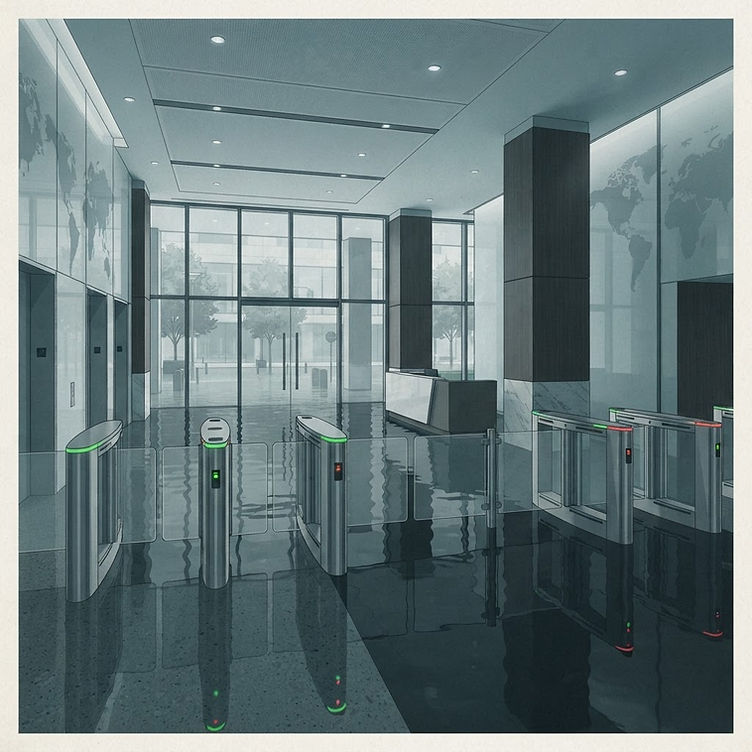
The Security System That Drowns First
In the aftermath of several severe urban flash-flooding events that paralyzed commercial business districts in 2025 and into mid-2026, a pattern emerged that property risk managers and security directors have been slow to name plainly. Electronic access control panels short-circuited. Perimeter gates that were rated for forced intrusion became impassable barriers trapping employees inside ground-floor suites. Stairwell pressurization systems, designed to hold smoke at bay during a fire, malfunctioned when mechanical rooms flooded. In each instance, the physical security infrastructure did exactly what its designers intended. The problem is that it was never designed for this.
The central thesis of this essay is straightforward and uncomfortable: flood mitigation is a critical asset protection failure when floodwaters bypass corporate security gates, short-circuit electronic access controls, and trap occupants. The physical security industry and the commercial real estate sector have spent decades refining protection against human-generated threats. They have built layered perimeters, invested in sophisticated credential management, and rehearsed active-threat response protocols. What they have largely neglected is the possibility that their own security infrastructure becomes a liability the moment groundwater rises past a threshold that was never part of the threat model.
This is an argument about systems failure, institutional complacency, and the professional obligation of everyone responsible for the physical safety of a commercial building to reckon with a category of risk that is now too frequent and too costly to treat as exceptional.
What the Standards Already Require (And Why Compliance Alone Falls Short)
ASCE 24-14, the American Society of Civil Engineers' standard for flood-resistant design and construction, provides the foundational engineering framework for buildings in flood hazard areas. It establishes minimum elevation requirements, specifies materials and methods for below-flood-level construction, and addresses the structural performance demands placed on buildings by hydrostatic and hydrodynamic loads. The standard is not new; its lineage extends through multiple ASCE revision cycles, and FEMA has long referenced it in National Flood Insurance Program technical guidance.
FEMA's flood zone directives, updated in 2026 to reflect revised flood-hazard mapping and updated base flood elevation determinations across numerous metropolitan areas, have expanded the universe of properties now formally classified within Special Flood Hazard Areas. That reclassification has direct consequences for property insurance, mortgage lending, and code compliance obligations. It also has consequences that most building owners have not yet internalized: a property newly placed in a regulated flood zone carries a legal and fiduciary expectation that its systems, including its security systems, function within the anticipated flood environment.
The difficulty is that ASCE 24-14 addresses structural and architectural resilience. It governs concrete, masonry, wood framing, and the placement of utilities. It does not govern electronic access control infrastructure, video surveillance systems, intercom arrays, or the behavioral and procedural dimensions of evacuation. Those domains fall to a different set of standards and a different set of professionals, and historically the two communities have rarely worked in the same room at the design stage.
The result is a compliance gap that functions as a systemic vulnerability. A building can satisfy every requirement of ASCE 24-14 and still deploy an access control architecture that will fail catastrophically in a flood event. Magnetic lock assemblies mounted below the anticipated flood elevation will short. Battery backup systems housed in basement electrical rooms will be submerged before they are needed. The card readers on exterior perimeter gates will lose power and default to a locked or unlocked state depending on their fail-safe configuration, a configuration typically chosen for security reasons rather than life-safety reasons, which means occupant egress in a flooding event may be compromised by a design decision made years earlier by someone who was thinking about unauthorized access, not rising water.
The Electronic Access Control Vulnerability in Detail
Fail-safe versus fail-secure is a distinction that access control engineers understand well. A fail-safe lock releases when power is lost, ensuring egress is always available. A fail-secure lock remains locked when power is lost, ensuring that an unauthorized person cannot enter a space simply by cutting the power. In most commercial applications, the choice between these configurations is made on a door-by-door basis according to the threat being managed: perimeter doors in financial facilities tend toward fail-secure; stairwell doors required to serve as exit routes tend toward fail-safe to comply with life-safety codes.
What the threat model rarely accounts for is the scenario in which power is lost simultaneously across an entire floor or building as a consequence of flooding, while occupants need to move through multiple door types in sequence to reach safety. A fail-secure perimeter gate that was chosen to deter unauthorized nighttime entry will hold an employee inside a flooding lobby with the same mechanical indifference it would show to an intruder. The lock does not know the difference between an intrusion attempt and an evacuation.
This is a documented category of failure. NFPA 3000, the Standard for an Active Shooter/Hostile Event Response Program, addresses mass evacuation dynamics in compounding crisis scenarios. While its primary focus is on intentional hostile events, its treatment of multi-modal emergencies, including cascading infrastructure failures during high-occupancy evacuation events, is analytically relevant. The standard's framework for unified command, pre-event planning, and real-time occupant accountability translates directly to scenarios in which a flooding event generates the same density of simultaneous evacuation demand as a hostile event. In both cases, the failure of a single chokepoint in the egress path, whether a jammed turnstile, a shorted magnetic lock, or a flooded stairwell, has multiplier effects on the outcome.
Property security directors and life-safety engineers need to approach extreme weather evacuation using the same systems-thinking methodology that NFPA 3000 applies to hostile events: map every chokepoint, assign accountability for every chokepoint, rehearse failure modes, and design redundancy into the path.
The Legal Landscape Is Clarifying Quickly
Litigation arising from commercial tenant losses in lower Manhattan flood events has begun to establish a body of case law that should concentrate the attention of commercial landlords and their insurers. Without attributing specific outcomes to specific cases that cannot be independently verified at the time of this writing, the general contours of the emerging legal theory are observable: plaintiffs have argued that landlords with notice of flood risk, whether through FEMA zone classification, prior flood history, or published engineering assessments, bear a duty of care that extends to the security and egress functionality of their buildings during foreseeable flood events. The argument is that flood risk, once formally documented, becomes part of the duty of reasonable care owed to tenants and their employees.
This legal theory has significant implications for how commercial property owners should document their risk assessments, how they should commission and retain engineering evaluations, and how they should structure their leases and their communication obligations to tenants. A landlord who received updated FEMA flood zone classification in 2026 and took no action to evaluate whether their access control systems would function in the newly mapped environment will have a difficult argument that the resulting losses were unforeseeable.
The Allianz Global Risk Barometer, which surveys risk managers across industries on an annual basis, has consistently ranked climate-related physical damage among the leading concerns for commercial enterprises. In recent barometer cycles, the intersection of climate risk and business interruption risk has emerged as a compound exposure that risk managers find particularly difficult to model and price. The relevance to physical security infrastructure is direct: a flood event that disables access controls, creates egress failures, and triggers business interruption claims simultaneously represents a category of loss that was historically treated as three separate insured events. The market is moving toward treating it as one integrated failure, which is analytically correct and which has significant implications for how security and resilience investments are capitalized and justified.
What an Integrated Security-Resilience Framework Looks Like
The professional response to this challenge requires an organizational posture that treats physical security design and climate resilience planning as co-dependent disciplines rather than parallel specialties that occasionally share a drawing set.
At the design and specification stage, every electronic security component should carry a documented flood elevation rating or a documented justification for why it is placed above the anticipated flood elevation. Access control panels, power supplies, battery backup systems, intercom hubs, and video recording infrastructure should be subject to the same elevation discipline that ASCE 24-14 applies to mechanical, electrical, and plumbing equipment. The fail-safe versus fail-secure configuration of every door on the egress path should be reviewed against the flooding scenario, with life-safety precedence given to fail-safe configurations on any door that a reasonable person might need to traverse during a flood evacuation.
At the operational and procedural stage, building security programs should incorporate a flood-specific emergency response procedure that is integrated with, rather than appended to, the general life-safety plan. This means pre-designating elevated assembly areas, establishing protocols for the manual release of access-controlled doors when electronic systems fail, and ensuring that the building's security personnel understand that their role during a flooding event includes active facilitation of egress rather than perimeter enforcement. Security officers stationed at a building during a flood event need clear authority and clear instructions to override normal access control protocols in the interest of occupant safety.
At the governance and documentation stage, commercial landlords should commission periodic flood resilience audits of their security infrastructure. These audits should be performed by professionals who hold competency in both physical security systems and flood hazard engineering, a combination that is presently rare but that the market will need to develop. The audit findings should be formally retained, acted upon with documented timelines, and communicated to tenants in a manner that satisfies the emerging duty-of-care standard that the litigation environment is establishing.
Insurance carriers and risk managers should be engaged in this process proactively. The Allianz risk data, among other industry sources, indicates that compound climate-security losses are becoming more predictable, which means they are becoming more insurable when properly documented and more difficult to recover when they are not.
The Role of Trained Security Personnel in a Flood Event
Physical infrastructure decisions, however well-made, do not operate themselves. In the scenario this essay has been examining, the human element of a building's security program is as important as any hardware specification. A trained security officer who understands flood response procedures, who knows where manual overrides are located, who has authority to act without waiting for a supervisor to answer a phone, and who has rehearsed egress facilitation in a tabletop exercise will perform differently from one who has been trained exclusively in access control enforcement and active-threat response.
This is an argument for security workforce development that explicitly incorporates climate emergency scenarios. It is also an argument for the value of having professional security staff on-site during elevated weather threat periods, which flash flood watches and warnings provide advance notice of in most circumstances. The combination of a pre-event staffing decision and a trained response capability represents a manageable operational investment relative to the liability and human cost of an egress failure during a flood.
Commercial landlords who deploy contract security services should require, in their service agreements, that the security provider can demonstrate flood emergency response training and can supply personnel who have been briefed on the specific building's flood-response procedures. That requirement should be written into the contract, documented in training records, and reviewed annually.
A Professional Obligation That the Industry Has Not Yet Claimed
The physical security industry has demonstrated, over decades, a capacity to adapt its frameworks to new categories of threat. The evolution from perimeter-only thinking to layered defense to integrated risk management is a professional accomplishment. The industry's engagement with active-threat response, workplace violence prevention, and cyber-physical convergence reflects genuine intellectual seriousness about a changing threat environment.
Climate-driven extreme weather has presented a challenge that the industry has addressed primarily at the margins, through flood sensors added to alarm systems, through generator specifications for backup power, through the occasional elevator shutdown protocol. What has been slower to develop is a coherent professional doctrine that treats flooding as a security scenario with its own threat model, its own failure modes, and its own training and design requirements.
FEMA's 2026 flood zone revisions, the litigation developing around commercial tenant losses, the engineering requirements embedded in ASCE 24-14, and the risk data compiled in barometers like Allianz's are collectively creating the conditions under which that doctrine will either be developed proactively by the profession or imposed reactively through regulation, litigation, and loss. The responsible path is proactive development, and it requires security professionals, facilities engineers, risk managers, and commercial landlords to engage with one another in a sustained and technically serious way that, in most organizations, has not yet happened.
The water is not waiting for that conversation to conclude.
Related Reading
Questions about fire watch, executive protection or guard coverage for your property? Request a quote or call our dispatch line.
More from the blog

Breaking News
Fire Crews Battle Vacant Apartment Building Fire in Kansas City's Wabash Block
Kansas City fire crews responded Sunday morning to a reported apartment building fire in the 2800 block of Wabash, where they encountered smoke and fire coming from a vacant two-story structure. Interior operations were conducted, searches came back all clear, and no injuries were reported. The cause remains under investigation.


Breaking News
Lithium-Ion Battery Fire Displaces Residents at Spokane's Donna Hanson Haven Apartment Building
A lithium-ion battery from an electric bicycle caused a fire on the third floor of Donna Hanson Haven in downtown Spokane on Saturday, October 25, 2026. The Spokane Fire Department evacuated all residents; Catholic Charities Eastern Washington coordinated decontamination, and most tenants returned home the same evening. Seventeen third-floor residents remain displaced with Red Cross support.

Breaking News
Pennsauken, NJ Apartment Building Evacuated After 3-Alarm Fire at Cooper River Apartments
A 3-alarm fire at the Cooper River Apartments on McClellan Avenue in Pennsauken, New Jersey forced the evacuation of roughly 40 residents early Monday morning. One woman jumped from the fifth floor before fire crews arrived and was transported to a local hospital. The cause of the fire has not been released.