
Buildings Are Storing Hazardous Materials. Most Managers Don't Know It.
October 8, 2026· Dan Manning
The Signal in NFPA's Unprecedented Decision
When the National Fire Protection Association designated its 2026 Fire Prevention Week theme as Charge Into Fire Safety: Safe Charging Is a Superpower—the second consecutive year centering the campaign on micro-mobility devices and battery hazards—the repetition itself carried a message. Awareness campaigns do not repeat themes absent evidence that the underlying problem is accelerating rather than resolving. The evidence, in this case, is unambiguous and its trajectory is steep.
According to Consumer Product Safety Commission data cited in the source material for this piece, micro-mobility battery fire deaths climbed from 5 in 2017 to 135 in 2024. Emergency room visits attributable to those fires surged from 37,300 to 149,100 over the same interval. The FDNY reported a 53% year-over-year surge in structural fires caused by lithium-ion battery failures entering 2025 and 2026. These are not fluctuations within a stable trend. They describe a compounding hazard growing faster than the regulatory and behavioral infrastructure built to contain it.
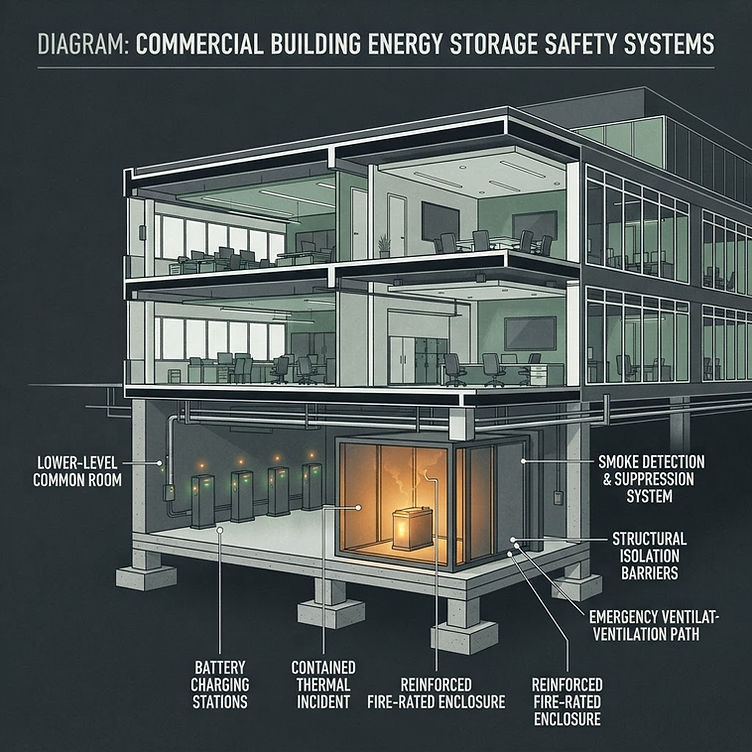
Commercial property managers—owners, operators, and asset managers of multifamily residential, mixed-use, and commercial buildings—are sitting at the intersection of this hazard. Their buildings now routinely house dozens or hundreds of lithium-ion devices: e-bikes, e-scooters, electric delivery vehicles, battery backup systems, and the consumer electronics carried by every occupant. Most of those devices are charged overnight in corridors, storage rooms, parking structures, and residential units without any systematic gatekeeping. The thesis of this commentary is direct: the accumulation of unmanaged lithium-ion battery arrays inside occupied structures constitutes storage of hazardous materials, and the management framework currently applied to that hazard—principally, consumer education—is structurally insufficient once ignition occurs.
The Physics of Thermal Runaway Defeats Conventional Response
Understanding why this hazard is categorically different from conventional fire risk requires engaging the physics, not the marketing language of battery safety awareness.
A lithium-ion cell is an electrochemical system under pressure. When an internal short circuit occurs—through physical damage, electrical overcharge, or manufacturing defect—the cell enters thermal runaway: a self-sustaining exothermic cascade in which heat accelerates the chemical reaction, which produces more heat, which accelerates the reaction further. FAA Fire Safety Branch testing has established that a single cell in thermal runaway exceeds 1,100°F (593°C) almost instantaneously, a temperature sufficient to ignite virtually any surrounding material without a sustained ignition source. A pack of cells experiencing sequential runaway—each cell thermally triggering its neighbor—releases energy at a rate that overwhelms the response time of any building evacuation or suppression system calibrated for conventional fires.
The Fire Protection Research Foundation has confirmed a finding that building managers and fire marshals must internalize: water-based sprinkler systems cannot extinguish an internal cell short circuit. Sprinklers cool the external air temperature and suppress secondary combustion in surrounding materials, but they cannot interrupt the electrochemical cascade occurring inside the cell. A sprinkler activation buys time and limits spread; it does not extinguish the initiating battery fire. This means that buildings relying solely on compliant sprinkler installations are relying on a system that addresses the consequences of a lithium-ion fire rather than the fire itself. That is not a deficiency in sprinkler design—sprinklers were not engineered for this hazard class—but it is a deficiency in the assumption that code-compliant construction is sufficient.
Lithium metal itself is classified under UN 1415 as a highly reactive hazardous material. The loose, unassembled 18650 cylindrical cells that appear widely in consumer modification markets carry particular risk: major original equipment manufacturers including Panasonic, Samsung, and LG have expressly disavowed and banned distribution of loose, unassembled 18650 cells to consumer markets, precisely because those cells lack the battery management systems, thermal fusing, and pack-level safety controls that make commercial battery assemblies marginally safer. A property storing large numbers of e-bikes charged with third-party cables, or residential units where occupants have assembled or modified battery packs, is storing materials that their original manufacturers have determined should not exist in that form.
Over 50% of CPSC deep-dive investigations have traced root cause to electrical overcharge or incompatible third-party charging cables. This finding deserves emphasis: the majority of the problem is not defective manufacturing in certified products. It is the interaction between certified cells and non-certified charging infrastructure, a condition that property managers can influence through policy and physical plant design but currently, in most cases, do not.
The Liability Landscape Has Materialized
For some years, the legal risk associated with lithium-ion battery fires in commercial buildings remained largely theoretical—a recognized hazard with limited case law and unclear lines of responsibility. That period has closed.
The $31 million settlement in Roll-Off Systems v. SKBA (2024) followed a structural fire traceable to lax corporate battery disposal practices. The case established that institutional actors bear financial accountability when they fail to implement reasonable hazardous material controls for battery systems. LG Chem Ltd. v. Superior Court, 80 Cal. App. 5th 348 (2022), held that single-cell 18650 power cells are commercial items unfit for casual loose consumer use, a finding that reverberates through any building management policy permitting uncontrolled use of such cells on the premises. The consolidated In re New York City Lithium-Ion Battery Litigation has brought landlords into litigation over tenant-initiated fires on implied warranty of habitability grounds—a theory that, if it develops, would make building owners defendants in fires they did not cause and cannot directly supervise. State Farm v. Amazon.com Inc. in the Southern District of New York is currently evaluating logistics chain accountability for defective lithium-ion products, a proceeding whose outcome will further define the reach of commercial liability.
The directional reading of this case law is clear without overstating any individual outcome: courts are moving toward distributed accountability across the chain of custody of battery products, and commercial property managers occupy a significant node in that chain. A manager who has adopted no policy, installed no compliant charging infrastructure, and documented no hazard assessment occupies a worse legal position than one who has done all three—regardless of how any specific litigation ultimately resolves.
The Standards Architecture Managers Must Understand
A credible response to this hazard class is not invented from first principles. A body of standards and regulatory requirements already defines what adequate control looks like; the problem is that most commercial property management practice has not yet integrated them.
NFPA 855 governs stationary energy storage systems with requirements covering separation distances, thermal management, ventilation barriers, and suppression design. Buildings deploying battery backup systems or EV charging arrays at scale need engineered compliance with NFPA 855, not ad hoc installation. UL 2849 is the certification standard for e-bike electrical systems and is widely regarded as the foundational certification for distinguishing compliant micro-mobility devices from uncontrolled risk. New York City's Local Law 39 operationalizes this by prohibiting the sale, lease, or rental of e-mobility devices and batteries that fail UL 2849 or UL 2272—a regulatory posture other municipalities are watching closely.
IFC Section 1207 requires fire-resistance rated construction barriers and continuous gas detection for battery storage installations of meaningful scale. NFPA 1 Fire Code Chapter 52 mandates operational permits to house, charge, or service industrial battery arrays. Chicago's municipal code prohibits e-mobility storage or charging in primary egress paths and stairwells—a practical restriction that many residential buildings are currently violating without awareness. The OSHA Safety and Health Information Bulletin on workplace lithium-ion fire and explosion hazards applies to any building with commercial occupancy or maintenance staff managing battery-dependent equipment.
The Society of Fire Protection Engineers' Engineering Guide addresses coupled risks in high-density multi-tenant structures specifically: the convergence of high occupant density, obstructed egress, and thermally energetic hazards creates risk profiles that standard residential or commercial fire engineering assumptions do not fully capture. Property managers with large multifamily portfolios should be aware that the SFPE guidance exists and that a fire protection engineer reviewing a building against it will apply a different analytical lens than a standard code inspection.
FM Global Data Sheet 5-32 is perhaps the most practically consequential document for asset managers focused on the near term: FM Global's underwriting guidance increasingly restricts coverage or raises premiums for insured properties that have not implemented thermal runaway mitigation. The insurance industry, operating on actuarial data rather than advocacy, has reached its own conclusions about the risk trajectory. The October 2026 EPRI report places stationary energy storage failure rates at 0.04% to 0.14%—comparable to oil-filled transformers—which provides a baseline risk quantification that underwriters are already incorporating into coverage terms.
What 'Consumer Education' Cannot Accomplish
The persistent policy response to lithium-ion battery fire risk has been consumer and occupant education: post a sign, issue a newsletter, remind residents to use original chargers. This response is not worthless, but it addresses a minority of the causal pathway and none of the fire dynamics once ignition occurs.
Consumer education cannot control the behavior of every occupant across every charging event in a building with hundreds of units. It cannot prevent a third-party cable from being purchased online and used in a unit the manager will never inspect. It cannot interrupt thermal runaway once it begins. It cannot satisfy an underwriter reviewing FM Global 5-32 compliance. It cannot document the hazard assessment that a litigation defense will require. And it cannot substitute for the physical plant interventions—smart charging hubs, code-compliant storage rooms, gas detection, separation barriers—that actually change the risk profile of the building.
The counterargument worth taking seriously is that regulatory overreach or cost burden could make building management impractical, particularly for smaller operators. That concern is legitimate at the margin. Standards like NFPA 855 and IFC 1207 carry implementation costs, and not every building presents an identical risk profile. A single-family rental with one occupant and no shared storage is different from a 200-unit multifamily building with a ground-floor bicycle room. Proportionality is appropriate. The error is applying a proportional response calibrated for low-density, low-volume battery use to a building where dozens of e-bikes are charged nightly in a common room twenty feet from a primary stairwell. The operational footprint of lithium-ion batteries in commercial buildings has grown; the management response has not kept pace.
The Operational Playbook
What does adequate response look like in practice? The following elements represent a defensible baseline for commercial property managers with significant battery hazard exposure.
First, a documented hazard inventory. Managers should know, with reasonable accuracy, what battery-dependent devices are being stored and charged in their buildings, where they are located, and under what charging conditions. This is not surveillance; it is the same due diligence applied to any hazardous material present in a commercial building.
Second, designated and engineered charging infrastructure. Smart charging hubs with thermal monitoring, automatic shutoff, and fire-resistance rated enclosures are commercially available and increasingly affordable at scale. Where e-bikes or e-scooters are permitted on the premises, they should be charged in designated areas built to the relevant IFC and NFPA standards, not in corridors, stairwells, or units.
Third, a device certification policy. Adopting a policy that micro-mobility devices charged on the premises must carry UL 2849 or equivalent certification is a defensible, legally coherent position. It is also the position that jurisdictions including New York City have already taken legislatively. Implementing it before legislation compels it is both operationally sensible and useful documentation in any subsequent liability proceeding.
Fourth, fire watch protocol for high-risk intervals. During construction, renovation, or any period when the normal detection, suppression, and egress infrastructure is compromised, a trained fire watch presence calibrated to battery fire hazards is materially different from a standard fire watch. Personnel need to understand the failure modes—smoke with unusual chemical odor, rapid heat escalation, the irrelevance of conventional suppression to an active cell runaway—and know when evacuation supersedes suppression attempts.
Fifth, insurance alignment. FM Global 5-32 compliance and its equivalents from other major underwriters should be reviewed against the building's current physical plant and policy. Coverage restrictions or premium increases triggered by non-compliance are not an abstract future risk; for properties with significant battery storage, they are an active underwriting question in the current renewal cycle.
Fire Prevention Week 2026 will generate a predictable volume of public awareness content. The useful signal in the NFPA's decision to repeat this theme is not that consumers need more reminders. It is that the hazard has grown faster than the institutional response, and that the institutions with the most leverage to change the risk profile—commercial building owners and managers—have not yet been reached by the urgency the data describes. The physics of thermal runaway does not respond to awareness. The liability trajectory does not pause for the next code cycle. The operational adjustments required are known, available, and increasingly mandated. The window for voluntary adoption ahead of regulatory and judicial compulsion is narrowing.
USPA Nationwide Security provides fire watch services for commercial properties, construction sites, and multi-tenant buildings where detection or suppression systems are temporarily impaired or where hazard profiles require continuous trained presence. For a consultation on fire watch coverage, contact USPA at (800) 214-1448 or visit the fire watch services page.
Related Reading
Sources
- U.S. Consumer Product Safety Commission — micro-mobility fire death and injury data
- NFPA Fire Prevention Week 2026 — Charge Into Fire Safety
- FAA Fire Safety Branch — lithium-ion thermal runaway testing
- EPRI — October 2026 stationary energy storage failure rate report
- OSHA Safety and Health Information Bulletin — Workplace Lithium-Ion Battery Hazards
- FM Global Data Sheet 5-32 — Electrical Energy Storage Systems underwriting guidance
Questions about fire watch, executive protection or guard coverage for your property? Request a quote or call our dispatch line.
More from the blog

Breaking News
Fire Crews Battle Vacant Apartment Building Fire in Kansas City's Wabash Block
Kansas City fire crews responded Sunday morning to a reported apartment building fire in the 2800 block of Wabash, where they encountered smoke and fire coming from a vacant two-story structure. Interior operations were conducted, searches came back all clear, and no injuries were reported. The cause remains under investigation.


Breaking News
Lithium-Ion Battery Fire Displaces Residents at Spokane's Donna Hanson Haven Apartment Building
A lithium-ion battery from an electric bicycle caused a fire on the third floor of Donna Hanson Haven in downtown Spokane on Saturday, October 25, 2026. The Spokane Fire Department evacuated all residents; Catholic Charities Eastern Washington coordinated decontamination, and most tenants returned home the same evening. Seventeen third-floor residents remain displaced with Red Cross support.


Breaking News
Pennsauken, NJ Apartment Building Evacuated After 3-Alarm Fire at Cooper River Apartments
A 3-alarm fire at the Cooper River Apartments on McClellan Avenue in Pennsauken, New Jersey forced the evacuation of roughly 40 residents early Monday morning. One woman jumped from the fifth floor before fire crews arrived and was transported to a local hospital. The cause of the fire has not been released.
