
Mass EV Fleet Charging Depots Are the Next Catastrophic Fire Grid Risk
October 22, 2026· Brian Fitzgibbons
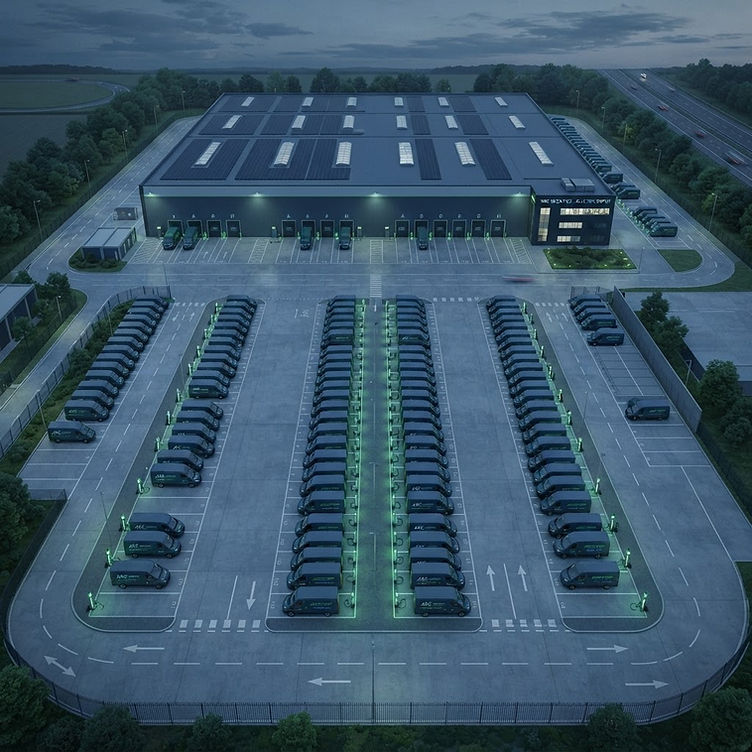
The Infrastructure Gap Nobody in Logistics Is Talking About
Across North America and Europe, corporate sustainability commitments and regulatory pressure are driving an accelerating rollout of electric commercial delivery vehicles. Amazon, FedEx, UPS, and their regional competitors have announced fleet electrification timelines anchored to 2025 through 2030 targets. The infrastructure being built to support those fleets, specifically the large-scale depot-level charging hubs where dozens or hundreds of vehicles park overnight and recharge simultaneously, is materializing at a pace that has outrun the fire protection engineering discipline's ability to establish consensus standards, update municipal water supply expectations, and educate site developers on what concentrated lithium-ion energy storage actually means at scale.
The central thesis of this piece is direct: placing one hundred commercial electric delivery vans in a shared charging depot, a configuration that logistics operators are now treating as routine, introduces a category of thermal hazard that exceeds the extinguishing capacity of most municipal water supply systems and the containment assumptions built into conventional warehouse or fleet garage construction. The fire protection community has known for years that lithium-ion thermal runaway presents unique suppression challenges. What it has been slower to articulate is the systemic multiplier effect that arises when you concentrate high-voltage, high-capacity battery packs in proximity, connect them to energized charging infrastructure, and surround them with structures engineered for vehicle storage rather than fire compartmentalization. Site developers who are pricing and permitting these facilities today largely do not appreciate what they are committing to.
What Thermal Runaway Looks Like at Fleet Scale
Lithium-ion thermal runaway is a well-documented phenomenon: an exothermic chemical reaction within a battery cell accelerates beyond the point of reversibility, releasing heat, flammable gases, and in many cases open flame and projectile material. In a single consumer electric vehicle, thermal runaway events are serious but spatially bounded. Emergency responders have adapted protocols accordingly, including extended cooling times and high-volume water application directed at the battery pack specifically.
A commercial electric delivery van carries a substantially larger battery pack than a passenger vehicle. Vehicles in the Class 3 to Class 6 commercial range, the segment most relevant to last-mile logistics, carry battery systems in the 100 to 200 kWh range, though specific capacities vary by manufacturer and model year. When one of these vehicles enters thermal runaway in an open yard, the suppression challenge is already significant. When the same event occurs in a charging depot where adjacent vehicles are physically close, sharing electrical infrastructure, and potentially in various states of charge, the hazard calculus changes dramatically.
The proximity factor is the critical variable. FM Global's Property Loss Prevention Data Sheet 5-33, which addresses fleet and vehicle storage facilities, emphasizes separation distances and drainage slope design as primary mitigation strategies for flammable liquid vehicle fires. The data sheet's underlying logic, that fire spread from vehicle to vehicle depends heavily on spacing and the behavior of burning fluids, translates imperfectly but instructively to EV fleet environments. Lithium-ion fires do not spread primarily through liquid pool fire dynamics; they spread through radiant heat transfer and the ignition of adjacent battery packs that have already been pre-heated by neighboring thermal runaway events. A vehicle that is fully charged and warm from recent operation is a higher-risk ignition candidate than one that is cool and partially discharged. In a depot where vehicles return from routes, plug in immediately, and sit in a charging state through the night, the thermal conditions for cascade propagation are at their most favorable.
NFPA 855, the Standard for the Installation of Stationary Energy Storage Systems, provides the most directly applicable technical framework for understanding the aggregate risk in these environments. NFPA 855 establishes maximum allowable energy quantities per fire compartment, separation distances between energy storage units, and suppression system requirements calibrated to the energy density involved. While NFPA 855 was developed primarily with fixed battery energy storage systems in mind, including grid-scale battery arrays and building-integrated storage, its underlying principles apply with equal force to any environment where large lithium-ion battery assemblies are concentrated in proximity. An installation of one hundred commercial EVs, each carrying 150 kWh of capacity, represents approximately 15,000 kWh of aggregate stored electrochemical energy in a single facility. That figure is within the range of utility-scale battery storage installations, and it carries comparable suppression implications.
The Water Supply Problem
Conventional fire suppression for large commercial structures relies on municipal water supply systems designed around historical occupancy types, primarily combustible goods warehousing, light manufacturing, and vehicle storage involving gasoline or diesel equipment. The Insurance Services Office and local fire codes establish water supply requirements in gallons per minute based on building size, construction type, and hazard classification. Those benchmarks were developed before the concept of a building containing 15,000 kWh of lithium-ion energy was operationally relevant.
The problem is compounded by the suppression behavior of lithium-ion battery fires. Standard sprinkler systems, even ESFR (Early Suppression Fast Response) systems designed for high-challenge warehouse occupancies, are not reliably effective at extinguishing lithium-ion thermal runaway. Water application can control the spread of fire and cool surrounding materials, but it does not suppress the electrochemical reaction occurring inside a compromised battery pack. Achieving meaningful cooling of an EV battery in thermal runaway requires sustained high-volume water application over extended periods, often measured in hours. Published guidance from fire departments that have responded to large EV fires, including guidance referenced in NFPA technical resources, suggests that water requirements for a single large-format EV battery fire can range from tens of thousands to hundreds of thousands of gallons depending on the vehicle type and suppression strategy employed.
Scale that requirement to a depot event involving cascading thermal runaway across multiple vehicles, and the implied water demand exceeds the sustained delivery capacity of municipal supply systems serving most industrial and logistics park locations. Many suburban and exurban logistics campuses, precisely the locations where large depot charging facilities are being sited due to land cost and access to freight corridors, are served by water distribution infrastructure designed for industrial light use. Flow testing data for specific sites would be required to establish actual available supply, but site developers are often not commissioning that analysis with the EV fleet fire scenario in mind.
The National Electrical Code Article 625, which governs electric vehicle charging system installations, addresses electrical safety requirements comprehensively, including grounding, circuit protection, and equipment listing. NEC 625 does not establish fire suppression or site planning standards; it operates within the electrical code's scope. The fire suppression gap is therefore not a failure of electrical code compliance. It is a consequence of the fact that fire codes, water supply standards, and site development practices have not yet converged around the specific hazard profile of high-density EV charging depots.
Compartmentalization as the Engineering Response
The technically sound response to the water supply constraint is to design the hazard around the available suppression capacity rather than expecting suppression capacity to grow to meet an uncontrolled hazard. That means compartmentalization: dividing the depot into discrete fire-rated enclosures, each containing a manageable number of vehicles with separation that limits radiant heat transfer between compartments, combined with drainage systems that prevent battery electrolyte and firefighting water from migrating between cells.
This is a structural engineering problem as much as a fire protection problem. Parking structures designed for conventional vehicles are not engineered for the thermal and load conditions associated with large-scale lithium-ion fire events. European fire safety research, including work published through the European Fire Safety Alliance, has examined structural failures in multi-level parking facilities during EV fire events and found that the thermal output of lithium-ion fires can compromise concrete structural elements more rapidly and severely than gasoline vehicle fires, partly due to the sustained nature of the thermal event and partly due to the chemical composition of gases released during thermal runaway. A multi-tier depot structure that experiences a cascading thermal runaway event involving multiple commercial EVs is at meaningful risk of partial structural collapse, a consequence that transforms a fire event into a recovery scenario measured in months rather than weeks.
Structural engineers designing depot facilities for EV fleets should be conducting thermal modeling specific to the battery types and vehicle configurations involved, rather than relying on load and fire resistance tables calibrated to conventional vehicle storage. The fire resistance ratings of structural concrete elements need to be evaluated against sustained heat flux values representative of lithium-ion events, which differ in duration and chemical character from hydrocarbon pool fires. This analysis is not yet routine in the design-bid-build process for logistics facilities, and it represents a material gap in current practice.
Regulatory and Liability Implications for Developers
Site developers and logistics operators building these facilities carry the liability exposure that follows from the gap described above. Property insurers, including FM Global and other industrial property carriers, are actively reassessing their underwriting criteria for EV charging installations. FM Global's data sheets and engineering guidance represent the state of insurer expectations; facilities that deviate materially from that guidance face coverage implications that developers should be pricing into project economics at the feasibility stage.
The regulatory environment is moving, though slowly relative to the deployment pace. NFPA 855 is under continuous revision cycle, and the technical committee work addressing vehicle-scale battery systems is ongoing. Local building and fire officials in jurisdictions with significant logistics development activity have begun requesting fire protection analyses specific to EV fleet charging scenarios as part of plan review, but this is inconsistent across jurisdictions and does not yet represent a uniform national standard. Developers who are building ahead of regulatory consolidation are making risk decisions that may look different under the regulatory framework that exists three to five years from now.
OSHA's General Duty Clause, which requires employers to maintain workplaces free from recognized serious hazards, is a plausible vector for enforcement action following a depot fire event that results in worker injury, particularly if post-incident investigation establishes that the thermal cascade risk was foreseeable and that available engineering controls were not implemented. The enforceability of that analysis depends on fact-specific circumstances, but the general framework is established and applicable.
What Responsible Development Looks Like
Developers and logistics operators who are currently planning or permitting large EV charging depot facilities should be taking several steps that are not yet standard practice. Fire protection engineers with specific lithium-ion battery expertise should be engaged during schematic design, before structural systems are committed, because the compartmentalization requirements have direct implications for column spacing, slab design, and drainage layout. Water supply analysis should be conducted with the EV fleet thermal runaway scenario as the design basis event, and the results should inform both site selection and on-site fire suppression infrastructure investment, including dedicated on-site water storage where municipal supply is insufficient.
Separation distance standards from NFPA 855 should be treated as a floor, with project-specific analysis determining whether greater separation is warranted given the vehicle types and energy densities involved. Multi-tier structures should receive independent structural thermal analysis calibrated to EV fleet fire conditions. And the insurance underwriting process should be engaged early, with FM Global's data sheet 5-33 guidance and any applicable EV-specific updates treated as underwriting baseline requirements rather than aspirational guidance.
None of this makes large-scale EV fleet charging depots infeasible. It makes them more expensive to build correctly, and it requires that the fire protection and structural engineering work be done at the design stage rather than retrofitted after construction. The cost of the engineering analysis and the infrastructure investment it will recommend is small relative to the cost of a total-loss depot fire, the liability exposure that follows, and the operational disruption to a logistics network built around a fleet that no longer exists.
The logistics industry is moving aggressively toward electrification, and that transition carries genuine environmental and operational benefits. The fire protection discipline's role is to ensure that the infrastructure supporting that transition is built with an accurate understanding of the hazards involved. The current gap between deployment pace and fire protection practice is real, it is measurable in engineering terms, and it is the kind of gap that tends to close only after a significant loss event makes the analysis undeniable. The more productive path is to do the analysis now, before the loss event provides the lesson.
For questions about fire watch services, fire safety planning, or emergency response coordination for industrial and logistics facilities, contact USPA Nationwide Security at (800) 214-1448 or visit our contact page.
Related Reading
Questions about fire watch, executive protection or guard coverage for your property? Request a quote or call our dispatch line.
More from the blog

Breaking News
Fire Crews Battle Vacant Apartment Building Fire in Kansas City's Wabash Block
Kansas City fire crews responded Sunday morning to a reported apartment building fire in the 2800 block of Wabash, where they encountered smoke and fire coming from a vacant two-story structure. Interior operations were conducted, searches came back all clear, and no injuries were reported. The cause remains under investigation.


Breaking News
Lithium-Ion Battery Fire Displaces Residents at Spokane's Donna Hanson Haven Apartment Building
A lithium-ion battery from an electric bicycle caused a fire on the third floor of Donna Hanson Haven in downtown Spokane on Saturday, October 25, 2026. The Spokane Fire Department evacuated all residents; Catholic Charities Eastern Washington coordinated decontamination, and most tenants returned home the same evening. Seventeen third-floor residents remain displaced with Red Cross support.

Breaking News
Pennsauken, NJ Apartment Building Evacuated After 3-Alarm Fire at Cooper River Apartments
A 3-alarm fire at the Cooper River Apartments on McClellan Avenue in Pennsauken, New Jersey forced the evacuation of roughly 40 residents early Monday morning. One woman jumped from the fifth floor before fire crews arrived and was transported to a local hospital. The cause of the fire has not been released.
