
A Block Island store fire, a grounded ferry, and the watch that has to sleep on the island

By Albina Bieci, Staff Writer
An electrical fire in a Water Street department store drew firefighters flown in from the mainland while the storm shut the ferries. Staffing the hours after that fire is a logistics problem before it is a security one.
NEW SHOREHAM, R.I.
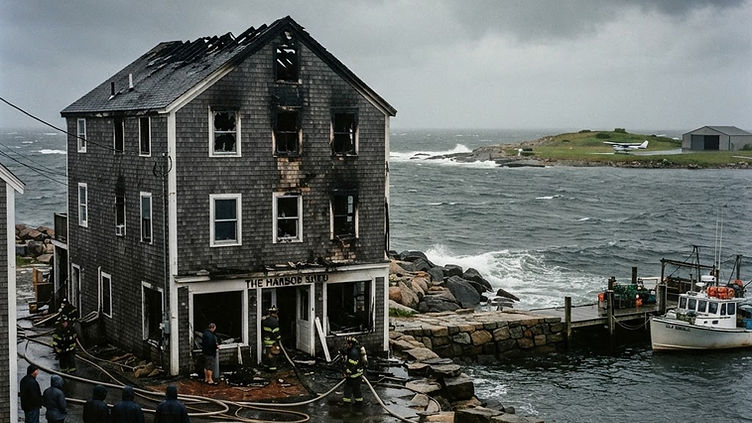
Firefighters battled an electrical fire at the Star Department Store on Water Street in New Shoreham on Nov. 26, while a severe coastal storm kept the ferries tied up, according to WJAR NBC 10. Ten mutual-aid firefighters from Westerly and Ashaway had to be flown to Block Island through Westerly Airport to bring the commercial blaze under control.
Emergency fire watch
Alarm or sprinkler system out of service? USPA can post a fire watch on site within 60 minutes.
Trained officers, documented patrol rounds and direct 911 notification, scoped to the order your fire marshal actually issued.
Live dispatch, 24 hours. In an emergency, call 911 first.
Read that again, because it describes a fire response unlike almost any on the mainland. The island's own department is small. The help it needed was on the other side of a body of water, in weather that had already stopped the boats. The firefighters arrived by air, which means they arrived with what they could carry, and which means every hour of the operation had a weather window attached to it.
The fire is out. The building is not.
What the record establishes
- The fire occurred at the Star Department Store on Water Street in New Shoreham (Block Island), Rhode Island.
- The fire was electrical in nature.
- A severe coastal storm had suspended ferry service.
- Ten mutual-aid firefighters from Westerly and Ashaway were flown to the island via Westerly Airport.
- The report was published by WJAR NBC 10 News on Nov. 27, 2026.
The extent of the damage, the building's condition and the fire marshal's determinations have not been established in the published reporting.
An electrical fire is a fire that can come back
Fires that begin in electrical equipment have a characteristic that firefighters respect: the ignition source is often still there after the flames are knocked down.
A circuit that faulted, a panel with a failed breaker, an appliance that overheated, aluminum branch wiring in an older wall, a junction box that was never closed: these do not necessarily stop being a fire hazard when the visible burning stops. Until the circuit is isolated at the source and an electrician has opened the equipment, the conductor can re-energize, arc again and ignite what is around it.
That is why the first order of business in an electrical fire is de-energizing the affected circuits, and why the building is not returned to service until an electrician has inspected the equipment. The National Electrical Code governs what that inspection has to establish; the fire department's job is to make sure the power stays off until it happens.
In a three-story retail building, the affected circuits are rarely confined to one room. A panel on the ground floor feeds upper floors, exterior lighting and signage. The result is a building where some circuits must stay off, some can be restored, and nobody can tell which is which until the electrician gets there.
The storm made every one of those problems worse
The fire occurred during a severe coastal storm, and that condition compounds the loss in three ways.
The utility is already unreliable. A storm that suspends ferry service is a storm that takes trees down onto overhead lines. An outage during or after the fire means the building's fire alarm panel goes to battery, and then to nothing. A panel on battery is not a working detection system for very long.
Water is coming in from outside, not just from hoses. Wind-driven rain enters through windows taken out by the fire, through roof damage, and through the openings crews made. Retail stock, fixtures and finishes that survived the fire are now exposed to weather.
Nobody can leave. On an island with no ferry service, the people who are there stay there. That includes the building's owner, its staff, the firefighters who came by air and anyone the town asks to keep an eye on the building.
What an island fire watch actually requires
Most fire watch planning assumes a crew can be dispatched from a nearby office in under an hour. On Block Island during a storm, that assumption fails, and the plan has to be built around the constraints rather than in spite of them.
Personnel have to be on the island before they are needed. A watch that is ordered at 6 p.m. and staffed from the mainland may not be staffed at all that night. The coverage has to be arranged with people already present, or with a flight and a weather window that nobody can guarantee.
Relief is the binding constraint. Fire watch is a continuous duty. A single person cannot patrol all night, every night, for a week. On the mainland, relief is a scheduling problem. On the island, relief is a flight and a bed.
Equipment has to fit the building. A three-story retail building on Water Street means stairs, a basement, and a roof. Patrols need lighting, thermal imaging where the fire area is deep-seated, and communications that work when the cell network is degraded by the storm.
The record has to travel. The patrol log is the evidence that the building was covered. On an island, the log has to reach the fire marshal and the insurer by email, because nobody is driving it over.
Why the building is not "just closed"
A closed retail building on an island in a storm is a building with no occupants, no alarm, and no lighting. That is the definition of an unsecured structure.
The tasks that follow a commercial fire here are the same tasks that follow one anywhere, with less margin:
Secure the openings. Board-up on an island takes longer, because materials come by barge or ferry. A crew that plans to board the building tomorrow may be planning to board it next week.
Control access. Contractors, the owner, the insurance adjuster, the fire investigator and the town all need entry. Each of them needs to be on a list, and the list needs to exist before the first one arrives.
Watch the utilities. With the power off, temporary lighting and heaters appear. Every one of them is a new ignition source in a building whose detection is down.
Protect the stock. Retail inventory that survived the fire is the owner's only recoverable asset. Water, smoke and theft all take it.
What the fire marshal will ask
In Rhode Island, where the fire safety code is built on NFPA 1 and NFPA 101, the code official has the authority to require a fire watch where a fire protection system is out of service, and to prohibit occupancy until protection is restored. The questions that follow are predictable:
- What is the condition of the alarm system, and what does the alarm contractor say about restoring it?
- Was the sprinkler system affected, and is it in service?
- What is the electrical condition of the building, and who has certified it?
- Who is on site overnight, and what is the patrol interval?
- Where is the log, and who does the fire department call?
A building owner who can answer those five questions on the day after the fire is an owner who will be allowed to reopen. An owner who cannot will be answering them to an insurer instead.
The larger point about island risk
Block Island is an extreme case, but the underlying lesson applies to every isolated property USPA covers: a fire watch is only as good as its staffing plan.
The department that fought this fire had to fly ten people across open water in a storm. That is what mutual aid looks like when geography is against you. The fire watch that follows should be planned with the same honesty about distance, weather and relief, because the building's protection for the next week depends on people who can actually get there, stay there, and be replaced.
What the town has to decide afterward
An island fire is also a municipal planning problem, and the questions it raises outlast the building.
Who covers the building overnight? On the mainland, that is a vendor decision made by an owner. On an island, it is a question the town has an interest in, because a rekindle at 2 a.m. draws the same small department out of bed in the same storm.
Where do the responders stay? The mutual-aid crews who flew in needed somewhere to sleep and a way home. That is a sheltering plan, and it belongs in the town's emergency operations plan rather than in a phone call made at midnight.
What happens to the next building? A commercial fire during a ferry shutdown reveals how much of the island's construction and repair capacity arrives by boat. Board-up materials, generators, drying equipment and contractors all have a weather dependency that mainland properties do not.
The answers are not glamorous, and they are the difference between a town that manages an incident and a town that improvises one. The fire at the Star Department Store was contained by people who improvised well. The next one should not have to.
USPA provides emergency fire watch with NFPA 601 patrol and documentation standards, and plans coverage for remote and island properties around the staffing constraint rather than around a dispatch radius. Its fire watch white paper explains how that planning is documented for a fire marshal and an insurer.
Reference and services
Knowledge base
NFPA 25 Impairment Protocols (2026): Fire Watch, the Ten-Hour Framework and System Restoration
National reference · 23 pages, citation registry attached
Read the volumeService
Fire watch services
How USPA staffs this work, with the coverage, licensing and dispatch terms for the assignment.
See the serviceSources
About the reporter
Staff Writer
Staff writer for the USPA Nationwide Security newsroom. Receives newsroom tips, corrections and editorial inquiries.
Author biography and credentialsMore from The Watchline

Fire Protection
A Thanksgiving fire displaced 36 people from a St. Paul building where one apartment burned
Firefighters held the flames to a single unit. Inspectors still emptied all sixteen, because smoke, water and severed utilities make a building uninhabitable long before the charred apartment does.
· Albina Bieci

Fire Protection
In Titusville, the sprinkler did its job. Now the system is the reason the building needs a watch
A single head held a third-floor bedroom fire in check before crews arrived. The discharge also left lower units under water and the system out of service, which is the condition that puts a fire watch on the building.
· Albina Bieci

Fire Protection
Eighty firefighters, one downtown Los Angeles commercial building, and the roof they had to cut
Crews knocked the fire down in twenty minutes at 717 E. Ninth Street. The ventilation openings and a compromised alarm panel are what keep the building a fire watch assignment after the trucks leave.
· Albina Bieci
