
Three-alarm fire at an Oakley storage building collapses part of the roof and empties it of its Civil War collections

By Albina Bieci, Staff Writer
A fast-moving fire in an aging commercial storage building on Verne Avenue forced a defensive attack at about 6:15 a.m. Tuesday, and the structure is now both unstable and full of material its owners cannot afford to lose.
OAKLEY, Cincinnati
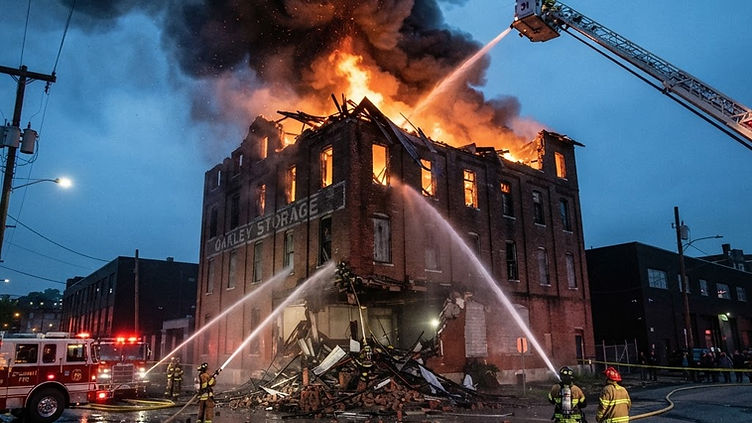
OAKLEY, Cincinnati — A three-alarm fire broke out at about 6:15 a.m. Tuesday in a commercial storage building on Verne Avenue, and within the first hour the response had turned from an interior attack into something the fire service calls defensive: crews outside, master streams on the fire from elevated positions, nobody going in.
Fire broke through the roof. A portion of the building collapsed. Between 60 and 70 fire personnel worked the scene, according to the accounts published Tuesday by Local 12 WKRC and FOX19 WXIX, which also reported that the aging building was being used to store Civil War artifacts and equipment.
The building is now three problems wearing one address. It is structurally questionable, which keeps people out. It contains material that cannot be replaced, which means somebody has to go in eventually. And its fire protection systems are compromised, which means that until it is either demolished or restored, the property is being watched rather than protected.
What is confirmed, and what is not
As of Tuesday morning, the fire department had not published a cause. Nothing in the public reporting identifies an origin area, an ignition source, or a failure mode. Anyone who publishes those details before the investigation releases them is guessing, and in a building full of historic material, a guess about origin is also a guess about what evidence was destroyed and what survived.
What the record does support is the shape of the response. A fire that goes to three alarms before 7 a.m. in a storage occupancy has usually found fuel the first-arriving company could not reach: stacked combustibles, a compartment layout without adequate access, or a roof assembly that failed early. The shift to exterior operations was a decision about firefighter safety, and once it is made, the building is written off as a container and the objective becomes exposure protection.
Why a defensive fire ends with a guard detail
A fire that has been fought from the outside does not end when the visible flame goes out. It ends when the last hot spot is confirmed cold, and that confirmation takes days in a large, collapsed, water-soaked structure. Hidden fire in a void space, a smoldering pile under a fallen roof deck, or a rekindle in debris behind a collapsed wall are all ordinary outcomes in exactly this building type.
That is the technical basis for the fire watch requirement most jurisdictions carry. The International Fire Code, at Section 901.7, requires a fire watch when a fire protection system is out of service, and the same logic applies to a building whose suppression system has been destroyed: where detection and suppression no longer function, a person has to stand in their place. Cincinnati's own fire prevention regulations follow the model code on this point.
A post-incident fire watch on a collapsed structure is a documented patrol, not a sentry standing in the street. The officer walks a defined route on a defined interval, checks the areas where a rekindle would begin, and records each round. On a building of this size, that route runs the perimeter, the exposure walls, the collapse zone boundary and any standing section the incident commander wants observed. Where the structure is unsafe to approach, thermal imaging from a safe distance replaces the interior check.
The artifacts problem
Civil War artifacts change the arithmetic of a fire watch in a way that most commercial losses do not. They are portable, they are identifiable, and once the building is open to the weather and to anyone who can get past a piece of tape, they are vulnerable in a way the fire itself no longer is.
Three separate obligations now run in parallel:
- Chain of custody. An insurer or a museum lender will ask who had access to the material and when. A guard post with a written access log answers that question. A chain-link fence with a torn gate does not.
- Condition documentation. The material that survived the fire is now exposed to water, smoke residue and temperature swings. Nothing can be moved until the structure is evaluated, so the sequence of entry has to be controlled rather than improvised by whoever arrives first.
- Salvage support. Fire departments run salvage operations, but salvage at scale happens in the days after, and it needs people on site who can let a conservator in and keep everyone else out.
Perimeter control on a building nobody can enter
A partially collapsed commercial building becomes the highest-liability property on its block the moment the trucks leave. It is attractive to trespassers because it is open, it is obvious to neighbors because it is damaged, and it is a legal exposure for the owner because the condition is now known.
The controls that matter are unglamorous. A single controlled access point. A posted and enforced exclusion zone beyond the collapse perimeter, not at the fence line. Photo identification of every person who enters, with a documented purpose. And a physical presence after dark, when the site is empty and the cameras that survived the fire are the ones pointed at a wall that no longer exists.
What similar property owners should take from this
The owners of aging storage buildings carry a specific combination of risks that this fire put on display. Older structures often have partial or degraded detection, storage that has crept upward in density over decades, and contents whose value was never written into a fire pre-plan because the building was classified as storage.
Three practical steps, none of them expensive:
- Give the fire department a pre-plan. Tell them what is inside, where the heavy combustible loading is, and what cannot be replaced. Crews fight the building they understand.
- Check the suppression system against the storage. Water-based protection designed for the original occupancy is frequently undersized for what the space holds today. An annual review against NFPA 25 is the floor, not the ceiling.
- Write the resilience plan before the fire. Who documents entry, who calls the conservator, who staffs the perimeter on night one. After a collapse, those decisions get made by whoever is standing there.
USPA Nationwide Security staffs post-incident fire watch and perimeter details on commercial losses in Ohio and across the country, including collapse-zone access control and documented patrol rounds. Dispatch is answered around the clock at (877) 246-4253.
Sources
About the reporter
Staff Writer
Staff writer for the USPA Nationwide Security newsroom. Receives newsroom tips, corrections and editorial inquiries.
Author biography and credentialsMore from The Watchline

Fire Protection
New York ordered inspections at 100 Brooklyn sites after a fatal collapse. Stop-work orders create a security problem at scale
A fatal three-story collapse in Brooklyn has produced a citywide structural investigation across 100 building sites, stop-work orders, and evacuated neighboring apartment buildings.
· Albina Bieci

Fire Protection
A Bethlehem duplex fire displaced several families. The building that remains is the liability
A two-alarm fire through the second floor of a multi-family duplex on East Union Boulevard displaced several households and brought the Red Cross in for emergency housing.
· Albina Bieci

Fire Protection
Syracuse firefighters cleared a four-story warehouse as unsafe. An empty building with structural holes is a security assignment
Crews knocked down a first-floor fire inside a four-story masonry warehouse on Maple Street, and fire officials then barred entry to a building with multiple structural holes.
· Albina Bieci
