
Six connected apartments, eleven people out, and the attic nobody was watching in DeKalb County

By Albina Bieci, Staff Writer
A fire in one apartment complex damaged six units and sent one person to hospital. In garden-style construction the roof space ties those units together, which is why the watch covers more than the burned rooms.
DEKALB COUNTY, Ga.
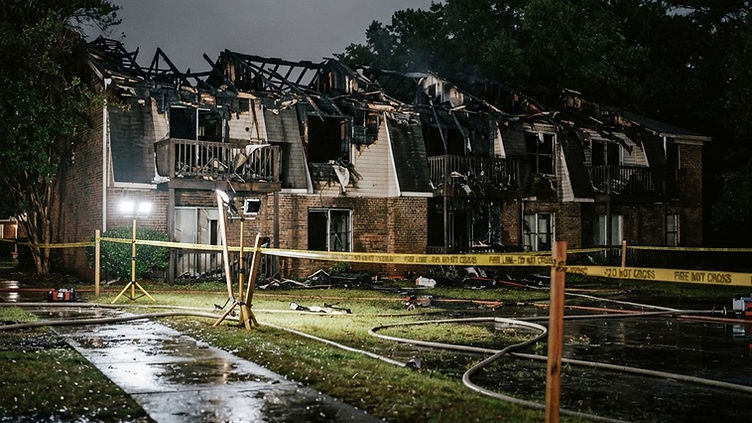
DeKalb County Fire Rescue responded to heavy smoke and flames at an apartment complex on the 600 block of Garden Walk Drive on Nov. 26, according to 11Alive. Six residential units were damaged and eleven residents were displaced. One person was hospitalized with minor injuries.
Emergency fire watch
Alarm or sprinkler system out of service? USPA can post a fire watch on site within 60 minutes.
Trained officers, documented patrol rounds and direct 911 notification, scoped to the order your fire marshal actually issued.
Live dispatch, 24 hours. In an emergency, call 911 first.
Eleven people out of six apartments is a ratio worth noticing. It means the damaged units were occupied, and it means the building's other residents are now living beside a fire scene while investigators work and while the property is repaired.
What the record establishes
- The fire occurred at an apartment complex on the 600 block of Garden Walk Drive in DeKalb County, Georgia.
- Crews encountered heavy smoke and flames.
- One person was hospitalized with minor injuries.
- Six residential units sustained damage.
- Eleven residents were displaced.
- The report was published by 11Alive (WXIA-TV Atlanta) on Nov. 27, 2026.
The cause has not been established in the reporting, and the investigation will take time.
Garden-style construction has a shared roof
The apartment complexes that line DeKalb County's corridors are mostly garden-style: two and three stories, exterior walkways or open corridors, and a continuous attic over each building.
That attic is the reason six units can be damaged by one fire.
In a building with a continuous roof space, the attic is a single void running the length of the structure. It is connected to the units below through penetrations, recessed light fixtures, bathroom and kitchen exhaust fans, and the gaps around plumbing. Once fire or heat enters that void, it can travel horizontally above the units while the units themselves appear intact from the outside. Firefighters call this a cockloft fire, and it is one of the most labor-intensive fires in residential construction because it requires opening ceilings to find the leading edge.
What that means for the residents of the other units is straightforward: the fire may be out in the apartment where it started and still be moving above their heads. That is why a six-unit damage figure in a garden-style building is not necessarily a six-unit fire. It is a fire whose extent is determined by the roof assembly, and the building's structural condition is determined by what the fire did to the trusses and the sheathing.
The three systems that decide whether the rest of the building stays occupied
After a fire of this size, the question for the remaining tenants is not whether the fire is out. It is whether the building they are living in still has the protection it was approved with.
The alarm system. Detection devices in the affected units and the adjacent corridors are damaged or destroyed. If the panel is in trouble, or if a zone has been removed from service because the wiring is gone, the building has lost detection in the area where the next fire is most likely.
The sprinkler system, where present. In a building with a shared riser, isolating the damaged portion can take protection away from units on the same branch. NFPA 25's impairment procedure requires notification and, where restoration will not be prompt, a fire watch over the affected area.
The electrical service. Fire in an attic frequently takes out wiring that serves the units below. Circuits are isolated, and units that appear undamaged lose power, which makes them uninhabitable regardless of their condition.
Each of these is a reason for the code official to order a fire watch under Section 901.7 of the International Fire Code, and each of them changes how the watch is scoped.
Why the watch is broader than the six units
An owner reading this might assume the watch covers the six damaged apartments. It does not.
The watch covers the building's unprotected area, which is defined by the systems rather than by the rooms. If the alarm zone serving twelve units is impaired, the watch covers twelve. If the attic is open and being worked on, the watch covers the whole roofline, because that is where a rekindle will appear.
That broader footprint is also why the watch and the security patrol are usually combined on a building like this. The building has:
- Six damaged units that are vacant and contain salvageable property.
- Six or more occupied units whose residents need to be warned and moved if something happens.
- A fire scene that is still the investigator's.
- A roof and attic that contractors will be opening.
Each of those is a different kind of access, and all of them are managed by the same person at 3 a.m.
The investigation and the scene
The reporting notes that the cause is under investigation, and in a six-unit loss the investigation has a practical effect on the building: the area of origin stays sealed until the investigator releases it.
That has two consequences for the owner. The first is that repairs cannot begin in the area of origin, which means the watch lasts longer. The second is that the scene has to be preserved, which means access control is not only a security measure but an evidentiary one. NFPA 921 sets out how a fire scene is examined and documented; a scene that has been walked through by contractors and tenants before the investigator arrives has lost evidence that cannot be recovered.
What the owner should be doing
Get the building's system status in writing from the alarm and sprinkler contractors before the fire marshal's inspection, so the order that follows is based on facts rather than on assumptions.
Secure the six damaged units individually. Each one is a door, and each door is an entry point into a shared building.
Tell the remaining residents what is and is not working. A tenant who does not know the corridor detector is out is a tenant who will not react when it matters.
Plan the watch around the attic work. The period when contractors are opening ceilings and running equipment in the roof space is the period of highest risk, and it is often after the initial order has been satisfied.
Keep the log. In a building that stays partly occupied, the log is also the record that the owner met the duty of care to the tenants who stayed.
The takeaway
A garden-style apartment fire is rarely contained by a wall. It is contained by a roof assembly, a sprinkler head, a closed door or a crew that arrived in time, and when it is not contained, the attic is what carries it.
That is why the coverage after this fire is not a perimeter around one burned apartment. It is a watch on a building whose roof, detection and power are all in question, for as long as the residents beside the damage are still living there.
Why eleven people came out of six apartments
The displacement figure in this fire is worth a second look, because it explains something about how apartment losses are counted.
Eleven residents out of six damaged units means an average of nearly two people per unit, and it means every one of those units was occupied by a household rather than by a single tenant. In DeKalb County's rental stock, that is the norm: one-bedroom units with two adults, two-bedroom units with children, and multi-generational households where a grandparent lives in what the lease calls a second bedroom.
The consequence for the response is that a six-unit loss is a sheltering event, not a housing inconvenience. Eleven people need somewhere to sleep on the night of the fire, and the Red Cross or the county's emergency assistance program is usually the first call, followed by the owner's insurer and the property manager.
There is a second consequence that owners rarely plan for: the residents who were not displaced. In a building where six units are damaged and the rest are occupied, the remaining tenants are living next to a fire scene, with contractors arriving at all hours, with utilities that may be interrupted, and with an alarm system that may not be fully functional. Their patience is finite, and their safety depends on the owner telling them the truth about what is and is not working.
The fire watch serves both populations. It protects the vacant units from entry and the occupied units from a second fire, and it does so under one log that a fire marshal can read.
USPA provides emergency fire watch for occupied multi-family buildings with impaired detection and suppression, staffed to NFPA 601 patrol and documentation standards, and its fire watch white paper explains how coverage is scoped and closed out with the authority having jurisdiction.
Reference and services
Knowledge base
NFPA 25 Impairment Protocols (2026): Fire Watch, the Ten-Hour Framework and System Restoration
National reference · 23 pages, citation registry attached
Read the volumeService
Fire watch services
How USPA staffs this work, with the coverage, licensing and dispatch terms for the assignment.
See the serviceSources
About the reporter
Staff Writer
Staff writer for the USPA Nationwide Security newsroom. Receives newsroom tips, corrections and editorial inquiries.
Author biography and credentialsMore from The Watchline

Fire Protection
A Thanksgiving fire displaced 36 people from a St. Paul building where one apartment burned
Firefighters held the flames to a single unit. Inspectors still emptied all sixteen, because smoke, water and severed utilities make a building uninhabitable long before the charred apartment does.
· Albina Bieci

Fire Protection
In Titusville, the sprinkler did its job. Now the system is the reason the building needs a watch
A single head held a third-floor bedroom fire in check before crews arrived. The discharge also left lower units under water and the system out of service, which is the condition that puts a fire watch on the building.
· Albina Bieci

Fire Protection
Eighty firefighters, one downtown Los Angeles commercial building, and the roof they had to cut
Crews knocked the fire down in twenty minutes at 717 E. Ninth Street. The ventilation openings and a compromised alarm panel are what keep the building a fire watch assignment after the trucks leave.
· Albina Bieci
