
A New Paltz warehouse fire rekindled at 3:40 a.m. That is what a post-fire watch is for

By Albina Bieci, Staff Writer
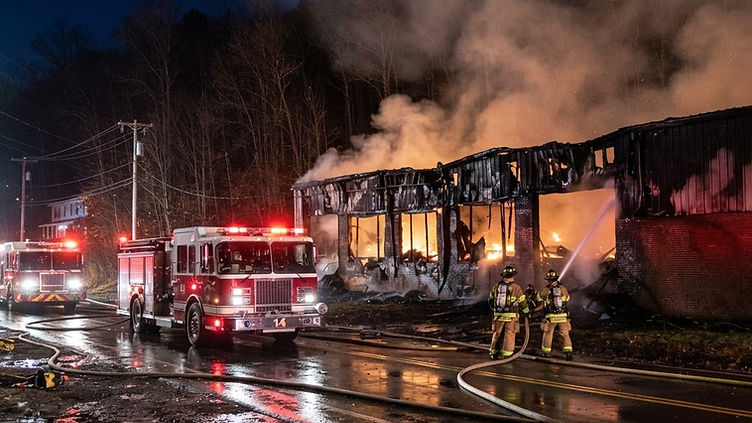
The Route 32 South warehouse fire went to three alarms, came back at 3:40 a.m. Tuesday, and pulled departments from three counties to the same building for the second time in a day.
NEW PALTZ, N.Y.
NEW PALTZ, N.Y. — The fire that tore through a commercial warehouse on Route 32 South went to three alarms. Crews from Ulster, Orange and Dutchess counties worked it, and by the time the last unit cleared, the building appeared to be out.
At 3:40 a.m. Tuesday it was not out. Fire came back through the structure hard enough that the same departments were recalled for a working fire, according to Mid Hudson News, which identified the affected business as Pantano's Wine, Grapes and Home Brew Shop.
There is no mystery in this. A rekindle like that is the most predictable failure mode in post-fire operations, and it is the exact event that fire watch requirements exist to prevent. It is also the one task that almost never has an owner on the night it is needed.
Why warehouses rekindle
A commercial building of this type is a collection of voids. Roof assemblies, drop ceilings, mezzanine framing, wall chases and the space between a new wall and an old one all hold heat and debris out of reach of a hose stream. When a deep-seated fire burns in a concealed space, extinguishment is a conclusion drawn from the absence of visible smoke rather than a fact anyone has verified.
Three conditions make the second fire more likely:
- Structural collapse or partial failure. Fallen material buries burning debris. A pile cannot be overhauled, only watched.
- Water damage without drainage. Standing water and saturated stock hold heat and keep the site difficult to walk, so the parts of the building nobody can reach become the parts nobody checks.
- Rapid freeze-thaw and wind. Overnight in the Hudson Valley in November, smoldering material under a collapsed roof deck gets air movement it did not have while crews were on scene.
The third condition is why so many rekindles are called in on the overnight shift, when the site is empty and nobody is looking at it.
What the model codes actually require
Where a fire protection system is out of service, the International Fire Code requires a fire watch at Section 901.7, and the same section defines what that watch has to be: an assigned person who patrols the affected area on a regular interval, keeps a record of the rounds, and is equipped and instructed to call the fire department on discovery of fire.
New York's fire prevention regulations incorporate that framework, and local officials apply it to post-fire buildings routinely. A building after a three-alarm fire has no working detection and no working suppression. The code's premise, that a functioning system may be replaced by a trained human presence, applies as directly as it ever does.
The interval is set by the authority having jurisdiction. In practice, on a large commercial loss, it is usually continuous on the overnight hours and hourly documented rounds during the day, with the patrol route drawn around the areas of greatest hidden-fire potential rather than around the property line.
The cost comparison is not close
Fire departments do not bill a building owner for a rekindle in the way the operation actually costs. A second working fire in the same structure on the same night consumes:
- Three counties' worth of apparatus and personnel on overtime.
- The remaining salvageable stock in the building, because a second fire destroys what the first one spared.
- The investigation itself, because a rekindled scene cannot be read as cleanly as an undisturbed one.
- Insurance standing, because a documented absence of post-fire watch is a difficult position to defend when the loss doubles.
Set against that, a single fire watch officer on an overnight post is one of the cheapest interventions available to a commercial property owner. That asymmetry is the entire argument, and it is the one that gets skipped because the decision has to be made in the twelve hours after the trucks leave.
What a post-fire watch on a warehouse looks like in practice
The work is specific. An officer assigned to a post-fire warehouse is briefed on the collapse areas and the areas of unoverhauled debris, carries a thermal imaging camera where the site allows it, and walks a route that includes the exposures. The officer checks for smoke odor, temperature rise in a wall, water running where there should be none, and the sound of structural movement.
Every round is logged with the time and the condition observed. Anything that would cause a fire crew to return is called in immediately rather than noted in a report. And because the building is now both unstable and open, the same post usually carries a second assignment: no unauthorized entry, and a written record of every person who goes inside.
USPA Nationwide Security provides post-fire fire watch and site security for commercial losses in the Hudson Valley and across New York, with documented rounds and 24-hour dispatch at (877) 246-4253. Under IFC Section 901.7, the required interval is set by the authority having jurisdiction; USPA recommends confirming the requirement with the local fire official before any post-fire watch begins.
Sources
About the reporter
Staff Writer
Staff writer for the USPA Nationwide Security newsroom. Receives newsroom tips, corrections and editorial inquiries.
Author biography and credentialsMore from The Watchline

Fire Protection
New York ordered inspections at 100 Brooklyn sites after a fatal collapse. Stop-work orders create a security problem at scale
A fatal three-story collapse in Brooklyn has produced a citywide structural investigation across 100 building sites, stop-work orders, and evacuated neighboring apartment buildings.
· Albina Bieci

Fire Protection
A Bethlehem duplex fire displaced several families. The building that remains is the liability
A two-alarm fire through the second floor of a multi-family duplex on East Union Boulevard displaced several households and brought the Red Cross in for emergency housing.
· Albina Bieci

Fire Protection
Syracuse firefighters cleared a four-story warehouse as unsafe. An empty building with structural holes is a security assignment
Crews knocked down a first-floor fire inside a four-story masonry warehouse on Maple Street, and fire officials then barred entry to a building with multiple structural holes.
· Albina Bieci
