
A South Baltimore rowhouse fire spread through shared walls. The exposure problem outlasts the flames

By Albina Bieci, Staff Writer
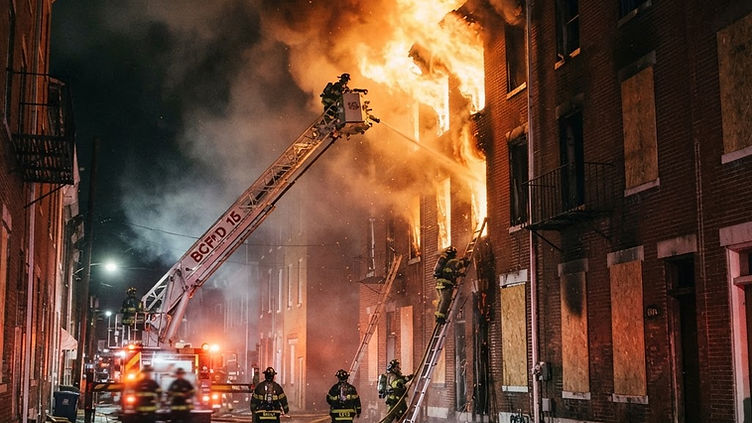
A two-alarm fire involving several attached rowhomes on the 200 block of South Gilmor Street sent heavy fire from both the front and rear of the structures overnight, and left a row of connected buildings exposed.
BALTIMORE, Md.
BALTIMORE, Md. — Baltimore City firefighters fought a two-alarm fire overnight involving multiple attached multi-unit rowhomes on the 200 block of South Gilmor Street, with heavy flame reported from both the front and the rear of the structures, according to CBS News Baltimore.
A rowhouse fire is never about one address. In a block of attached brick homes, every unit in the row is a compartment facing a shared wall, and the fire's real boundary is wherever the department can stop it. When flames are showing from the front and rear of a group of units at the same time, the fire has already found the roof or the party walls, and the operation shifts from extinguishing a room to holding a line.
Once the fire is out, the block stays a security problem for weeks. That is the part that the public rarely sees and that property owners are usually unprepared for.
What makes an attached row worse after the fire
Four conditions are created by a fire in a row of connected dwellings, and each of them is a reason the buildings need to be watched rather than simply vacated:
- Open party wall penetrations. Firefighting in a rowhouse means opening walls, ceilings and roofs to find fire in the cockloft or between units. Those openings are not restored before crews leave. They connect units that were designed to be separated.
- A shared roof. Most Baltimore rows are one continuous roof structure. A hole cut over one unit is an entry point into the attic space that continues over its neighbors.
- Compromised utilities. Gas and electric service to a damaged unit is generally shut off, and, in a connected row, it can take time to determine which meter and which service feed which unit. The building is dark and cold while it is also open.
- Displacement and confusion. Occupants of undamaged adjoining units are often allowed back, or vacate voluntarily, while the damaged units stay empty. An empty, unlocked, burned unit next to an occupied one is a persistent problem for both.
Baltimore has a long institutional familiarity with all four. The city's vacant building program exists because rowhouse blocks can decline unit by unit after a fire, and the interval between the fire and the boarding order is when that decline starts.
The code basis for watching the exposures
Section 901.7 of the International Fire Code requires a fire watch wherever a fire protection system is impaired, and requires the watch to be conducted by a person assigned to the area, patrolling on a regular interval and keeping a record of the rounds. Maryland's fire prevention regulations follow the model code, and Baltimore City enforces its own property maintenance and vacant structure provisions alongside them.
In a rowhouse fire, the impaired systems are not always obvious. A single unit may have lost its detection and its standpipe connection while its neighbor's alarm panel is still functioning, and yet the two now share an opening. Where the fire has compromised the separation between units, the effective protection for the adjoining units is a person who walks the alley and the front of the row and looks for smoke, glow, or entry.
What the watch is looking for
On an attached row, a post-fire patrol has three distinct jobs and they are not the same job:
- Fire watch. Overnight rounds on the burned units and the adjoining ones, checking the openings, the roof line and the alley for smoke or heat. Rekindle in a rowhouse typically announces itself at a party wall or in the cockloft, not at the front door.
- Access control. A chain of custody over entry. Contractors, adjusters, investigators, and salvage crews all need in, and none of them should be able to walk into a neighbor's unit through a hole in a shared wall.
- Exposure monitoring. The occupied units in the row are the reason the post exists. A guard who knows which units are occupied, which are vacant, and which are under a stay-out order is doing more for the block than any camera that survived the fire.
For landlords and neighbors on a block like this
The most useful thing an owner can do before the next fire is to know the row. Write down the unit addresses, the occupancy status of each, the location of gas and electric service, and where the roof access is. Give it to the fire department and keep a copy with the management company.
After a fire, the sequence that protects the property is: secure the burned units the same night, document every entry from that point forward, and put a person on the alley overnight until the openings are closed and the utilities are re-established. Insurance carriers increasingly ask for that record, and in a densely built city it is also just what the neighbors are entitled to expect.
USPA Nationwide Security provides post-fire fire watch and exposure perimeter security in Baltimore and across Maryland, with written round logs and a documented access log at (877) 246-4253.
Services in Baltimore, MD
Sources
About the reporter
Staff Writer
Staff writer for the USPA Nationwide Security newsroom. Receives newsroom tips, corrections and editorial inquiries.
Author biography and credentialsMore from The Watchline

Fire Protection
New York ordered inspections at 100 Brooklyn sites after a fatal collapse. Stop-work orders create a security problem at scale
A fatal three-story collapse in Brooklyn has produced a citywide structural investigation across 100 building sites, stop-work orders, and evacuated neighboring apartment buildings.
· Albina Bieci

Fire Protection
A Bethlehem duplex fire displaced several families. The building that remains is the liability
A two-alarm fire through the second floor of a multi-family duplex on East Union Boulevard displaced several households and brought the Red Cross in for emergency housing.
· Albina Bieci

Fire Protection
Syracuse firefighters cleared a four-story warehouse as unsafe. An empty building with structural holes is a security assignment
Crews knocked down a first-floor fire inside a four-story masonry warehouse on Maple Street, and fire officials then barred entry to a building with multiple structural holes.
· Albina Bieci
