
At 4:40 a.m. in Woodbourne, a house was fully involved and the water came by tanker

By Albina Bieci, Staff Writer
Multiple Sullivan County departments and a tanker task force answered a fully involved structure fire on Riverside Drive. What follows a rural knockdown is a building nobody can enter and a scene an investigator has to keep.
WOODBOURNE, N.Y.
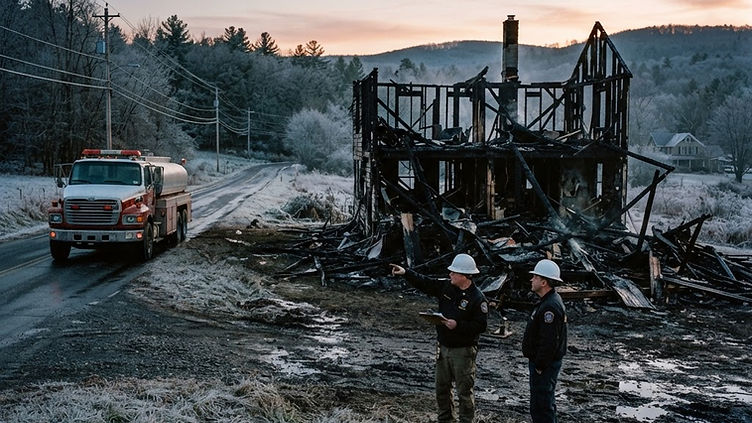
Multiple Sullivan County fire departments and a specialized tanker task force responded at 4:40 a.m. on Nov. 27 to a fully involved structure fire at 403 Riverside Drive in Woodbourne, according to Mid-Hudson News. Fire investigators were dispatched to the scene while crews worked to contain the blaze.
Emergency fire watch
Alarm or sprinkler system out of service? USPA can post a fire watch on site within 60 minutes.
Trained officers, documented patrol rounds and direct 911 notification, scoped to the order your fire marshal actually issued.
Live dispatch, 24 hours. In an emergency, call 911 first.
A 4:40 a.m. call in a rural hamlet, a building already fully involved on arrival, and a tanker task force on the road: that combination tells you most of what the fire was like before anyone saw it. It also tells you what the site will be like for the next several days.
What the record establishes
- The fire was reported at 4:40 a.m. on Nov. 27 at 403 Riverside Drive in Woodbourne, New York.
- The structure was fully involved.
- Multiple Sullivan County fire departments responded, along with a specialized tanker task force.
- Fire investigators were dispatched to the scene.
- The report was published by Mid-Hudson News on Nov. 27, 2026.
The cause, the occupancy and the extent of the damage have not been established in the published reporting.
What "fully involved" means at 4:40 in the morning
A building that is fully involved when the first apparatus arrives has usually been burning for a while, and in a rural hamlet at 4:40 a.m. there is a specific reason: nobody saw it early.
In a village or a city, a fire in a house is generally reported within minutes, because a neighbor sees smoke, a passer-by sees flame, or a smoke alarm in an adjacent building sounds. In a hamlet like Woodbourne, houses sit further apart, the road is dark, and the first person to notice may be the occupant, a newspaper carrier or a driver on the way to work.
By the time a building is fully involved, the fire has usually passed through the roof, and the firefighting problem has changed from extinguishment to containment. Crews protect exposures, knock down what they can from the outside, and prepare for the part that comes after: a structure that is no longer safe to enter and a pile of debris that will smolder for days.
Water supply is the other fire
Woodbourne is a hamlet in the town of Fallsburg, in a county where hydrants are not a given. When there is no hydrant, water comes from a draft site, a pond, a dry hydrant or a tanker shuttle, and a tanker shuttle is a logistics operation run at speed.
NFPA 1142, the standard on water supplies for suburban and rural firefighting, exists because this problem is structural rather than incidental: the water available at a rural fire is a function of how many tankers can be filled, driven and emptied per hour, and that number determines what tactics are possible.
A tanker task force is the organized answer. Tankers are assigned to fill sites and dump sites, a water supply officer tracks the flow, and the operation runs until the fire is out. It works, and it is slow in a way that a hydrant system is not.
For the property owner, the operational consequence is this: a rural fire is likely to be larger at knockdown than an urban fire of the same duration, because the water arrived in trucks.
The building after the fire is a hazard, not a building
A fully involved structure fire leaves a structure that has been heated, wetted, and in many cases partially collapsed. The parts of it that are still standing are not necessarily the parts that are still sound.
The specific hazards at a site like 403 Riverside Drive:
Collapse. Floor assemblies that burned through, roof framing that lost section, and walls that were pushed out by a hose stream can fail hours or days later, sometimes without warning. The collapse zone around a fire-damaged building is not a formality.
Chimneys and masonry. A masonry chimney that survived the fire can stand while everything attached to it is gone. It is the most common object to fall on a person at a fire scene after the fire is out.
Utilities. A rural property may have propane, a well and a septic system, and overhead electric service that is still energized to a meter that is no longer attached to a building.
Hazardous materials. Older houses contain asbestos, lead paint, and whatever was stored in the garage or the basement. A burned pile of that material is an exposure hazard for anyone who walks it.
Smoldering debris. Deep-seated fire in a collapsed structure can persist for days, especially in a debris pile where water cannot reach the seat of the heat.
That last one is the reason a fire watch is ordered at scenes like this, and it is the reason the watch often continues after the fire department has gone.
Why the investigator's scene has to be protected
The reporting notes that fire investigators were dispatched, which means the origin and cause of this fire is an open question. In New York, as in most states, that investigation may involve the local fire department, the county, and in some cases the state Office of Fire Prevention and Control.
The investigation depends on the scene, and the scene is fragile. NFPA 921 sets out how a fire scene is examined, documented and reconstructed, and the first principle of that work is that the physical evidence is altered by everything that happens after the fire. A collapsed wall that was moved to reach a hot spot, a debris pile that was spread by a hose stream, a floor that was walked by the owner before the investigator arrived: all of it changes what can be determined.
That is why scene security after a fire is an investigative function as much as a property-protection one. The watch that keeps people out of a burned building is also the watch that keeps the evidence intact.
What the owner faces in the days after
The sequence in a rural total-loss fire is different from a commercial one, and the differences matter:
The building may be condemned before the claim is filed. A code enforcement officer who finds a structure unsafe can order it secured, fenced or demolished, and that order runs on the town's schedule, not the insurer's.
Demolition is a fire risk. Once demolition begins, heavy equipment, cutting torches and fuel are on site, and the debris pile is still capable of burning. The watch does not end at demolition; it often shifts to the demolition site.
The site is remote. A rural property with no neighbors is a property with no informal security. A vacant burned house on a county road is an easy target for scavenging, and the metals in it are worth money.
The insurance adjuster may not arrive for days. Photographs taken before anything is moved are the only record of the loss.
How the watch is scoped at a site like this
A fire watch at a burned rural structure is usually a smaller assignment than a commercial building watch, but it is not a simpler one. The scope that works:
Control the perimeter, not just the door. The building is not enterable; the site is. A fence line or a marked boundary, with a documented access point, is the unit of control.
Patrol for heat, not only for people. A round that walks the debris pile with a thermal imager finds a rekindle before it becomes a second alarm.
Coordinate with the investigator and the demolition contractor. Both will need access at unscheduled times, and both need to be on the list.
Keep the log in a form the town will accept. In a rural jurisdiction, the fire marshal, the code officer and the insurer may all ask for it, and they may all ask for it separately.
The point
The fire at 403 Riverside Drive was over as a firefighting operation long before it was over as a problem. What remains is a structure that cannot be entered, a debris pile that can still burn, and a scene that an investigator needs to keep intact.
A fire watch covers all three, and it is the reason the site can be released to the owner without being abandoned.
USPA provides emergency fire watch for fire-damaged structures with NFPA 601 patrol and documentation standards, including scene security coordinated with fire investigators and demolition contractors. Its fire watch white paper sets out how that coverage is scoped and documented.
Reference and services
Knowledge base
NFPA 25 Impairment Protocols (2026): Fire Watch, the Ten-Hour Framework and System Restoration
National reference · 23 pages, citation registry attached
Read the volumeService
Fire watch services
How USPA staffs this work, with the coverage, licensing and dispatch terms for the assignment.
See the serviceSources
About the reporter
Staff Writer
Staff writer for the USPA Nationwide Security newsroom. Receives newsroom tips, corrections and editorial inquiries.
Author biography and credentialsMore from The Watchline

Fire Protection
A Thanksgiving fire displaced 36 people from a St. Paul building where one apartment burned
Firefighters held the flames to a single unit. Inspectors still emptied all sixteen, because smoke, water and severed utilities make a building uninhabitable long before the charred apartment does.
· Albina Bieci

Fire Protection
In Titusville, the sprinkler did its job. Now the system is the reason the building needs a watch
A single head held a third-floor bedroom fire in check before crews arrived. The discharge also left lower units under water and the system out of service, which is the condition that puts a fire watch on the building.
· Albina Bieci

Fire Protection
Eighty firefighters, one downtown Los Angeles commercial building, and the roof they had to cut
Crews knocked the fire down in twenty minutes at 717 E. Ninth Street. The ventilation openings and a compromised alarm panel are what keep the building a fire watch assignment after the trucks leave.
· Albina Bieci
