
Bangkok burned a building that had no fire containment yet

By Michael Evans, Founder and Strategic Advisor, USPA Nationwide Security
A multi-story apartment block under construction lost its upper floors to fire. The risk profile of an unfinished building is the opposite of a finished one, and fire watch is the control that fits it.
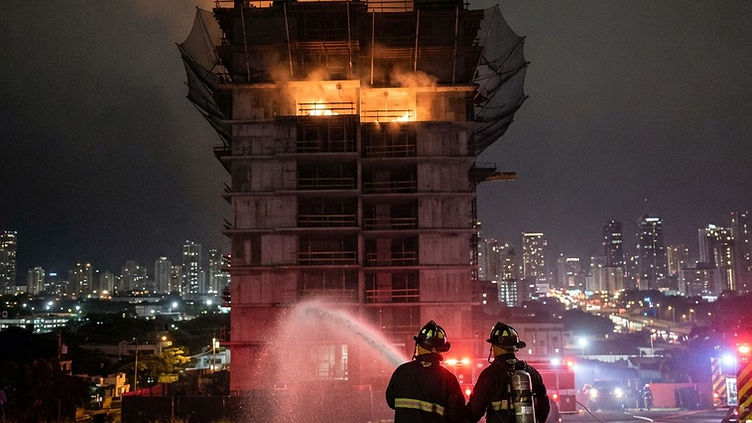
BANGKOK
BANGKOK — Fire spread through the upper floors of a multi-storey residential building under construction here before crews brought it under control, and local authorities are now assessing whether the concrete frame was structurally compromised by the heat.
The building was in its construction phase, not its occupancy phase. That distinction governs almost everything about how the fire behaved, how long it took to control, and what the site needed before the first flame appeared.
What is confirmed, and what is still open
Confirmed at the time of writing: a residential tower in its construction phase, a fire that climbed through the upper floors, a response that took an extended period to bring under control, and an active structural assessment of the frame.
Not yet established publicly: a confirmed ignition source, a verified damage estimate, casualty information, and whether a hot-work permit was in force at the time. Those four items are what an origin-and-cause investigation will settle, and none of them should be assumed from the visible fire load.
Why an unfinished building fails differently
A finished high-rise resists fire with systems that are commissioned, tested and maintained. An unfinished one has the structure and little of the protection. Compartmentation is the clearest gap: fire-rated walls stop short of closure at the top of a floor, penetration seals around ducts and conduits are still open, and stairwell pressurisation is not yet balanced. Detection is usually absent because the addressable system is not terminated. Sprinklers, where they are installed, are frequently not charged, and standpipes may not be extended to the fire floor.
What remains is fuel and vertical continuity. Temporary power distribution, solvent-based adhesives and coatings, formwork, packaging, insulation bales, and open floor plates around service risers. A fire on an upper floor of such a building does not need to breach a fire door to reach the floor above; it only has to find the opening that has not yet been sealed.
The controls that exist for exactly this phase
Construction fire protection is not improvised. It is codified in NFPA 241, the standard for safeguarding construction, alteration and demolition operations, which places explicit duties on the owner or the owner's authorised representative for a written fire prevention program, housekeeping, hot-work permitting, temporary heating safeguards, protection of combustibles, and a fire watch where the risk requires one.
Hot work carries its own standard. NFPA 51B requires a permit, a trained fire watch during the operation and for a defined period afterwards, clearance of combustibles within a specified radius, and termination of the operation if conditions change. The detail that most sites get wrong is the second half of that requirement: the watch continues after the torch is off. A cutting operation leaves latent heat in a steel member or slag in a joint that can ignite hours later, and a site that packs up at the end of the shift converts a supervised risk into an unsupervised one.
OSHA's construction standards impose parallel obligations on the employer for fire prevention, temporary heating and the availability of firefighting equipment, and several jurisdictions add local requirements on top for occupied-adjacent construction and for buildings over a threshold height.
The decision a site manager actually makes
Fire watch on an active site is a cost line, and the argument against it is always the same: nothing has burned yet. The argument for it is arithmetic that site managers can run themselves. A single shift of a trained watch on the floors where containment is incomplete costs a fraction of one damaged floor, and a fraction again of the schedule slip that follows a structural assessment.
The practical threshold most experienced operators use is not a building height. It is a condition: anywhere the passive or active protection is not yet functional, and anywhere an occupied or adjacent structure is exposed. That condition includes the floors where fire partitions are open, the floors where the alarm is not terminated, and the period after any hot-work operation while the assembly cools.
The second decision is who does the watching. A trade worker handed a fire extinguisher and told to keep an eye on things is not a fire watch under any standard that will survive a review. A fire watch is a person with no other assignment, a documented patrol route, a written log with times, and a clear instruction about when to call the fire service rather than attempt an attack.
What the site needs in the next 72 hours
If the frame is declared sound and work resumes, the sequence should be deliberate: a documented assessment of the protection that the fire destroyed or revealed as absent, a revised fire prevention program signed by the owner's representative, reinstated standpipes with flow tested at the top outlet, hot-work permits reissued only after a review of the conditions that allowed the fire to spread, and a fire watch covering the floors where containment remains incomplete until it is not.
Sites that skip the review tend to repeat the incident. Sites that use it as a genuine reassessment usually find two or three controls that were assumed to be in place and were not.
What fire does to a concrete frame
The structural question after a construction fire is not whether the building "survived". It is what the heat did to the elements that carry load, and whether that damage is measurable.
Reinforced concrete performs comparatively well in fire because concrete is a poor conductor and the steel inside is shielded. Performance degrades on a curve. Sustained temperatures in the range of several hundred degrees begin to reduce the compressive strength of the concrete itself; higher sustained heat drives moisture out, causes spalling, and can expose and soften the reinforcement. High-strength concretes used in slender columns and transfer elements are more sensitive to this than the ordinary mixes in older buildings, and thin floor plates in a residential tower give the fire less material to absorb heat before the steel is affected.
Post-fire assessment therefore follows a sequence: map the fire's movement, identify the elements exposed, test rather than assume, and model the residual capacity. Core samples, ultrasonic or rebound testing, and in some cases a load test determine whether an element is reinstated, repaired with a jacket or section enlargement, or demolished. The last option is the one that changes a project's calendar, and it is the reason a fire in a building under construction is a schedule event as much as a safety event.
What insurers ask first
After a construction fire, the insurance conversation turns on documentation faster than most contractors expect. The questions are predictable: was there a written fire prevention program, who was the designated responsible person, was a hot-work permit issued for the operations in the affected area, and what did the fire watch record show for the hours before ignition.
A contractor who can produce a program, a permit with times and signatures, a watch log with patrol intervals, and a housekeeping record has a defensible position. A contractor who cannot produce them may find that the absence is treated as evidence of an uncontrolled site, irrespective of what actually happened.
The second fire is the pattern
Operators who work construction losses see the same recurrence. The first fire damages a floor and is extinguished. Work resumes, the cleanup generates new temporary conditions, and the second fire follows within weeks, often in the debris or in the temporary power installation that was never re-inspected after the first event.
The control against recurrence is a post-incident review that actually changes the plan. Reinstated standpipes tested at the highest outlet, extension of temporary detection to the floors where work has resumed, re-permitting of hot work against the new conditions, and a fire watch that covers the cleanup phase as well as the construction phase. Cleanup is the phase most often left unwatched, and debris piles on an open floor plate are as good a fuel bed as anything installed.
Reading a site's fire plan in ten minutes
For an owner, lender or insurer reviewing an active site, three questions reveal most of the answer. Who is the named person responsible for fire prevention, and can they describe their authority to stop work? Where is the written hot-work permit, and what does the last completed one show? And when the passive protection on a floor is incomplete, who is watching that floor tonight, on what route, and writing it down.
A site that answers all three without leaving the room has a program. A site that has to find someone has a document.
Construction-phase fire protection is a service USPA Nationwide Security provides through construction site fire watch and hot work fire watch coverage, coordinated with the general contractor's safety plan and the authority having jurisdiction.
Related coverage
- Fire Safety and Overnight Vigilance: Lessons from Van Zandt County
- Electric Fleets and Thermal Runaway: How Fire Watch Protects Commercial Facilities Overnight
- Fire Crews Contain Commercial Structure Blaze at Interfor Lumber Facility in Georgetown County
Request fire watch for an active construction site: (800) 214-1448 or request emergency fire watch.
The Watchline will update this report when authorities publish the origin-and-cause findings and the structural assessment.
Sources
About the reporter
Founder and Strategic Advisor, USPA Nationwide Security
Michael Evans founded USPA Nationwide Security in 2005 and led it as chief executive for sixteen years. He reports on protective operations, security regulation and the business of guarding.
Author biography and credentialsMore from The Watchline

Fire Protection
Fire in a laboratory room triggers Site Area Emergency at Savannah River; no contamination detected
The classification was declared at 5:07 p.m. and lifted at 9:45 p.m. after the fire in a laboratory room was extinguished; one employee was treated and released and radiological surveys found no detectable contamination.
· Albina Bieci

Fire Protection
Aberdeen apartment fire displaces 28 and kills three pets; state fire marshal rules out a cooking fire
Investigators say the fire started in a lower-level kitchen on East Bel Air Avenue but was not a cooking fire; 28 people are displaced and the building sustained about $500,000 in damage.
· Albina Bieci

Fire Protection
Before the first hard freeze: what a property needs in place to avoid an impaired sprinkler system
Wet-pipe failures follow the first sustained freeze every year. The properties that recover fastest are the ones that had a documented plan before the pipe broke.
· Brian Fitzgibbons
