
Nobody moved, so she did: the Wicked red carpet and the myth of the co-star bodyguard

By Michael Evans, Founder and Strategic Advisor, USPA Nationwide Security
At the Singapore premiere, Cynthia Erivo reacted first to a barricade breach while a repeat red-carpet intruder held onto Ariana Grande. Months later she rejected the 'bodyguard' framing, and the exchange exposes two different confusions: what fans owe celebrities, and what a co-star's instinct is not.
SINGAPORE
SINGAPORE — The most instructive moment in the year's biggest celebrity-security story did not happen on a red carpet. It happened months later, in an interview, when Cynthia Erivo declined the role the internet had written for her.
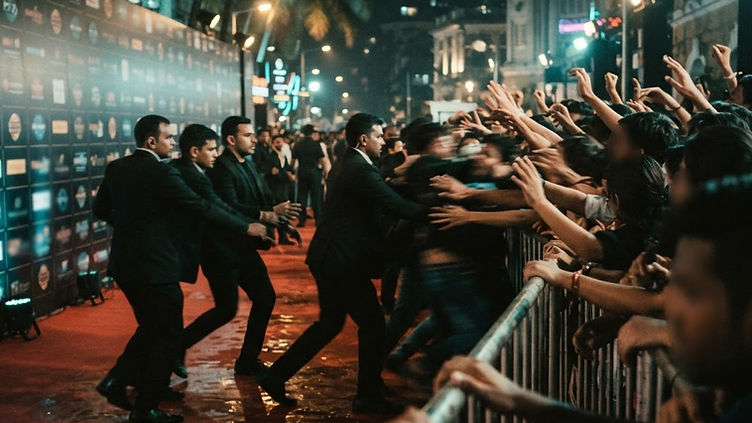
At the November premiere of 'Wicked: For Good' at Universal Studios Singapore, a man jumped the barricade, rushed the carpet and grabbed Ariana Grande. Erivo, standing beside her, pushed him off. Security reached them moments later. Grande was visibly shaken; Michelle Yeoh helped comfort her. The man, later identified as Australian prankster Johnson Wen, was arrested the following day, charged with public nuisancy and sentenced to nine days in jail.
Then the footage went viral, and the commentary did what commentary does: it turned a colleague's reflex into a punchline about a bodyguard.
What the footage actually shows
The clip is short, and the sequence matters.
A man clears a waist-high barricade at speed and closes on a principal who is standing still, posing, and therefore unable to react. For several beats, nobody in frame moves toward him. It is Erivo, mid-interview posture and heels, who reacts first, pushing at him while he holds onto Grande. Security arrives after that, not before.
Erivo described it plainly in an interview with Variety: "Nobody moved. Nobody moved. So I moved because my brain went, 'Get him away! Get him out of here!'" She added that the man would not let go of Grande, and that she kept pushing to get him off.
That is not a protection detail doing its job. That is the gap in coverage between a publicist's carpet position and a guard's post, closed by a co-star.
The label she refused
Wen was a repeat offender with a documented pattern: running at artists including Katy Perry and the Weeknd, filming it, posting it. He reportedly tried the carpet a second time after being removed once.
His method is the reason celebrity security has changed, and it is worth stating clearly: the threat is not only the obsessed fan. It is the content creator for whom a celebrity is a prop and an assault is a clip. The motive is engagement, the tool is a public event with predictable geometry, and the barricade is the entire plan.
The reaction online, though, ran in a different direction. Fans praised Erivo and joked that she had served as Grande's bodyguard or security guard. Erivo pushed back hard, and her objection was not about modesty.
"I think that we haven't really come to terms with the insidious nature of how we view Black women," she told Variety. She pointed at what the joke was actually built on: her physique, her shape, her shaved head. "Because of that, there was this assumption that I was bigger than my co-star and so I had to be controlling or protecting, and that was my role. I would hazard a guess that it would not have been the same had it been the other way around."
She said the framing made her feel her "humanity had been bastardised," and that it contributed to her reluctance to campaign for awards for the film.
The distinction she drew is one security professionals should be able to draw too. A person who intervenes for someone they know, in a moment of fear, is performing a human act. A protective agent is performing a contractual one, under a written post order, with an advance plan, a legal authority to lay hands on a stranger, and a supervisor who will review the decision afterwards. The two are not interchangeable, and treating them as the same thing flattens both.
What the carpet got wrong, operationally
The security lessons here are not about Erivo. They are about the twenty seconds before she moved.
A premiere carpet is a corridor with a crowd pressed against one side of it. Every professional advance treats that corridor as a series of zones with named owners: the public side of the barrier, the press pen, the carpet itself, and the zone around each principal. When a breach happens and no one moves for several seconds, the failure is almost never courage. It is ownership. Everyone present believed the person beside them was watching that section.
Three specific control weaknesses recur at events of this type:
- Known-repeat subjects are not screened against the access list. A man with a public history of rushing performers should be a name on a sheet at every gate in the city, not a surprise on the carpet.
- Barricades are treated as a boundary rather than a delay. A waist-high barrier buys about a second and a half against a determined runner. It must be backed by a response posture, not a pose.
- Principals are posted in fixed, lit, predictable positions for long stretches, which is exactly when a lone actor has the best approach. Movement plans and handler placement should account for the photograph, not only for the arrival.
The culture question underneath it
The parasocial bargain has changed. Fans are no longer spectators at a distance; they are creators with an audience, and the fastest route to that audience is physical proximity to a celebrity, however obtained.
Against that, protection has become both more necessary and harder to talk about. When a co-star's instinct is repackaged as a staffing decision, the conversation drifts away from the actual operational questions: who owned that section of the carpet, why a repeat offender was inside the perimeter, and how long it took a professional to reach the principal.
Erivo's point is compatible with all of it. She was not Grande's bodyguard. She was the person closest to the breach when the breach happened, which is a description of a security failure, not a job title.
USPA Nationwide Security provides executive protection for public figures and event security for premieres, red carpets and media-attended events, including advance work and access-list screening for known disruptors.
Sources
- Variety: Cynthia Erivo on surviving Wicked, texting Ariana Grande and the red-carpet incident
- The Guardian: 'I felt my humanity was bastardised' — Erivo says reaction to Grande red carpet incident rooted in racism (May 28, 2026)
- The Independent: Erivo says comments calling her Grande's 'bodyguard' reflect 'insidious' treatment of Black women
- The Guardian: Man who grabbed Ariana Grande at Wicked: For Good premiere sentenced to nine days in jail (Nov. 17, 2025)
About the reporter
Founder and Strategic Advisor, USPA Nationwide Security
Michael Evans founded USPA Nationwide Security in 2005 and led it as chief executive for sixteen years. He reports on protective operations, security regulation and the business of guarding.
Author biography and credentialsMore from The Watchline


Executive Protection
Brazen Home-Invasion Burglaries Target Wealthy Families in Menlo Park's Sharon Heights
A string of at least 13 reported burglaries in Sharon Heights, Menlo Park, California has shifted from the familiar pattern of striking empty homes to targeting families during dinnertime hours — a tactical change that has rattled one of Silicon Valley's most established residential enclaves and drawn coordinated law enforcement response across multiple Bay Area agencies.
· Albina Bieci


Guard Operations
A guard was fired. The perimeter is still the story.
An intruder passed the exterior checkpoint at 30 Rockefeller Plaza, reached the live set and confronted Craig Melvin before being arrested on felony burglary and hate crime charges. The officer's dismissal answers the staffing question and leaves the structural one open.
· Michael Evans

Industry
The U.S. is moving its people out of the target set before it moves its missiles
A Patriot battery pulled from Texas, troops moved off exposed installations and a warning delivered quietly to Gulf capitals: read together, the moves describe a defense-first posture that keeps a strike decision in reserve while Qatar runs a parallel negotiating channel.
· Michael Evans
