
Super Bowl LXI planning is exposing the handover, not the venue

By Albina Bieci, Staff Writer
USPA's prospective assessment of the corporate hospitality layer around Super Bowl LXI finds that protection fails when a room, a vehicle or a guest list changes hands, not when the original plan was written.
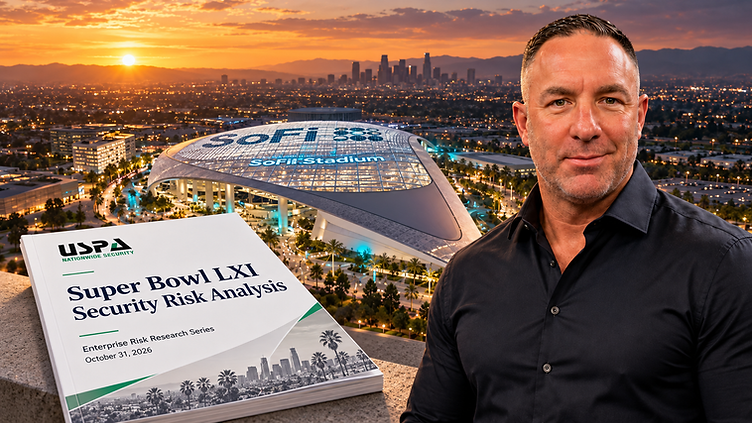
LOS ANGELES
Super Bowl LXI is scheduled for February 14, 2027 at SoFi Stadium in Inglewood, and the security work that decides how that week goes is already being written in hotel meeting rooms and private reception spaces across the Los Angeles region, a long way from the field.
USPA Nationwide Security published a prospective assessment of that corporate hospitality layer on October 31. The physical-security and safety analysis is attributed to founder and strategic advisor Michael Evans, with a fire-safety contribution from director of operations Brian Fitzgibbons. It is built from public sources and the company's own operating experience rather than from any brief issued by the venue, the league or a law-enforcement agency.
Its conclusion is narrow. The plan is rarely the thing that fails. What fails is the handover, the moment a room, a vehicle or a guest list changes hands between a venue, a host and a contractor, when protection written for one set of conditions is carried into another that nobody has re-checked.
The room that was not the room that was inspected
Consider a reception moved to a different room shortly before opening. The replacement has a different entrance arrangement and equipment installed by another contractor during setup. Checks completed against the original space no longer describe the space guests are walking into.
USPA's answer is procedural rather than technological. Earlier findings should be compared against the new conditions, and someone in the chain must hold the authority to delay opening while material differences are resolved. A written record of what was checked lets the next supervisor know which findings still apply.
The same principle governs technical surveillance countermeasures. A sweep of a confidential meeting room has a defined scope and a recorded set of limitations. If the meeting moves, the report describes a room nobody is using, and the meeting owner needs a fresh assessment before a sensitive discussion proceeds. Commercial pressure to keep the programme moving belongs in the approval process, not at the door.
Who is allowed to say stop
Screening guidance for public venues extends the question to employees and suppliers during event preparation, not only to invited guests. A venue can run a well-managed guest entrance while access behind it changes hourly through setup and rehearsal.
That is where improvised rules appear. Clear permissions and a documented process for approving substitutions give door staff a basis for challenging an unexpected arrival without inventing authority. The analysis treats that as a supervision problem: each shift needs a named person who can pause arrivals, and a route to whoever is managing the crowd outside.
Barriers introduced to slow or channel a queue have to be reviewed against emergency access and usable exit routes before they go in, not after an inspector asks.
A voice on the phone is not an identity
In May 2025 the FBI warned that malicious actors were using text messages and AI-generated voice messages to impersonate senior U.S. officials. Its recommended response was an independent check through a separate, established channel before acting on the request.
For a hospitality programme that translates directly into transport. A request to replace a driver, change a pickup or admit an extra vehicle should be verified against a contact held in advance rather than against the number that called. Rehearsing that check before a hurried departure is cheaper than discovering it during one.
Two vendors, one staffing pool
Procurement is where a programme's apparent depth is most often overstated. A host needs to know which organisation is actually delivering each protective service and which supervisor is accountable for it, then agree in writing how substitutions are approved.
Contingency arrangements deserve the same scepticism. Two vendors drawing from the same local staffing pool offer substantially less backup than two contracts suggest. Confirming that dependency early gives the host time to arrange an alternative before a shortage reaches the programme.
The jurisdiction decides which fire authority answers
The address determines the authority. Inglewood contracts with the Los Angeles County Fire Department for fire protection and emergency medical services. Inside the City of Los Angeles, the Los Angeles Fire Department's Public Assemblage Unit reviews event plans and enforces occupancy and exit requirements.
A corporate programme staging events on both sides of that line needs a venue-by-venue review rather than one approval carried between them.
Section 901.7 and the staffing arithmetic
Under section 901.7 of the 2025 California Fire Code, a required fire protection system taken out of service calls for immediate notification to the fire department and the fire code official, subject to an exception for facilities operating an approved notification and impairment management programme. Where the official requires it, affected occupants must be evacuated or protected by an approved fire watch until the system is restored, and the personnel assigned must patrol continuously for signs of fire and hold an approved means of notifying the fire department.
The staffing consequence arrives immediately. An impairment watch cannot double as the person checking invitations at the door. Where a property arranges emergency fire watch in Los Angeles, the assignment should name the affected areas and the relief coverage answering to the authority's directions, while the event team keeps admission and crowd management separate. The facilities team also needs written criteria for restoring normal operation and ending the watch.
Fitzgibbons' Los Angeles Fire Watch and Hot Work Regulations volume, part of the company's regulatory series, separates protection-system impairment from hot-work hazards and sets out the management responsibilities attached to each.
Rehearsing the handover, not the plan
USPA's recommended test is a tabletop exercise that introduces a late room change or a protection-system outage and follows the organisation's real decision path. Guidance for temporary facilities recommends coordinating emergency plans with local responders and exercising them where possible.
A useful rehearsal ends with a documented operating decision, the conditions that must be met before guests enter, and an owner for every unresolved item. A second exercise tests whether the revision actually resolved it. A third, smaller drill rehearses the shift change, because the incoming supervisor needs both the current restriction and the reason behind it.
What readiness looks like
The practical test is whether the host can walk a guest's movements end to end and name who is responsible at each transfer, from the airport through the lobby, the meeting room, the reception and the return. When conditions change mid-programme, the next person in that chain should receive an explicit decision, in writing, and the information needed to carry it out.
Evans made a related point about an assignment he coordinated at an Art Basel private event in 2023, working alongside a client's existing security team: individual assignments overlap, and the host's judgement about who belongs in a confidential meeting has to meet the venue's judgement about what happens on its property. Protective coverage booked around the game runs on the same seam, which is why the Los Angeles corporate risk practice treats the handover as the unit of planning.
The complete assessment, including its fire-safety section and sourcing, is published as the Super Bowl LXI security risk analysis monograph.
Sources
- USPA Nationwide Security · Super Bowl LXI security risk analysis
- California Building Standards Commission · 2025 California Fire Code
- Los Angeles Fire Department · Public Assemblage Unit
- City of Inglewood · fire protection services
- CISA · venue and event security guidance
- FBI Internet Crime Complaint Center · impersonation warning, May 2025
- SoFi Stadium · Super Bowl LXI venue
- NFL · Super Bowl LXI
About the reporter
Staff Writer
Staff writer for the USPA Nationwide Security newsroom. Receives newsroom tips, corrections and editorial inquiries.
Author biography and credentialsMore from The Watchline
Executive Protection
Silicon Valley details are spending on analysts before they spend on bodies
Practices serving the technology corridor are hiring analysts before officers, on the finding that the useful warning arrives days before the principal moves.
· Michael Evans

Executive Protection
The most dangerous address in the program is the one they sleep at
Assessments presented to close protection conferences now rank the private residence above public appearances as the likeliest place a high-profile client is breached. The budget rarely follows the finding.
· Mike Edwards

Executive Protection
Protective details are moving past the C-suite, and the reason is attribution
Boards are funding protective details for general counsels, chief operating officers and researchers. The driver is attributable exposure, not seniority.
· Michael Evans