
More Than 100 Firefighters Battle Miami Apartment Fire; 15 Residents Displaced, 2 Hospitalized
October 27, 2026· USPA Operations
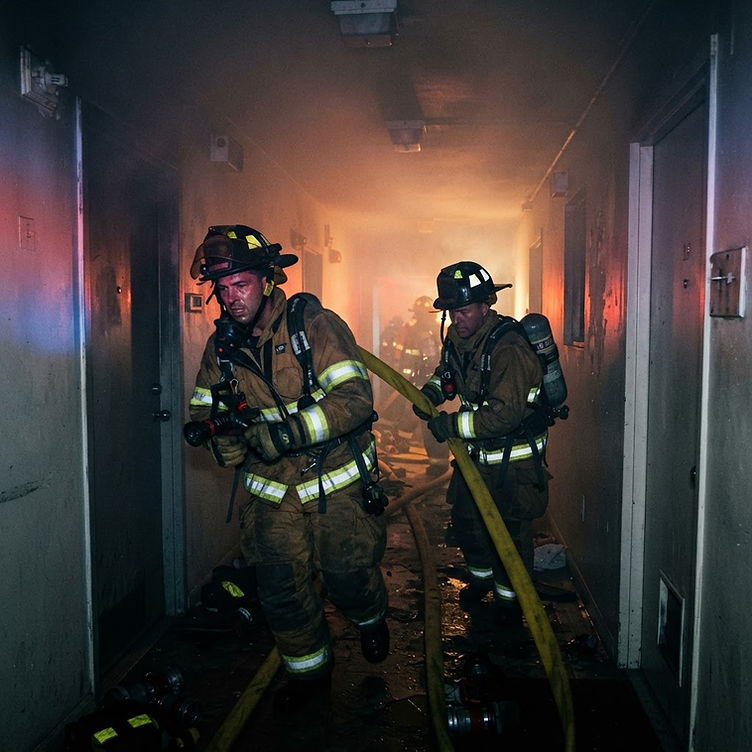
MIAMI, Fla. — More than 100 firefighters responded to a five-story residential building at 5275 NW 7th Street in Miami in the early hours of Tuesday morning after fire broke out on the fourth floor, according to reporting by Local 10 News (WPLG) and statements from Miami Fire Rescue officials. Two residents were transported to Jackson Memorial Hospital in stable condition for smoke inhalation; four others were evaluated on scene. Fifteen residents were displaced, and the building's elevator sustained damage — a complication that raises immediate accessibility concerns given that several occupants required assistance evacuating due to wheelchairs or bed confinement.
The fire was brought under control in approximately 30 minutes, confined to the apartment of origin, though heavy smoke spread across the fourth floor's 12-unit corridor. The cause remains under investigation by city officials.
Key Facts at a Glance
- Date and time: Early Tuesday morning, approximately 2:30 a.m., per Miami Fire Rescue
- Address: 5275 NW 7th Street, Miami, Florida
- Building: Five-story residential structure
- Floor of origin: Fourth floor; fire contained to the originating apartment
- Response: Second-alarm; more than 100 firefighters deployed
- Casualties: 2 transported to Jackson Memorial Hospital, stable; 4 evaluated on scene for minor smoke inhalation
- Displacement: 15 residents; 8 occupied units on the fourth floor smoke-damaged; 4 units on that floor were vacant
- Elevator status: Damaged; out of service as of initial reporting
- Structural/systems assessment: City of Miami Building Department and an electrical engineer contacted
- Red Cross: On scene; working with building management on relocation options
- Cause: Under investigation; no cause has been confirmed
Source: Local 10 News (WPLG), October 27, 2026; Miami Fire Rescue officials
What We Know
Miami Fire Rescue crews arrived around 2:30 a.m. to reports of fire at 5275 NW 7th Street, according to Local 10 News. On arrival, firefighters observed heavy smoke issuing from the fourth floor. Interior crews advanced hose lines toward the fire while additional teams conducted a systematic search of apartments, prioritizing residents who could not self-evacuate. Several occupants were wheelchair-bound or confined to their beds, making the evacuation especially difficult given the heavy smoke conditions in the corridor. The circumstances prompted a second-alarm upgrade, bringing the total response above 100 firefighters.
The fire was located inside a single apartment that was fully engulfed upon firefighter entry. Crews extinguished the blaze while simultaneously assisting residents to safety. Control was achieved in roughly 30 minutes — a relatively contained timeline given the building's occupancy profile and the mobility challenges involved.
Smoke damage spread across the fourth floor, affecting all 12 apartments in that corridor. Four units were already vacant; the eight occupied units were rendered uninhabitable pending assessment, leaving 15 residents displaced. The American Red Cross responded to the scene and began coordinating with building management to determine whether any of those displaced residents could be moved into the four vacant apartments elsewhere in the building.
Two residents were transported to Jackson Memorial Hospital for smoke inhalation and were listed in stable condition as of initial reporting. Four others were evaluated on scene for minor inhalation symptoms.
The City of Miami Building Department was notified and an electrical engineer was contacted to assess the building's systems and structural condition. The elevator, which serves as the primary vertical access route for mobility-limited residents, was reported damaged.
What Has Not Been Released
As of this report, Miami Fire Rescue has not confirmed the origin point within the apartment, the ignition source, or whether any fire protection systems — sprinklers, detection devices, alarm panels — were present, activated, or impaired at the time of the fire. The extent of the elevator damage and the estimated timeline for repair have not been disclosed. The building's ownership and management have not been publicly identified in available reporting. Insurance carrier involvement, the precise number of residents per displaced unit, and the structural engineer's preliminary findings have not been released. This article will be updated as information becomes available.
Technical Analysis: What a Florida Property Owner Faces Now
The Florida Fire Prevention Code and NFPA Obligations
Florida's Fire Prevention Code, administered through the State Fire Marshal's office and enforced locally by the authority having jurisdiction — in this case Miami-Dade Fire Rescue — incorporates by reference a suite of NFPA standards that govern what a building owner must do immediately following fire or smoke damage to occupied residential property.
The most directly applicable standard in a post-fire scenario involving smoke damage to detection and suppression systems is NFPA 25, the Standard for the Inspection, Testing, and Maintenance of Water-Based Fire Protection Systems. When any component of a sprinkler or standpipe system is damaged, taken out of service, or compromised by heat, smoke, or water from firefighting operations, NFPA 25 classifies that system as impaired. An impaired system triggers a formal impairment procedure: the property's responsible party must notify the authority having jurisdiction, the building's alarm monitoring company, the insurance carrier, and any occupants affected. Until the system is restored and tested back into service, the owner is obligated to implement compensatory measures — and the primary compensatory measure for an impaired fire protection system in an occupied building is a fire watch.
NFPA 601, the Standard for Security Services in Fire Loss Prevention, defines fire watch as a systematic patrol of the affected area by trained personnel who observe conditions, report hazards, and initiate alarm or evacuation if fire is detected. Under NFPA 601, fire watch is a documented service: the patrol officer must log each round with time, location, conditions observed, and any anomalies. Those logs are retained as part of the building's compliance record. Intervals between patrol rounds depend on the nature and extent of the impairment and the occupancy type; in a residential high-occupancy building with a known life-safety event earlier in the same shift, intervals are typically kept short — often 15 to 30 minutes — though the authority having jurisdiction retains discretion to set specific requirements.
For an overview of how patrol rounds are structured and documented in practice, USPA's fire watch patrol rounds explainer covers the procedural requirements in detail, and the fire watch compliance guide addresses Florida-specific obligations for property managers navigating post-incident requirements.
Property owners seeking immediate assistance in Miami-Dade can review USPA's emergency fire watch services and the Miami-Dade fire watch service page for local deployment options.
Smoke Damage vs. Fire Damage: Why the Distinction Matters
In insurance and re-occupancy terms, fire damage and smoke damage are treated differently, and the distinction carries practical consequences for both the property owner and the displaced residents.
Fire damage — structural compromise, charring, collapse of assemblies — is typically visible and can be assessed by a structural engineer within a defined inspection protocol. Smoke damage is more diffuse and in some respects more insidious. Smoke particles and combustion byproducts deposit on surfaces, penetrate HVAC ductwork, infiltrate adjacent units through gaps around door frames and utility penetrations, and can coat detector sensors and sprinkler heads in ways that affect their reliability without producing obvious visible evidence of damage. A sprinkler head coated with smoke residue may pass a visual inspection but fail a flow test.
For re-occupancy purposes, Florida's building code process requires that the Building Department — which was already contacted at 5275 NW 7th Street — issue a clearance before displaced residents are permitted to return. In a smoke-damaged building, that clearance typically requires confirmation that life-safety systems have been inspected, cleaned, tested, and restored to full operation. Until that confirmation is in hand, the units remain uninhabitable by code, regardless of whether the smoke odor has dissipated.
Insurance adjusters will categorize smoke-damaged contents and finishes separately from fire-damaged structural elements. This matters because smoke remediation — including cleaning or replacing ductwork, repainting and resealing surfaces, and replacing soft goods — is a distinct line item from structural repair, and the timeline for smoke remediation often outlasts the timeline for visible fire damage repair. Residents displaced by smoke damage from an adjacent apartment — not from direct fire damage to their own unit — may face a longer displacement than initial assessments suggest.
The Damaged Elevator and Re-Occupancy Sequencing
The elevator damage at 5275 NW 7th Street creates a re-occupancy sequencing problem that goes beyond simple inconvenience. Several residents were identified during the evacuation as wheelchair-bound or bed-confined. Their ability to return to fourth-floor units is legally and practically contingent on vertical access being restored. The Americans with Disabilities Act and Florida's accessibility statutes require that accessible routes be maintained in occupied multi-story residential buildings; a damaged elevator serving a floor with mobility-limited residents creates a condition that must be resolved before those residents can lawfully and safely return.
This means the building owner faces a layered sequence: structural and systems clearance from the Building Department, elevator inspection and repair certification from the Florida Department of Business and Professional Regulation (which oversees elevator safety in Florida), and restoration of life-safety systems — all before the fourth-floor units can be re-occupied. The elevator repair timeline is not within the building's direct control; it depends on the nature of the damage, the availability of parts, and the inspector's schedule.
For residents with significant mobility limitations, this creates a prolonged displacement scenario. The Red Cross's coordination with building management to explore the building's vacant units as interim housing is a practical interim measure, but those vacant units are also on the fourth floor — accessible only via the damaged elevator or the stairwell, neither of which may be viable for wheelchair users in the near term. It is not yet known whether the building has accessible units on lower floors or whether those vacant units are distributed across other floors. That information has not been released.
Documentation the Owner Must Produce
Following a second-alarm residential fire with confirmed impairment of building systems, the property owner and manager in Florida face a documentation burden that begins immediately and runs parallel to the physical remediation. The expected documentation package includes:
- A formal impairment notification to Miami-Dade Fire Rescue under NFPA 25 procedures, including the nature of the impairment, affected systems, and compensatory measures in place
- A fire watch log initiated from the time the impairment was identified, with patrol round entries at the required intervals — maintained continuously until systems are restored and tested back into service
- A structural assessment report from the contacted Building Department and electrical engineer, with findings and any conditions placed on re-occupancy
- Elevator damage and repair documentation submitted to the Florida DBPR elevator safety program
- A life-safety systems inspection report from a licensed fire protection contractor confirming that sprinklers, detection devices, alarm panels, and any suppression systems on the affected floor have been inspected, cleaned as necessary, tested, and restored
- Documentation of displaced resident notifications and the accommodations offered or arranged, which may be relevant to both local housing authority requirements and insurance subrogation proceedings
The USPA fire watch white paper provides a detailed reference on impairment management documentation requirements for property owners and risk managers navigating post-incident compliance.
Local Context
5275 NW 7th Street falls within the City of Miami, in Miami-Dade County. Miami-Dade Fire Rescue serves as the authority having jurisdiction for fire code enforcement across unincorporated Miami-Dade, while the City of Miami Fire Rescue Department covers incorporated Miami — and both operate under the Florida Fire Prevention Code. The density of the NW 7th Street corridor, the age profile of residential buildings in that area, and the documented presence of mobility-limited residents in this building are consistent with broader occupancy patterns in urban Miami residential stock.
Property owners and managers in Miami-Dade County managing buildings with similar occupancy profiles — multi-story residential structures with elderly or mobility-limited populations — should be aware that post-fire fire watch and system impairment procedures apply regardless of whether the fire originated in their unit. A fire in one apartment that disables corridor detection, contaminates sprinkler heads, or damages shared alarm panels creates an impairment condition for the entire affected floor or zone, not just the unit of origin.
USPA Nationwide Security provides fire watch services throughout Miami-Dade County. The Miami-Dade fire watch service page covers local deployment capabilities for properties requiring immediate post-incident coverage, and the security guard services page for Miami, Florida addresses ongoing building security needs for properties managing displaced residents and active remediation work.
For context on comparable recent incidents involving residential high-rise and multi-story apartment fires and the fire watch obligations that followed, see USPA's coverage of the Kansas City apartment building fire on Wabash, the Johnstown Connor Tower high-rise apartment fire, and the Pennsauken Cooper River Apartments fire.
For properties in Miami Beach, the Miami Beach fire marshal compliance page outlines local fire marshal requirements that parallel those applicable in the City of Miami.
The Property's Next Obligations: A Sequenced Summary
Based on the confirmed facts and Florida's applicable regulatory framework, the building at 5275 NW 7th Street faces the following immediate obligations — pending confirmation from the authority having jurisdiction and the Building Department's assessment:
- Fire watch initiation: If any fire protection system on the affected floor is impaired, NFPA 25 requires a documented fire watch to begin immediately and continue until systems are restored
- System inspection and testing: A licensed fire protection contractor must inspect all detection, alarm, and suppression system components on the fourth floor for smoke contamination, heat damage, and operational integrity before systems can be signed back into service
- Elevator certification: Repair and inspection by a Florida DBPR-certified elevator contractor before the elevator can return to service
- Building Department clearance: Structural and systems clearance required before displaced residents may return
- Displaced resident accommodation: Documentation of offers, placements, and coordination with Red Cross and any applicable local housing authority
- Insurance notification: Formal notice to the property carrier, including impairment documentation and fire watch logs
Sources and Open Questions
Sources used in this report:
- Local 10 News (WPLG), October 27, 2026: original reporting
- Miami Fire Rescue officials, as cited in Local 10 News reporting
- NFPA 25, Standard for the Inspection, Testing, and Maintenance of Water-Based Fire Protection Systems
- NFPA 601, Standard for Security Services in Fire Loss Prevention
Open questions pending further reporting:
- Was a fire sprinkler system present and activated in the apartment of origin or the fourth-floor corridor?
- What is the current status and estimated repair timeline for the elevator?
- Has the Building Department issued any conditions on re-occupancy or a formal unsafe structure notice?
- What is the confirmed ownership and management of the building?
- Has Miami Fire Rescue or the fire marshal's office issued a formal impairment notice or fire watch order?
- What is the cause of the fire, and is arson being considered or excluded?
- Are any of the four vacant units on the fourth floor accessible to mobility-limited residents via current routes?
- Has the Red Cross or city housing authority arranged interim shelter for all 15 displaced residents?
This article will be updated as Miami Fire Rescue and the City of Miami Building Department release additional information.
Related Reading
- Miami-Dade Fire Watch Service
- Uniformed Security Guard Services
- Emergency Fire Watch
- Fire Watch Patrol Rounds Explained
- Fire Watch Compliance Guide
- USPA Fire Watch White Paper
- Kansas City Apartment Building Fire — Wabash, October 2026
- Johnstown Connor Tower High-Rise Apartment Fire, October 2026
- Pennsauken Cooper River Apartments Fire
- Miami Beach Fire Marshal Compliance Requirements
Questions about fire watch, executive protection or guard coverage for your property? Request a quote or call our dispatch line.
More from the blog

Opinion
Securing the Subsea Cable Landings: The Vulnerable Chokepoints of Global Data
The entire digital economy transmits roughly 95 percent of international data through undersea fiber-optic cables, yet the physical points where those cables make landfall remain among the least protected nodes in global critical infrastructure. This op-ed argues that the security community's fixation on digital perimeters has left a concrete, addressable vulnerability largely unguarded.

Breaking News
Fire Crews Battle Vacant Apartment Building Fire in Kansas City's Wabash Block
Kansas City fire crews responded Sunday morning to a reported apartment building fire in the 2800 block of Wabash, where they encountered smoke and fire coming from a vacant two-story structure. Interior operations were conducted, searches came back all clear, and no injuries were reported. The cause remains under investigation.


Breaking News
Lithium-Ion Battery Fire Displaces Residents at Spokane's Donna Hanson Haven Apartment Building
A lithium-ion battery from an electric bicycle caused a fire on the third floor of Donna Hanson Haven in downtown Spokane on Saturday, October 25, 2026. The Spokane Fire Department evacuated all residents; Catholic Charities Eastern Washington coordinated decontamination, and most tenants returned home the same evening. Seventeen third-floor residents remain displaced with Red Cross support.
