
An e-bike battery fire on the sixth floor emptied three floors of the Asteri Ithaca after the power was shut off

By Albina Bieci, Staff Writer
Sprinklers stopped the battery fire. The contaminated water and damaged electrical panels took the exit signs, emergency lighting and ventilation offline across three residential floors, and the city ordered everyone out.
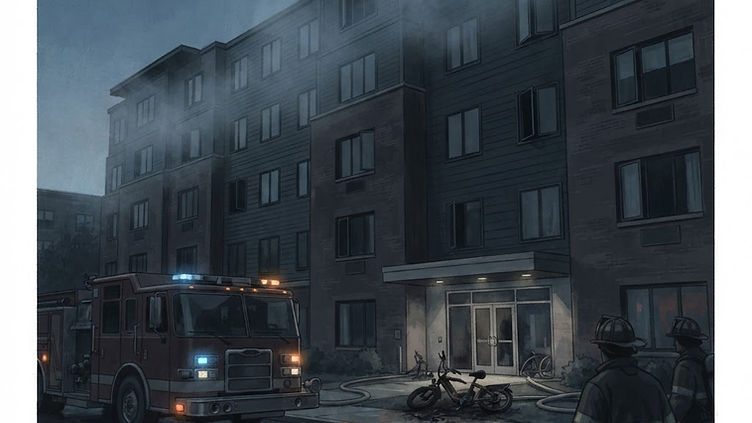
ITHACA, N.Y.
A lithium-ion battery on an electric bicycle caught fire on the sixth floor of the Asteri Ithaca apartment building early Friday, setting off the sprinkler system and beginning a sequence of water and electrical damage that ended with city code enforcement ordering the fourth, fifth and sixth floors evacuated.
The fire itself was limited to a battery and whatever it ignited around it. The evacuation order came hours later, and it was not about flame. It was about what those three floors lost when the power went off.
What has been confirmed
According to reporting by Finger Lakes Daily News, the fire began on the sixth floor of the Asteri Ithaca complex at 118 East Green Street in downtown Ithaca. A lithium-ion battery on an e-bike caught fire. The sprinkler system activated and discharged, and the resulting water, described as contaminated, along with damage to electrical panels, affected the fourth, fifth and sixth floors.
City code enforcement then ordered all three floors evacuated after electrical power was shut off. With the power off, those floors lost mechanical ventilation, illuminated exit signs and emergency lighting.
The reporting available at publication does not describe any injuries, does not give a damage estimate, and does not state how many units are on the three affected floors or when residents will be allowed back. Those details will be added here if the city or the property releases them.
The sprinkler worked, and it created the second incident
A residential sprinkler head that flows for even a few minutes puts hundreds of gallons of water into a building. That water does not arrive clean. It picks up corrosion products and sediment from pipe that has sat wet for years, and it carries whatever it washed through on the way down. Contractors call the result black water, and it is classified as contaminated for restoration purposes, which is why the reporting uses that word.
The water lands on ceilings, runs into wall cavities and pools on floors, and from there it finds the paths that electrical systems use. Panels in a building of this type are often mounted in rooms or closets that sit below or beside the sprinklered space, and water tracking through a floor assembly reaches them. Once a panel has been wetted, the safe assumption is that it is damaged, whether or not it looks it. Breakers that were submerged or sprayed can fail closed, fail open, or arc, and the corrosion that starts immediately continues after the surface dries.
So a fire that was extinguished in one room produced an outcome that a fire in three rooms would not have: an electrical distribution system that had to be de-energized to be made safe, on three residential floors at once.
Why the e-bike battery is now a building system problem
Lithium-ion battery fires are not like the fires the codes were written around. A battery in thermal runaway produces its own oxygen, burns at temperatures that defeat ordinary extinguishing, and can reignite hours after it appears out. That is why the response to an e-bike fire so often ends with a battery in a bucket of water outside the building, or with a fire watch standing over a removed pack.
The upstream problem is that the devices are cheap, numerous, and often charged in exactly the places the code did not anticipate: apartment living rooms, bedroom closets, common corridors, stairwells. Certified equipment exists. UL 2849 covers the electrical system of an e-bike, UL 2271 covers the battery, and UL 2849A covers retrofit kits, but certification is not visible from the outside, and a building cannot tell a compliant charger from an uncertified one by looking at it.
New York State has moved faster than most. New York City's Local Law 39 of 2023 banned the sale and rental of e-mobility devices and batteries that do not meet those standards, and the state has been debating its own version since. For a property manager in Ithaca, the practical consequence is that the building now has a battery exposure it did not have a decade ago, concentrated in the units where residents charge devices overnight, and it sits inside a structure whose fire protection was designed for furniture and cooking, not for a fuel that supplies its own oxidizer.
What turning off the power actually takes offline
The phrase in the reporting is precise: no ventilation, no illuminated exit signs, no emergency lighting. Each of those is a code requirement, and each fails in a different way when a panel is de-energized.
Illuminated exit signs are required at exits and along the path of egress travel. Emergency lighting is required to keep the means of egress illuminated for a defined period when normal power fails. In most buildings of this age and type, both are provided by unit equipment: a battery pack inside each fixture that charges from the normal circuit and switches on when that circuit goes dead. That design assumes the circuit feeding the fixture has power to charge from. When a panel is shut off for damage rather than because of a utility outage, the batteries discharge over their rated duration, usually ninety minutes, and then the building has neither normal lighting nor emergency lighting, in stairwells that residents still need to use.
Mechanical ventilation matters in a residential corridor for a different reason. In a sealed modern building, corridor ventilation is part of how smoke is kept out of the path of egress in a fire, and how humidity and cooking exhaust are controlled day to day. Lose it and the corridor becomes both a smoke path and, within days, a mold problem on top of a water problem.
A fire official looking at a six-story residential building with three floors that have no egress lighting, no exit signs and no corridor ventilation has one defensible option, and it is the one Ithaca took: remove the occupants and require the building to be watched until the systems are back.
The authority behind the order and the watch
New York's Uniform Fire Prevention and Building Code adopts the International Fire Code with state amendments, and the International Fire Code gives the code official explicit authority over buildings with systems out of service. Section 901.7 requires that where a required fire protection system is out of service, the fire department and the code official be notified, and that an approved fire watch be provided, either by the department or by the property, until the system is restored.
The same section is what converts a repair job into a staffing obligation. A fire watch is not a suggestion and not a courtesy. It is a person, or a rotation of people, physically walking the affected floors on a defined interval, checking for smoke and fire in the places a detector would have caught it, and keeping the building's exits usable. When the impairment is the alarm system, the watch substitutes human sensing for detection. When the impairment is the lighting, the watch substitutes for the lighting as well, and that changes the job.
What a watch looks like in a building with no exit signs
On a normal impairment, a fire watch officer works a documented round: stairwells, corridors, the affected units, the electrical rooms, the roof access. On these three floors, the officer is also the thing that keeps the path of egress usable. That means temporary illumination, either battery units or string lights on a standalone supply, at every stair landing and corridor turn, and it means a physical check that the stair doors are operable from the inside, because a door that latched behind a resident in the dark is a life-safety failure that no alarm panel will report.
Rounds get logged with times. The log is not paperwork for its own sake. If a fire starts on the fifth floor at three in the morning and the log shows the officer was on the fourth floor at 2:52 and the fifth at 3:14, that record answers the first question an investigator and an insurer will ask.
Access control is the other half of the order
An evacuated building with three floors of unoccupied apartments and no power to the electronic access system is a building with doors that behave in ways nobody planned. Maglocks that fail safe release when power drops, which is correct for egress and wrong for security. Card readers go dead. Garage and vestibule doors may sit unlocked. Meanwhile the building holds the belongings of every displaced resident, and the fire damage is on the same floors as the forced entry points crews used.
That is why an evacuation order of this kind is normally paired with a posted officer at the entrance, a sign-in for escorted access, and a documented record of who went to which unit and when. Residents need to retrieve medication, pets, documents and car keys, and they need to do it through a building with no lighting and no working alarm.
What residents should ask for, in writing
Three things, and they should be in writing. First, which systems in the building are working and which are not, floor by floor. Second, what the property is doing to watch the building in the meantime, including who is on site and how often they walk the floors. Third, the condition under which each floor can be reoccupied, expressed as a specific milestone rather than a date, because a date set before the electrical inspection comes back is a guess.
For renters, the cost side is documentation. Hotel nights, meals, medication that had to be replaced, and the value of food that spoiled when the refrigeration went off are recoverable under most renters policies, and the receipts are much easier to collect in the first week than in the third.
Related coverage
The Watchline has reported repeatedly on sprinkler discharges that outlast the fires they extinguish. In Perrysburg Township, Ohio, sprinklers put out an overnight fire in a business and left the building with a water problem. In North Naples, a fast-moving fire in an apartment complex emptied units overnight.
The service connection
USPA Nationwide Security provides emergency fire watch and post-fire access control for multi-unit residential properties across upstate New York and the Finger Lakes, including buildings where a sprinkler discharge has taken power, exit signs or emergency lighting out of service. Officers work documented rounds, hold the entrance, escort residents for retrieval, and call the fire department directly when something is found. Requests can be made through the emergency fire watch page, the national fire watch service page, or by calling (800) 214-1448.
Sources and status
Reporting on the incident is attributed to Finger Lakes Daily News. The cause beyond the battery, the damage estimate, the number of affected units and the reoccupation timeline remain open pending release by the City of Ithaca and the property owner. Technical references include NFPA 101, Life Safety Code, NFPA 25 and the International Fire Code's out-of-service provisions.
Sources
About the reporter
Staff Writer
Staff writer for the USPA Nationwide Security newsroom. Receives newsroom tips, corrections and editorial inquiries.
Author biography and credentialsMore from The Watchline

Fire Protection
A fire confined to one bathroom at Audubon Park Apartments still took a building's plumbing and alarm loop out of the argument
Daphne police and fire crews contained the late-night fire to a bathroom with no injuries reported. Investigators are still working the ignition source, and that is the period when the unit has to be held.
· Albina Bieci

Fire Protection
Two residents were displaced by an overnight fire at Quail Oaks Apartments, and the unit is now an open, unpowered space
Petersburg Fire Rescue stopped the fire before it reached the adjoining units. The cause is still under investigation, which means the damaged unit cannot be repaired yet and has to be held.
· Albina Bieci

Fire Protection
A third-floor fire on Warsaw Avenue did $100,000 in damage in thirty minutes, and displaced three people
Firefighters had the East Price Hill fire under control in about half an hour and carried a dog out of the building. Three residents were displaced from a three-story walk-up whose upper floor and roof assembly now have to be inspected.
· Albina Bieci