
A resident died in a fire at 201 West 98th Street, and the building next door now has a fire guard problem

By Albina Bieci, Staff Writer
Seventy-nine FDNY and EMS personnel worked the Upper West Side building at 2:46 a.m. One resident died and one firefighter was injured. The overhaul that follows a fatal fire is what leaves a Manhattan building without alarms and without occupants.
NEW YORK
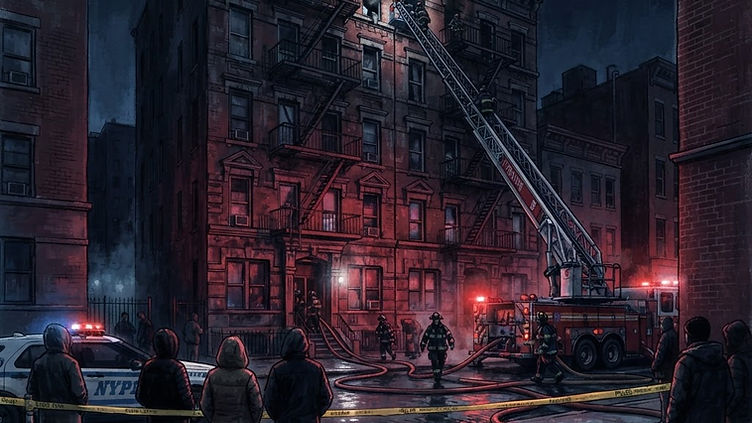
A fire in a multi-story residential building at 201 West 98th Street on the Upper West Side killed one resident and injured one firefighter early Friday, drawing 79 FDNY and EMS personnel to the scene at approximately 2:46 a.m., according to reporting by PIX11 News.
The identity of the resident who died has not been released in the reporting available at publication, and the cause of the fire has not been established. What is already clear is the size of the response, and what a response of that size leaves behind in a Manhattan apartment building once the last unit leaves.
What has been confirmed
The fire occurred inside a multi-story residential building at 201 West 98th Street. One resident died. One firefighter was injured during suppression and overhaul operations. Seventy-nine fire and EMS personnel responded, and the alarm came in at approximately 2:46 a.m. Eastern.
The reporting available at publication does not state the floor of origin, the number of apartments damaged, whether the building's alarm system performed as designed, or the condition of the injured firefighter. It does not name the resident. Those details will be added here as the department releases them.
Why one apartment fire draws 79 people
New Yorkers see large responses and assume a large fire. The staffing number usually reflects something else: how many companies are required to search a building, protect the stairs, and supply water at a given height, and how many ambulances are staged when a fire is reported with a possible victim.
A mid-rise Manhattan building with a fire above the first floor generates a search problem. Every apartment on the fire floor and the floor above has to be entered and cleared, and the doors are heavy, the corridors are narrow, and the stairs are the only way up once the elevators are recalled. That work is manpower, not water. Add a reported occupant trapped, and the response escalates further, because a rescue assignment and a fire attack assignment run at the same time.
A fatal outcome does not end the response. It extends it. Once a death occurs, the fire becomes a scene that has to be preserved for the fire marshal, and the overhaul that would otherwise be quick becomes deliberate.
Smoke, not flame, is what killed
The overwhelming majority of civilian fire deaths in residential buildings are caused by smoke inhalation and the carbon monoxide and hydrogen cyanide it carries, not by burns. That is not a technicality. It determines what a fire department does first, and it determines what a building's alarm and compartmentation are supposed to buy.
In a prewar Manhattan apartment building, the apartment of origin is usually separated from the public corridor by a rated wall and a self-closing door, and the corridor is the protected path of egress. A fire inside one apartment should not put smoke into that corridor for a meaningful period. When a resident dies, the questions the investigation will work through are about how the smoke got to that person: whether the apartment door was open, whether the fire was in the apartment where the person was found, whether a window failed, and whether the building's systems were in service.
What overhaul does to a building
Overhaul is the phase in which crews open walls and ceilings to find fire in concealed spaces and wet down what is still hot. In a fatal fire, it is also evidence preservation, which means the building is not restored to normal when the trucks leave.
The physical result is a floor with sections of plaster and lath or drywall removed, windows taken out for ventilation, doors forced and left off the latch, and standing water in the apartment below. The systems result is more consequential. Alarm devices in the affected apartments are heat-damaged or destroyed. Sprinkler heads that flowed are spent. Electrical circuits in the fire apartment are shut off at the panel, and often the service to part of the building is de-energized while the department makes sure nothing is live that should not be.
The occupants result is that the fire apartment and usually the units around it are vacant, and vacant apartments in a building with a damaged entrance are an open invitation.
The fire guard obligation in New York City
The New York City Fire Code, section 901.7, requires that when a required fire protection system is out of service, the owner notify the department and provide an approved fire watch or fire guard until the system is restored. The requirement is not discretionary and it is not satisfied by a note on the door.
In practice, a post-fire fire guard assignment in a Manhattan building covers three jobs at once. It substitutes for the detection that is offline, by walking the affected floors and the floors below on a defined interval. It keeps the building's remaining residents safe while the lobby, the stairs or the standpipe are out of service. And it controls access to the vacant units, which is the part owners underweight until something goes missing.
New York is unusual in how much of this work is formalized. Fire guards are registered, their duties are defined, and the record of their presence is expected to exist. That matters when the Department of Buildings or an insurer looks at the building afterward, because a fire in a building with a known impairment and no documented watch is a different liability question than the same fire with one.
The marshal investigation changes the security requirement
A fatal fire is a fire marshal investigation, and the investigation runs on its own schedule. The scene may be held for days. Access is controlled by the department, and the building owner does not get to clean up until it is released.
During that period the building has two populations with conflicting needs: residents of undamaged apartments who want to come and go, and an active investigation that cannot have people wandering through it. The resolution is normally a posted officer at the entrance, an access list, and escorted entry for residents of the affected floor. It is unglamorous work and it is the difference between a scene that stays intact and one that does not.
What the neighbors inherit
A fatal fire in a connected building is a reminder of how much of Manhattan's housing stock shares structure. Row buildings on the side streets of the Upper West Side sit wall to wall, and a fire that opens a roof or a party wall exposes the building next door to water and to smoke that travels through shared voids.
That is why neighboring properties often end up with their own fire watch, their own water damage and their own insurance claim from an incident that happened in someone else's apartment. Boards and managing agents should be checking, in the days after a fire like this one, whether their own alarm system is fully in service, whether any shared riser or standpipe was shut down, and whether anything in the connected structure was compromised.
What residents in the building should do now
Get the impairment in writing. Ask the managing agent which systems are out of service, on which floors, and what is being done in place of them. Ask whether a fire guard has been posted and on what schedule, because the answer is a legal obligation rather than a courtesy.
Then check the two devices that matter most in an apartment: the smoke alarm inside the unit and the door closer on the apartment door. In a building where the corridor is the protected path, a door that does not latch is the single most common way smoke reaches a stairwell.
What the injured firefighter represents
Firefighter injuries in residential fires cluster in two phases: the initial interior attack, and overhaul. The initial attack puts crews into a space where the floor may already be compromised and the fire is overhead. Overhaul puts them into the same space hours later, when the smoke has cleared, the adrenaline has dropped and the building looks safe because the fire is out.
Overhaul injuries are the ones departments work hardest to reduce, and the measures are unglamorous: full protective equipment retained until the last crew clears, no working alone in a damaged apartment, and a structural assessment before anyone opens a ceiling that has been carrying load for a century. A firefighter injured during overhaul at 2:46 in the morning is a reminder that the dangerous part of a fatal fire extends well past the moment the flames go out.
Related coverage
The Watchline has covered the same failure mode across the city this week. In Brooklyn, New York ordered inspections at 100 sites after a fatal collapse, a case that turned on the same question of who is responsible for a building's condition between inspections. In Dallas, a two-alarm roof fire at The Hive apartments damaged six units.
The service connection
USPA Nationwide Security provides fire watch, fire guard and post-fire access control for multi-unit residential buildings in Manhattan and the outer boroughs, including buildings where a fatal fire has left alarm zones, standpipes or electrical service out of commission during a marshal investigation. Officers hold the entrance, log rounds, and control access to vacated apartments. Requests can be made through the emergency fire watch page, the New York City fire watch page, the Brooklyn page, or by calling (800) 214-1448.
Sources and status
Reporting on the incident is attributed to PIX11 News. The cause, the floor of origin, the identity of the resident who died and the condition of the injured firefighter remain open pending release by the FDNY. Technical references include NFPA 101, Life Safety Code and the U.S. Fire Administration's residential fire loss data.
Services in New York, NY
Sources
About the reporter
Staff Writer
Staff writer for the USPA Nationwide Security newsroom. Receives newsroom tips, corrections and editorial inquiries.
Author biography and credentialsMore from The Watchline

Fire Protection
A fire confined to one bathroom at Audubon Park Apartments still took a building's plumbing and alarm loop out of the argument
Daphne police and fire crews contained the late-night fire to a bathroom with no injuries reported. Investigators are still working the ignition source, and that is the period when the unit has to be held.
· Albina Bieci

Fire Protection
Two residents were displaced by an overnight fire at Quail Oaks Apartments, and the unit is now an open, unpowered space
Petersburg Fire Rescue stopped the fire before it reached the adjoining units. The cause is still under investigation, which means the damaged unit cannot be repaired yet and has to be held.
· Albina Bieci

Fire Protection
A third-floor fire on Warsaw Avenue did $100,000 in damage in thirty minutes, and displaced three people
Firefighters had the East Price Hill fire under control in about half an hour and carried a dog out of the building. Three residents were displaced from a three-story walk-up whose upper floor and roof assembly now have to be inspected.
· Albina Bieci