
A three-alarm fire in a Mongaup Valley commercial building held mutual aid crews through the night

By Albina Bieci, Staff Writer
The Smallwood Fire District fire broke out around 1:30 a.m. and kept several departments hauling water to the scene for hours. Rural water supply sets the length of a fire like this, and the damaged building sets what comes after it.
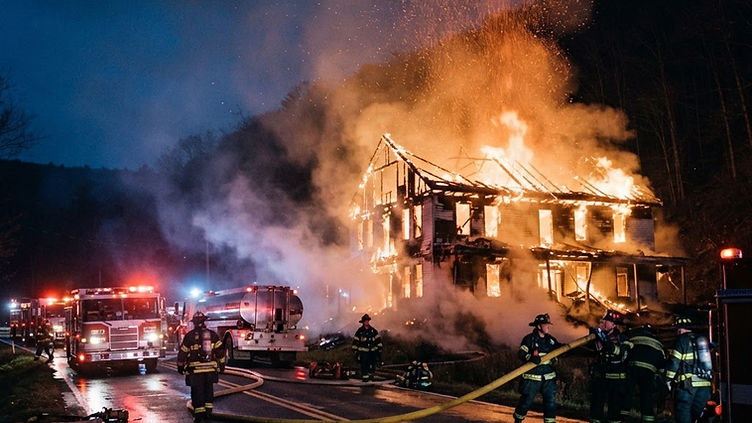
MONGAUP VALLEY, N.Y.
A three-alarm fire broke out around 1:30 a.m. at a large commercial building in the Smallwood Fire District of Mongaup Valley, New York, drawing multiple mutual aid departments and tankers that battled the flames for several hours, according to reporting by Mid-Hudson News.
A three-alarm assignment in a rural district is a different event from a three-alarm fire in a city. It is a statement about water, not only about fire. Departments from neighboring towns sent apparatus and crews, and tankers ran a shuttle to the scene because the district does not have the hydrant system that would let an engine stay parked and supplied.
What has been confirmed
The fire occurred at a large commercial building in the Smallwood Fire District, with the alarm raised around 1:30 a.m. The response escalated to three alarms, involving multiple mutual aid departments and tanker operations, and crews worked the fire for hours.
The cause has not been established in the reporting available at the time of publication. Neither a damage estimate nor a confirmed account of injuries has been released. The building's occupancy at the time of the fire, and whether it was in active commercial use, are details that matter to what follows and should be treated as open until the district or the town says otherwise.
Why rural water supply changes the fire
An engine at a hydrant can deliver a sustained fire flow for as long as the main holds pressure. An engine working a rural water shuttle receives water in batches: tankers fill at a dry hydrant, pond or fill site, drive to the scene, dump into a portable tank, and leave again. The rate that reaches the fire depends on the number of tankers, the round-trip distance, and how quickly the fill and dump points can be worked.
When that rate is below what the fire demands, the incident commander has to choose what gets water. The choice is usually made in favor of protecting exposures and knocking down the most active fire, which means parts of a large building burn longer than they would in a city response. A commercial building with a long span, an open interior and a combustible roof assembly will use every gallon the shuttle can deliver and still gain ground between tanker arrivals.
That arithmetic explains the hours. It also explains the outcome: a building that has been burning under a limited water supply for an extended period is not merely smoke damaged. The structural members have been heated for hours, the roof deck has been loaded with water it was never designed to carry, and the interior has been exposed to temperatures that alter the strength of steel and char the timber that holds the building up.
What the district faces in the morning
The fire district's work does not end when the last hot spot is wet down. A large commercial structure that has burned for hours becomes an investigation scene, a demolition question and a security assignment, often in that order and sometimes all at once.
New York's Uniform Fire Prevention and Building Code adopts the International Fire Code, which gives the code official authority to require a fire watch when a building's fire protection systems are out of service or when conditions in a structure create a hazard the systems cannot address. In a building this size, the sprinkler system and the alarm system were almost certainly damaged or shut down during the fire, and the building is now either unoccupied or partly occupiable depending on what the code official finds.
That is the point where a watch gets ordered, and it is also the point where the assignment stops being only about fire. A commercial building in a rural district, standing open after a three-alarm fire, has no neighboring occupancy to notice a person going in. Doors are forced, windows are out, and the site is dark. Fire investigators need the scene preserved. The owner needs the building secured until an engineer can say whether it can be entered safely. Both needs are served by a posted officer rather than by a chain and a padlock on a door that no longer closes.
Related coverage
Watchline has reported on the same post-fire sequence in two other upstate New York communities. In Syracuse, firefighters cleared a four-story warehouse as unsafe, and the building became a security assignment the moment the crews left. In New Paltz, a warehouse fire rekindled at 3:40 a.m., which is precisely what a post-fire watch exists to catch.
The rekindle window
Most rekindles occur in the first 24 to 48 hours, and they occur in buildings where fire has been driven into concealed spaces: roof assemblies, wall cavities, insulation, and the void between a ceiling and a deck. Water applied from outside does not reliably reach those spaces. Heat remains, air reaches it, and the fire starts again after the apparatus has left.
A fire watch is the control for that exposure. An officer walking the building and its exterior on a documented schedule looks for the specific signs a thermal camera and a nose will find: warmth on a wall surface, smoke from an eave, a smell that does not match wet char. When one of those appears, the call goes to 911 from the site, not to the owner in the morning.
What owners should be asking
The first question for the owner of a fire-damaged commercial building is whether the structure can be occupied or entered at all, and that answer comes from the code official or a licensed engineer rather than from the contractor who wants the cleanup work. The second is what the insurance carrier requires in writing before it will treat the loss as mitigated.
Carriers commonly ask for the date the systems went out of service, the interim measures put in place, and the records showing those measures were actually performed. A fire watch log with times, locations and initials answers that question. An assurance that someone drove past the building does not.
The service connection
USPA Nationwide Security staffs emergency fire watch and post-fire site security for commercial properties in the Hudson Valley and across New York, including buildings where a fire has left sprinkler and alarm systems out of service. Officers are posted on site, log rounds, and maintain the written record an owner needs for the code official and the carrier. Requests can be made through the emergency fire watch page or by calling (800) 214-1448.
The fire watch white paper covers how post orders are written for a structurally compromised building, and NFPA 601 sets out the fire prevention responsibilities a watch is meant to carry.
The shuttle arithmetic in practice
A rural water shuttle is a system with a known capacity, and incident commanders estimate it before they commit crews. A tanker carrying 1,500 to 2,500 gallons that takes eight minutes to fill, drive and dump contributes roughly 190 to 310 gallons a minute. Four tankers on that cycle, with a portable tank large enough to keep an engine drafting, deliver something in the range of 750 to 1,200 gallons a minute.
That figure has to be compared with what the fire demands. A commercial building with a heavy fuel load and an involved roof assembly can consume more than the shuttle delivers, and the shortfall shows up as fire that keeps returning after it appears to be knocked down. Commanders respond by protecting what can still be saved and accepting the loss of what cannot.
Timber, steel and what the assessment will look like
A building that has burned for hours under a limited water supply is not evaluated by looking at the char. The engineer who walks it afterward is looking for what heat and water did to the structure.
Structural steel loses a predictable share of its strength as it heats, and it does not recover all of it when it cools. Timber that has charred loses section, and a beam that carried a roof load at full dimension may not carry it at three-quarters. A roof deck loaded with water from master streams and then with the weight of crews can sag between supports without failing outright, which is the condition that makes a building dangerous rather than obviously ruined.
That is why the sequence after a fire like this runs from the code official to a licensed engineer to the contractor, and why nobody signs a re-occupancy until the third of those has put a report in writing.
The insurance notification clock
Most commercial property policies require prompt notice of a loss and, where the building is left unoccupied, notice of that too. A building that will sit empty for weeks while an engineer and an adjuster work is a building the carrier treats as a vacancy exposure, and terms often tighten once a property has been empty beyond a stated period. Owners who post a documented watch and tell the carrier what they did are answering a question the carrier will ask regardless.
Sources and status
Reporting on the incident is attributed to Mid-Hudson News. The cause, the damage estimate and the building's occupancy status at the time of the fire remain open pending release by the Smallwood Fire District and the town. Technical references include NFPA 601, Standard for Security Services in Fire Loss Prevention, NFPA 25 and the U.S. Fire Administration. This article will be updated if the district releases additional detail.
Sources
About the reporter
Staff Writer
Staff writer for the USPA Nationwide Security newsroom. Receives newsroom tips, corrections and editorial inquiries.
Author biography and credentialsMore from The Watchline

Fire Protection
A two-alarm fire broke through the roof at The Hive apartments on Abrams Road and damaged six units
Fire broke through the roof of the northeast Dallas complex and six units were damaged. A roof breach and an impaired alarm panel are what put the neighboring wings into a fire watch posture.
· Brian Fitzgibbons

Fire Protection
A two-alarm fire on College Hill gutted one unit, displaced about 15 residents and sent a Pullman officer to the hospital
The fire ran through a six-unit building in the campus neighborhood, and a responding officer was treated for smoke inhalation. Smoke and water damage across the adjoining units is what forces the power and alarm shutdowns.
· Albina Bieci

Fire Protection
A three-alarm fire tore through the vacant former Stockton Record building on East Market Street
Crews fought the multi-story former newspaper office and warehouse complex defensively and closed downtown streets. A vacant building that has burned is a security assignment before it is anything else.
· Albina Bieci