
A filing changed one sentence about the Hilton. The protective lesson is older than that.

By Mike Edwards, VIP Security Director, USPA Nationwide Security
A revised federal filing in the Washington Hilton case changed how a Secret Service agent was injured during the takedown. What survives the revision is the part protective teams can use.
WASHINGTON
WASHINGTON — A revised federal filing in the case against the man accused of attacking Donald Trump at the Washington Hilton, identified in earlier filings as Cole Thomas Allen, has changed the account of how a Secret Service agent was injured during the response, clarifying that the agent was hospitalised during the chaotic multi-agency takedown rather than struck directly by the suspect's gunfire.
The revision is narrow in scope and significant in consequence, because the record of a protective failure is what every subsequent protective plan is built against.
What the filing changed
Confirmed by the revised filing: an attack at the Washington Hilton during the White House Correspondents' Dinner, a Secret Service agent seriously injured in the course of the response, and a corrected account of the mechanism of that injury.
Not established: the full sequence of the response, the number of agents in contact with the suspect, and what the advance had or had not accounted for. Those details are what a full after-action review would establish, and they are typically not public.
Why an account that shifts matters operationally
After-action accounts in protective work become three things at once. They become evidence in a criminal case, they become the substance of the training cycle, and they become the institutional memory that survives the people who were in the room.
Each of those uses degrades when the account is wrong in a specific way. A training scenario built on an agent being struck by gunfire rehearses a different problem from one built on an agent being injured in the physical collapse of a takedown at close quarters. The first trains reaction to a shooting. The second trains body positioning, the mechanics of a protective pile, and the risk the detail itself creates for the principal when several people converge on one point at speed.
The distinction is not academic. In a crowded ballroom, the mass of responding agents is a hazard in its own right: it obstructs the route the principal needs, it occludes the eyes of the agent who is supposed to be watching the crowd, and it can take the principal to the floor.
The medical timeline is part of the protective plan
That an agent was hospitalised rather than treated at the scene is the kind of detail that reads as administrative until you plan a detail of your own.
In a protective operation, the principal is the priority casualty, and the second priority is the person most likely to become a casualty next: the agent in contact. A detail that has rehearsed only the principal's extraction has no plan for an agent down in the middle of the room, and the instinct in that moment is to stop everything, which is the worst available option while the threat is unresolved.
The workable arrangement, and the one experienced details use, separates three functions before the event. Somebody moves the principal. Somebody controls the immediate threat or the space around it. Somebody owns the casualty, with a named destination, a route to it, and a handover to the venue's medical standby or the responding EMS unit. That third assignment is the one most often left implicit, and the agent injured in the takedown is the one who pays for it.
Screening has a throughput problem, not a technology problem
A ballroom holding a thousand guests cannot be screened to an airport standard, at an airport rate, through the doors available in the ninety minutes before a dinner.
The consequence is a set of predictable compromises. Magnetometer lanes sized for a rate that assumes guests arrive evenly, which they do not. Bag checks that become cursory once a queue forms. Credential checks at an outer point that assume the credential was validly issued. And a period, usually the last twenty minutes of arrivals, in which the standard is quietly reduced to keep the room filling.
Every one of those compromises is a decision, and decisions can be written down. The advance that records the accepted rate, the queue management plan, and the point at which the door closes regardless of who is still outside is doing its job. The advance that assumes the plan will hold at peak has written fiction.
Hardening matters for the same reason. The route from the entrance to the room, the space around the stage, and the position of the head table relative to the crowd are all structural choices that cannot be changed once guests are seated.
What the review should record, and usually does not
A post-incident review of a protected event tends to record what worked: the response time, the team that moved the principal, the medical handover. The useful document records the opposite, and it records it specifically.
Where did the route fail in the room, and at what point did the principal's movement stop? Which post lost sight of the crowd because the detail converged on the threat? How long between the first indication and the first radio transmission, and who transmitted it? What did the venue do that either helped or obstructed?
Those four answers, written down while the detail is still together, are the difference between an organisation that learns and one that repeats. A detail that disperses without writing them has had an experience, which is not the same thing as a lesson.
The room is the threat multiplier
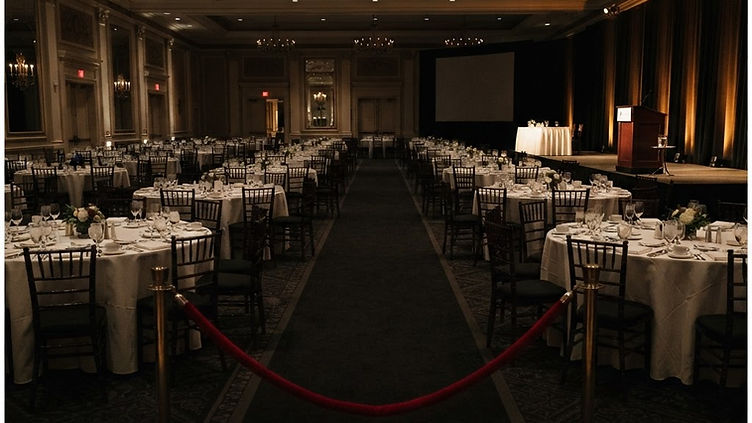
A seated black-tie dinner is the hardest protective environment short of a rope line. Every guest is stationary, dressed identically, and screened at one door hours earlier. The aisles are narrow, the tables are fixed, and the principal's route from the head table to an exit is contested by hundreds of people who all want to stand up at the same moment.
Three planning consequences follow, and they are the same three that recur in every review of an incident like this.
First, the route must be rehearsed as a physical action, not drawn on a plan. An agent who has walked the aisle at speed in the actual room knows where the chair backs are and where the service doors open inward.
Second, the detail must decide in advance who moves the principal and who holds the crowd. A response in which everyone converges on the threat leaves the principal unshielded and unmoved, which is the failure mode most often identified after the fact.
Third, communication must survive the noise. A ballroom at the moment of an incident is louder than any radio check, and a detail that depends on voice commands has no plan.
The detail's own communications fail first
In every account of a response inside a crowded room, the first thing to degrade is communication. Radio traffic collides, the earpiece is drowned by the room, and the agent closest to the principal cannot hear the instruction that concerns them.
The mitigation is procedural and cheap: pre-agreed physical signals for move, hold and down, a designated voice on the net who is not also physically engaged, and a rehearsal in the actual noise of the room rather than in a quiet corridor. Details that skip the noisy rehearsal discover this problem once, in the room, at the worst possible moment.
The advance is where these incidents are decided
Weeks before the dinner, an advance team surveys the venue and commits to a set of judgements in writing. Where the principal enters and leaves. Which aisles are wide enough to move through at speed. Which doors open outward. Where the protective bubble sits relative to the stage. What the screening standard is at each entrance, and who owns the gap between the magnetometer and the table.
Most protective failures in public venues are traceable to a judgement made in that document and never revisited. An aisle width accepted because the room cannot be reconfigured. A screening point placed where a bag can be passed across a rope line. A stage approach that puts the principal's back to an unsearched section of the room.
The remedy is procedural rather than heroic. A written advance that names the accepted risks, a walk-through in the actual room at the actual hour, and a post-event review that compares the plan to what happened, with the discrepancies recorded rather than smoothed.
What a private detail can copy from a federal one
Private protective operations cannot replicate the resources of a federal agency, and should not pretend to. The methods that transfer are the cheap ones.
A single reconciled timeline produced within 24 hours, drawn from radio logs, camera footage and named witnesses, before recollection hardens into a narrative nobody can support. A written advance with the accepted risks stated plainly rather than implied. A rehearsal of the movement, not just the route. And a defined handover to medical, because the agent injured in a takedown is as much a casualty of the incident as anyone else in the room.
USPA Nationwide Security provides executive protection for principals whose schedules are public, including advance work for banquets, award ceremonies and media-attended events, and works alongside event security teams where the protective and the crowd function must be separated.
Related coverage
- Nobody moved, so she did: the Wicked red carpet and the myth of the co-star bodyguard
- A guard was fired. The perimeter is still the story.
- Brazen Home-Invasion Burglaries Target Wealthy Families in Menlo Park's Sharon Heights
Protective coverage for a public event: (800) 214-1448 or request executive protection.
The Watchline will update this report as the case proceeds and if further filings revise the record.
Sources
About the reporter
VIP Security Director, USPA Nationwide Security
Mike Edwards directs VIP protection details at USPA Nationwide Security, including the selection and supervision of close protection personnel.
Author biography and credentialsMore from The Watchline

Executive Protection
The Secret Service is defending airspace now, and the ground perimeter is the wrong place to start
Federal updates show protective planning shifting toward drone detection and mitigation, including systems built to defeat jamming. Ground security assumptions have not caught up.
· Michael Evans

Executive Protection
Nobody moved, so she did: the Wicked red carpet and the myth of the co-star bodyguard
At the Singapore premiere, Cynthia Erivo reacted first to a barricade breach while a repeat red-carpet intruder held onto Ariana Grande. Months later she rejected the 'bodyguard' framing, and the exchange exposes two different confusions: what fans owe celebrities, and what a co-star's instinct is not.
· Michael Evans


Executive Protection
Brazen Home-Invasion Burglaries Target Wealthy Families in Menlo Park's Sharon Heights
A string of at least 13 reported burglaries in Sharon Heights, Menlo Park, California has shifted from the familiar pattern of striking empty homes to targeting families during dinnertime hours — a tactical change that has rattled one of Silicon Valley's most established residential enclaves and drawn coordinated law enforcement response across multiple Bay Area agencies.
· Albina Bieci