
After three alarms on West Broad Street, the fight is over who enters a five-story building nobody may occupy

By Albina Bieci, Staff Writer
The three-alarm fire is out, but the five-story building on West Broad Street is still held: residents and businesses are out, and the terms of securing the property and letting people back in are the unresolved part.
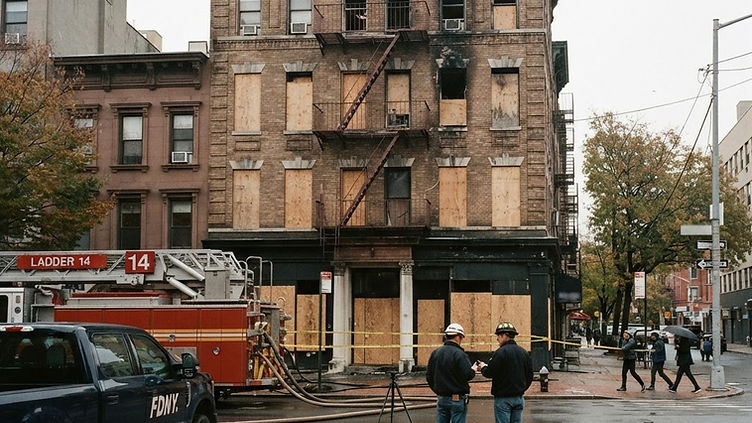
RICHMOND, Va.
Residents and commercial tenants remain out of a five-story mixed-use building on West Broad Street after a three-alarm fire, and the recovery has moved into the phase where the argument is no longer about the fire but about who controls the building.
WRIC 8News reported the fire, the three-alarm response and the continuing displacement. The property security question is the one with no fast answer, because a mixed-use building holds two populations with different legal relationships to the same address and one shared means of escape.
What has been confirmed
WRIC 8News, the ABC affiliate in Richmond, reported a three-alarm fire in a five-story mixed-use building on West Broad Street, and that residents and commercial tenants remain displaced afterward.
Not established in the public reporting: the cause, the floor or occupancy where the fire began, the number of units and businesses affected, whether anyone was injured, and the condition of the building's alarm, sprinkler and standpipe systems. The terms under which the property is being secured and reentered are also not published. A fire under investigation is under investigation, and no finding that the owner or an occupant violated the fire code has been announced. This report makes none.
Why a mixed-use building is harder after a fire than an apartment building
In a five-story mixed-use building, the ground floor is usually commercial and the floors above are residential, with the whole stack served by a single stair in many older layouts and by a shared standpipe the fire department relies on for water above street level.
The two occupancies fail differently. A ground-floor commercial space brings cooking equipment, storage, refrigeration, and utility rooms that the residential floors do not have. The residential floors bring sleeping occupants who need the alarm to work at three in the morning. The fire protection design is what ties them together: the separation between the commercial space and the dwelling units, the alarm system's voice notification, the sprinkler coverage, and the standpipe connections that let crews get water to the fourth floor without laying hose up a stairwell.
Any one of those being impaired closes floors, and in a building of this age the systems are frequently a mix of original and replacement components with a paper trail that has to be reconstructed after the fact.
Two displaced populations, two sets of rights
Residential tenants have a lease, a security deposit and a legal claim to habitable space. Commercial tenants have a lease with its own terms about business interruption and restoration, inventory they need access to, and often equipment that cannot simply wait.
That split is why displacement disputes in mixed-use buildings can outlast the fire itself. The residents want to know when their units are safe and what happens to their belongings in the meantime. The businesses want into the ground floor to retrieve stock, records and point-of-sale equipment so they can operate somewhere else. The owner is balancing an insurance claim, an engineer's report and the fire marshal's occupancy hold, and is usually being advised by counsel not to let anyone inside until the building's condition is documented.
All of those positions are legitimate, and none of them resolve by themselves. What resolves them is a written re-entry protocol: who may enter, in what order, escorted by whom, for how long, carrying what, with what recorded on the way out. Without that protocol, people enter informally, and an informal entry into a fire-damaged building is how a salvage visit turns into an injury claim.
What securing a fire-damaged mixed-use building involves
The physical work is board-up, door control and, where the structure warrants it, temporary shoring or fencing. Plywood over a ground-floor storefront is a visual deterrent, not a security measure, and it fails the first time someone decides the building is empty.
The security work is the harder half. A five-story building with a fire-damaged upper floor and a closed ground floor has several openings that matter: the front entrance, the rear service door, the roof access, and any alley or side door the commercial tenants used. Each needs to be controlled or monitored, and the fire department needs access that does not depend on a working lock.
What makes this a personnel question rather than a hardware question is the traffic. Adjusters, engineers, restoration contractors, the fire investigator, tenants retrieving medication and documents, and the owner's own representatives all need entry in the first two weeks. A building with that much traffic needs one person at one point of entry with a logbook, and it needs a supervisor checking the upper floors and the rear of the building at intervals that are stated rather than assumed.
The relevant distinction is the one property managers routinely blur. A fire watch is ordered because a fire protection system is impaired; the officer walks a route, looks for fire, and logs the rounds. A security post exists because the property is empty and its contents are exposed; the officer controls entry and records who is inside. In a building held by an investigator with an impaired alarm system, both duties exist simultaneously and belong in two separate written assignments.
Virginia's code path
Virginia enforces fire safety through the Virginia Uniform Statewide Building Code and the Virginia Statewide Fire Prevention Code, with local enforcement by the fire official, which in the city is the Richmond Fire Marshal's Office. The building code governs repairs and reoccupancy; the fire prevention code governs the maintenance of protection systems, the impairment procedure and any watch requirement while a system is out of service.
Section 901.7 of the International Fire Code, from which the state's provision derives, is the mechanism everyone ends up discussing: notify the fire official when a required fire protection system is out of service, and where the system cannot be restored, provide a fire watch for the affected area. In a partially occupied or held building, the scope of that watch is a decision the fire official makes, and it is written in terms of areas and hours rather than in terms of a single guard in a lobby.
For the property, the documentation that ends the dispute is unglamorous and complete: the impairment tag and notification, the fire watch log for every hour the protection was out, the engineer's report on the structure, the fire official's occupancy determination, the restoration test results, and the re-entry log showing who was inside and when. A property that produces that file resolves tenant questions quickly. A property that cannot produces a dispute that grows.
Related coverage
Mixed-use and multifamily recoveries follow the same curve elsewhere on this beat. In Orlando, a condemned building on Rio Grande Avenue turned a fire into a perimeter problem (read that report). In Fort Lauderdale, a storage-area fire on East Las Olas Boulevard damaged monitoring circuits and the businesses could not reopen without a person on patrol (that story is here). In Allston, six rooftop rescues at 118 Brainerd Road came with an alarm system that had stopped reporting (previously reported).
Coverage in Richmond
A Richmond property facing an impaired alarm, sprinkler or standpipe system, an occupancy hold, or a fire watch order can review what documented coverage involves on the Richmond fire watch page and on the national emergency fire watch page. The property-security side, including how a post and log are structured while tenants retrieve property, is covered by the uniformed security guard services page, and the technical basis for the watch requirement is set out in the fire watch white paper.
Nothing in that material implies USPA responded to or was retained for this incident. It was not.
The occupancy hold is a legal instrument, not a delay
An occupancy hold from the fire official is not a suggestion the property may work around, and it is not the same thing as a damaged building. It is a determination that specific areas are not safe for the use they were approved for, and it is issued against areas rather than against the whole address.
That distinction matters in a five-story building, because it allows a partial answer. Floors that took no fire and no water can be released. Floors directly beneath or above the fire floor usually cannot, because water travels down and heat travels up through the same assemblies. Commercial spaces on the ground floor may be released for salvage access while remaining closed for occupancy, which is the difference between a tenant retrieving inventory and a tenant reopening.
Nobody reopens anything on their own schedule. A property that reopens a space the fire official has not released is carrying the entire risk of the next event in that space, and its insurer will say so in the first letter after a claim. The safe course is the slow one: ask the fire official for a written area-by-area determination, publish it to tenants with the re-entry protocol, and let the documentation answer the questions that would otherwise become a dispute.
What to watch next
Three documents will decide when this building reopens. The fire official's occupancy determination sets the line between held and occupied. The engineer's structural report decides how the held floors are separated from the rest. The fire protection restoration test decides whether the building is protected again, and until it exists the watch requirement runs.
WRIC 8News is the primary account of this incident at this stage. This article will be updated if the fire marshal's office, the property or a tenant representative releases information that changes the sequence above, and any update note will state what changed.
Services in Richmond, VA
Sources
- WRIC 8News (ABC Richmond) — report on the West Broad Street three-alarm fire
- National Fire Protection Association — NFPA 25 impairment procedures and NFPA 101 life safety requirements
- U.S. Fire Administration — fire loss in mixed residential and commercial occupancies
- Occupational Safety and Health Administration — 29 CFR 1910.38, emergency action plans
About the reporter
Staff Writer
Staff writer for the USPA Nationwide Security newsroom. Receives newsroom tips, corrections and editorial inquiries.
Author biography and credentialsMore from The Watchline

Fire Protection
Private hydrants at a Huntsville complex could not hold pressure, so crews ran hose to the street instead
Crews ran more than 100 feet of hose to street hydrants after the property's own hydrants could not hold pressure. Fifteen families are out, and the flow test that was never produced is the document that now matters most.
· Albina Bieci

Fire Protection
A roof fire at The Elements at Cedar Bluff displaced 17 residents and closed all fourteen units
The fire went through the roof of a 14-unit building at the Cedar Bluff complex, heavily damaging five units. Two assessments now decide whether nine other households can return, and the fire-protection one starts a clock.
· Albina Bieci

Fire Protection
Sprinklers held a Deerfield Beach office fire to one room, and the discharge is what closes the building next
Broward Sheriff Fire Rescue found the fire in a third-floor office at 800 Fairway Drive already suppressed by the building's own system. The water that stopped it is what puts part of the building's protection out of service until the system is drained, repaired and recertified.
· Albina Bieci
